| CRES programs arise by request. Our management principle is "management by opportunity." Every year we are delighted by the number of opportunties given to us, as our yearly program pages demonstrate. (Of course we also provide free private consulation to organizations and other services as requested, not listed on our public website.) |
This page is continuously updated. Events listed by date, earlist first
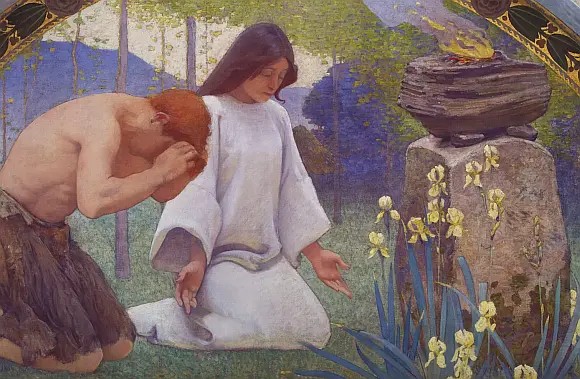 Vern's lecture notes on worship and worship styles in world religions are here. Vern's lengthy notes on his own approach and experience with worship are here. #MLK 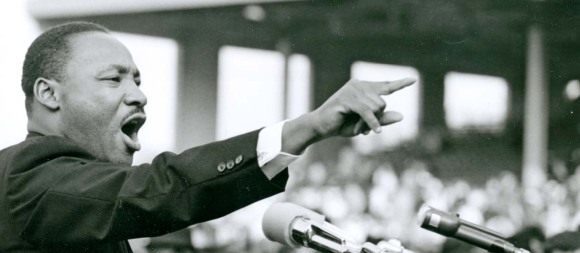 King Holiday Essay — 2025 January 16 Download a PDF of Vern's 2-page summary of the genius of the spiritual approach of Martin Luther King Jr by clicking this link. You can also read the Letter from a Birmingham Jail here. Bill Tammeus writes about King's visits to Kansas City here. Vern writes:
I remember meeting King in a church basement in
Washington, DC, the year before he was assassinated. I remember his
appearance was delayed quite a while as his team checked the church for
threats and dangers, as those of us gathered to hear him hoped to see
him alive. It was a dark time. I remember his brilliant analysis of
Vietnam, and particularly its effect on young Black men. #ThurmanInBrooks I was a student at the University of Chicago Divinity School when he was assassinated. The next Sunday was Palm Sunday, April 7, and I was to be a guest preacher. I remember struggling to find something uplifting to say, and I was thankful to be able to rely on King's teachings and his public ministry in the context of the Christian story. I used a recording of the April 3 "Mountain Top" speech in many sermons in the following months. I remember studying the writings and speeches of King, with their eloquence and depth. Each year I continue to reread the Letter from the Birmingham Jail, which every year renews me with astonishment. I also especially cherish his last sermon, March 31, at the Washington National Cathedral, a few days before his assassination. And I claim King also as an exemplar of interfaith respect, which is why I wrote this essay. In a NYTimes column, David Brooks discusses Robert Thuman's summary of the principles of non-violence. (We can add that it was in meeting Thuman that Gandhi said, “It may be through the Negroes that the unadulterated message of nonviolence [Gandhi's satyagrapha, or 'Truth-force'] will be delivered to the world.” Later King went to India himself, and kept a photo of Gandhi above his desk.) Here is a passage from Brooks which includes the summary: To be a good citizen, it is necessary to be warmhearted, but it is also necessary to master the disciplines, methods and techniques required to live well together: how to listen well, how to ask for and offer forgiveness, how not to misunderstand one another, how to converse in a way that reduces inequalities of respect. In a society with so much loneliness and distrust, we are failing at these social and moral disciplines.#Parliament On 2026 January 30, the Parliament of the World's Religions, originating in 1893 in Chicago with the world's Columbian Exhibition, issued a Statement on Interfaith Responsibility in a Time of Rising Authoritarianism. It begins, "Around the world, communities are witnessing a troubling rise in fear‑based governance, shrinking civic space, and the targeting of vulnerable groups. These developments are not isolated events, nor are they confined to one nation or community. They remind us that injustice grows when silence replaces solidarity." We commend the full statement, which you can find here. We suggest that the Parliament's statement can be supplemented by a fuller and more balanced proclamation of the wisdom from the world's three great families of faith, articulated in Kansas City at the 2001 "Gifts of Pluralism" conference in its Concluding Declaration. Western Enlightenment and Colonial conceptions of religion sometimes obscure the wisdom we believe must be recovered and applied in order to respond effectively to the authoritarianism the Parliament addresses, because the damage to the environment, personhood, and social order are all interrelated.
ASIAN TRADITIONS MONOTHEISTIC TRADITIONS #RickChilds  In Memoriam Dr Richard Childs Rick's lively interests in religious matters were part of his interest in everything -- from Wagner to Maxwell's equations, but mostly his cherishing of family and friends. Our sincere condolences to Donna and family. Arrangements are pending. #IFHarmony February 1-7  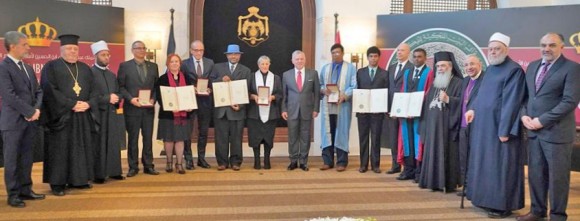 To observe World Interfaith Harmony week, we offer one of our most cited essays, "Stealing Another's Faith." The question of honoring without misappropriating material from others is not so easy, and this essay raises awareness so faiths can be less in conflict and more in harmony. Read, download this PDF, and share this important essay by Vern -- with excerpts from Huston Smith and Harvey Cox. The North American Interfaith Network (NAIN), The Interfaith Center, and the Federation of Zoroastrian Associations of North America (FEZANA) present A WORLD INTERFAITH HARMONY WEEK EVENT Is the Harmony in the Room with Us? 2026 February 20 Friday 11 am - noon Kansas City time Live on Zoom -- Register with this link 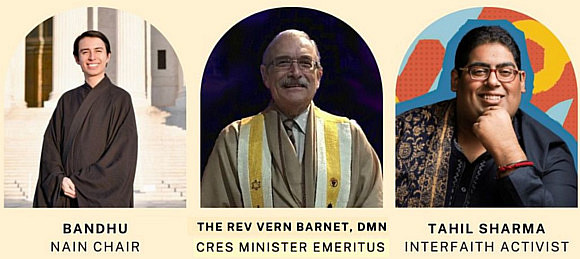 A candid interfaith conversation: moving beyond feel-good dialogue toward meaningful engagement. Join the North American Interfaith Network (NAIN) and the Interfaith Center at Miami University for this timely conversation. Interfaith spaces are often framed through the language of peace, dialogue, and harmony—but how well does that narrative reflect our current realities? This event opens with a candid contextual reflection on where we stand locally, nationally, and globally today, challenging the comforting but often vague rhetoric that surrounds interfaith engagement. Rather than relying on abstract ideals, the conversation asks whether the language of “harmony” has at times obscured deeper tensions, inequalities, and unresolved harms within these spaces—and when we face these harder truths, what we gain from the deeper wisdom of our traditions for ourselves and the world. Participants: Vasu Bandhu Vern Barnet Tahil Sharma  Here
is a screen shot of some of the many participants. While we are
grateful to the North American Interfaith Network and the other
sponsors, we proudly name our former intern, who was instrumental in
arrangements and who is now persuing post-doctoral studies
at Cambridge University, Dr Geneva Blackmer. A recording of the
60-minute plus overtime session can be viewed here: https://youtu.be/axDqlHOjz3Y Here
is a screen shot of some of the many participants. While we are
grateful to the North American Interfaith Network and the other
sponsors, we proudly name our former intern, who was instrumental in
arrangements and who is now persuing post-doctoral studies
at Cambridge University, Dr Geneva Blackmer. A recording of the
60-minute plus overtime session can be viewed here: https://youtu.be/axDqlHOjz3YNOTES Thanks to CRES Chief Learning Officer Maggie Finefrock for these notes:
#BrooksVideoBHM BLACK HISTORY MONTH A Video with Alvin Brooks -- 2 min 31 sec 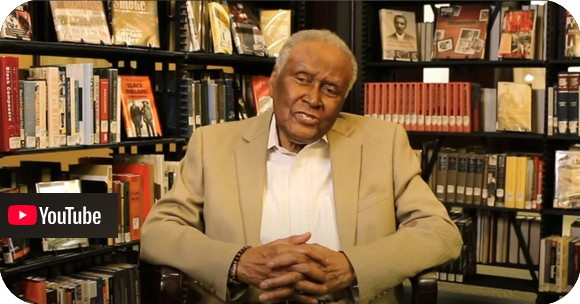 #EIHKC update The Ecumenical and Interfaith History of Greater Kansas City  This valuable resource for understanding interfaith work in Kansas City, linked from the CRES home page (right column) and directly available here is now also available to researchers throughout the world through the ProQuest academic library database. Our former intern, Geneva Blackmer, prepared the history. The History includes both text and video. The website includes a page inviting additional contributions to further detail this critical, but often overlooked, dimension of religious and civic life in our region. #ReligionScienceWeekend 2026 February 13-15 21 Years of Celebrating The Compatibility of Religion and Science Religion and Science Weekend Thanks to The Clergy Letter Project for its sponorship of the weekend. Below is a statement prepared by CRES in the Kansas City area. It has been distrubted nationally: https://www.theclergyletterproject.org/Interfaith/InterfaithClergyLetter.html (The announcement naming CRES is here.) The theme for this year: Truth Matters Science and Religion both explore truth, but in mainly different domains, often using different methods and language. In some ways, within each domain, truth can be considered sacred. Science is an accumulating body of explorations and understandings of the world tested by experience and experiment. The scientific impulse may originate in awe or curiosity, which are also features of religious questions and encounters. Science and religion are complementary ways of approaching our place in the cosmos. While science may use a chemicals in a test tube and religion may use an image in a stained glass window, both can help us appreciate wholesome opportunities before us. Religion consists of stories, the arts and other humanities, and may kinds of explorations enacted in rituals embraced by communities that reveal or point to what our lives depend upon, what religions may call the sacred, sometimes in theistic language, sometimes not. One possible overview of the world's religions arises from asking of them where they go to find the sacred. In general, with exceptions and qualifications, the Primal faiths find the sacred in the world of nature, the Asian faiths discern the sacred within the person, and the Monotheistic traditions find the sacred revealed in the history of covenanted community. ● In the Primal faiths we find ecological awe: nature is respected more than controlled; nature is a process which includes us, not a product external to us to be used or disposed of. Our proper attitude toward nature is wonder, not consumption. Our lives depend on nature.What, then is the place of science? Sciences like physics, geology, ecology, and climatology enhance our wonder of the natural world -- and show how easily we can corrupt and destroy this planet. Sciences like psychology, personal economics, and even computer modeling can illuminate moral decisions for wholesome personhood. Sciences like anthropology and sociology can guide us as we seek to repair the social and political crises of our time. Just as we increasingly recognize that the domains of specific sciences have permeable boundaries, so the world's religions are increasingly shaped by each other. Even more broadly, advances through history in fields like astronomy, electromagnetism, chemistry, medicine, evolution, genetics, information science, and many others, and associated technologies, offer possibilities for the protection and enhancement of nature, the individual, civilization itself by showing us what our lives depend upon, which religions call sacred. The mysteries of the universe -- the electron spin, the Krebs cycle in the metabolism of the cell, the migrations of early hominids, stories of service and even sacrifice on behalf of others, episodes of wonder at the birth of a child, rituals that bring people together in a shared sense of decision-making or even destiny -- may typically lie in different domains of science and religion. Nonetheless, the increasing overlap of the various disciplines of science and the interpenetration of the world's faiths as they come to know each other more clearly. We believe that there is no conflict between these great domains of humanity encountering the astonishing miracle of existence. honorifics and degrees omitted
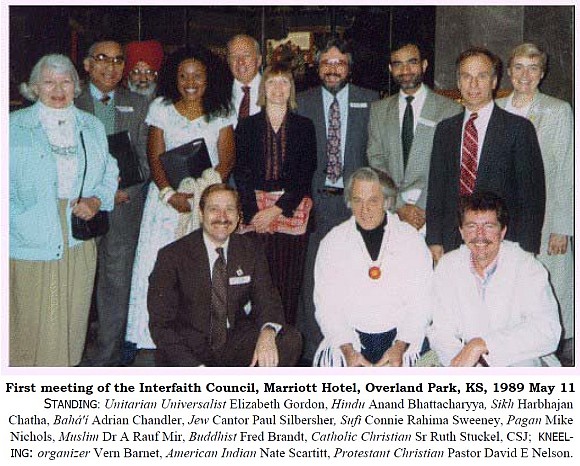
*member of Retired Clergy of All Faiths additional signatures appear on the national website  In Missouri, the population is 62% Christian, 4% other religions, and 33% report as religiously unaffiliated (5% atheist, 8%v agnostic, 20% other) In Kansas, the population is 70% Christian, less than 1% other religions, and 28% report as religiously unaffiliated (3% atheist, 4%v agnostic, 21% other) In the US, 62% Christian, 7% other religions, and 29% report as religiously unaffiliated (5% atheist, 6%v agnostic, 19% other). Religions in the population with at least 1 percent are Buddhist, Jewish, Hindu, and Muslim faiths. For more interesting details of this study, visit the Pew Research Center here or for the main Pew menu, click on the logo above. #250214 Valentine's Day Weddings  KMBZ featured Kansas City's Pilgrim Chapel on Valentine's Day last year where Vern performed a vow renewal ceremony and three "elopements," all very brief . . . and all without charge. You can see one version of the TV report here: https://www.pilgrimcenterkc.org/valentines-day. This year Pilgrim Chapel had assigned Vern SIX weddings on Valentine's Day; on that day another was added: SEVEN were performed. Congratulations and Best Wishes! #reach CRES reaches beyond Kansas City FIRST We are enormously proud of our former intern, Geneva, now Dr Geneva Blackmer, currently doing post-doctoral work in the UK, at Cambridge University. in 2015, we originally discouraged her from interning for us because we were overwhelmed with program requests and did not have time to supervise an intern, and no money had been budgeted for an intern. She wrote a second time, and again we refused her application. A third time she insisted on visiting Kansas City and we consented to interview her. She said CRES was doing the most interesting interfaith work in the country. Beginning in 2016 we arranged for her to give us half of her time and work half time with the Interfaith Council, which we had spun off from CRES in 2005. Her connections beyond Kansas City have included local-regional, and national-international organizations. Here are some. Administrative Director, The Interfaith Council of Southern NevadaNEXT We note the recent national program in which our part was significant: Is the Harmony in the Room with Us? NEXT We note the national distribution of the statement about Science and Religion which we wrote. Truth Matters NEXT CRES was featured in 2002 on a national half-hour CBS special for our work following the 911 terrorist attacks and how we observed the anniversary of that horror. Our increasing profile then eventually led to being selected to arrange the nation's first Interfaith Academies, co-sponsored by the Pluralism Project at Harvard University, Religions for Peace at the UN Plaza, the Saint Paul School of Theology, and the Greater Kansas City Interfaith Council. For this honor, we were recommended by the Rev Bud Heckman, who had been executive director at Religions for Peace. We recently sent a short note to Bud recalling his work here and his book, InterActive Faith: The Essential Interreligious Community-Building Handbook which I used in my classes at Central Baptist Theological Seminary. He responded in part: I’ve met so many people over the years who have been touched by your leadership and mentoring. I smile every time I hear or see it.While Bud deserves the credit and praise for envisioning the Interfaith Academies and making them happen, we are pleased that the work CRES was able to do then continues, even with my so-called "retirement," not only locally, often "behind the scenes," but nationally as with last month's Zoom conversation (February 20, 2026) and the Science and Religion statement we wrote for this year's Science and Religion Weekend (February 13-15). In turn, we are grateful for the support we receive from our friends. A BRIEF HISTORY OF THE Table of Faiths EARLY YEARS -- #CouncilPhoto1989_____________________________________________________________The first Table of Faiths event, with David Nelson as convener, was a luncheon at the Marriott Muehlebach Hotel downtown Nov 10, 2005. Alvin Brooks, one of the co-chairs (Gayle Krigel, Mahnaz Shabbir, and Chuck Stanford), welcomed guests. Mayor Kay Barnes was the keynote speaker and presented the first Table of Faiths Award to Vern Barnet. The second Table of Faiths luncheon, Nov 14, 2006, honored Don and Adel Hall and Ed Chasteen. The third Table of Faiths luncheon, Nov 7, 2007, honored Alvin L Brooks and The Kansas City Star. The fourth Table of Faiths luncheon, Nov 13, 2008, included a presentation of Donna Ziegenhorn's play, The Hindu and the Cowboy. Honored were Robert Lee Hill and the Shawnee Mission Medical Center, and Steve Jeffers (1948-2008) was lovingly remembered. The fifth Table of Faiths luncheon, Nov 12, 2009, introduced The Steve Jeffers Leadership Award, given to Ahmed El-Sherif. All Souls Unitarian Church was also recognized, and Allan Abrams (1939-2009) was lovingly remembered. The sixth Table of Faiths luncheon, Nov 11, 2010, honored Notre Dame de Sion High School with the Table of Faiths Award and Queen Mother Maxie McFarlane with the Steve Jeffers Leadership Award. The seventh Table of Faiths luncheon, Nov 10, 2011 honored the Kansas City Public Library with the Table of Faiths Award and Donna Ziegenhorn with the Steve Jeffers Leadership Award. The eighth and last Table of Faiths luncheon, Nov 8, 2012, presented the theme of "Spirituality and the Environment: Caring for the Earth, Our Legacy." The Steve Jeffers Leadership Award was given to Mayor Sly James and the Table of Faiths Award went to Unity Church of Overland Park. There was no Table of Faiths event in 2013. Beginning in 2014, Table of Faiths events were no longer major downtown civic luncheons involving elected, cultural, and business leaders. With a longer evening format, the first in the new Table of Faiths dinners was held May 8, 2014, at Unity Village. --CRES ARCHIVES Vern Barnet founded the Council
in 1989 as a program of CRES and is Council Convener Emeritus. The Council newsletter has
published his brief notes about three
milestones in the early history of the Council.
#NYTimes1988 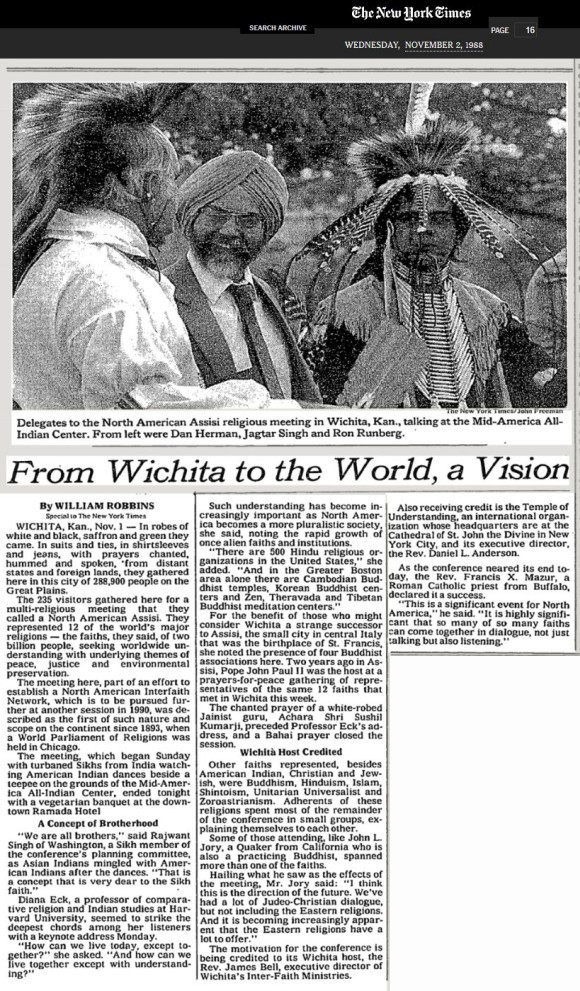 #250404 SEVEN DAYS  The themes help us focus on kindness in seven different ways, on seven different days. LOVE DISCOVER OTHERS CONNECT YOU GO ONWARD The SevenDays website gives you the SevenDays story (with the horrific past on April 14, 2014), the present, and the future, the
SevenDays events this year, how to get involved, resources, and an
opportunity to shop and various sponsorship opportunities. 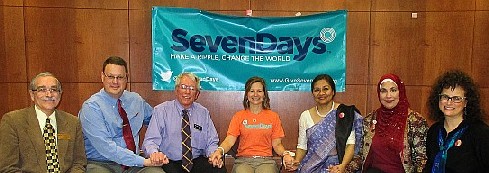 CRES
is glad to have been involved from the very first year with an
interfaith panel, and admires the folks and the organization involved
for turning tragedy into continuing community benefit by advancing
understanding and relationships.
Vern offers his conclusions from over 50 years of experience and
study: in a troubled world, what paths lie forward? and how can one
dare offer praise for the intertwined mix of the horror and the beauty
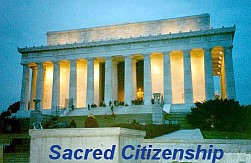
of existence? * Doing theology is less like mathematics and more like expounding why you love someone. #July4 Independence Day readings * Vern Barnet directly below on Sacred Citizenshi * Frederick Douglass second below * A 2024 Episcopalian perspective: Fr John Spicer here * A perspective on what makes America great by a President leaving office here * Ken Burns on American history here
--------------
This is the first public program David has provided since his stroke in March. We are grateful he remains so effective in connecting with his audience and presenting his material, even with some impairment which only those who know David might notice. He continues to improve and has recently met with local government officials in planning programming for next year. David has also resumed leading twice-monthly "Morning Prayer" over Zoom. The Vital Conversation series, begun in 2002, has ended. Because the material David prepared for the series remains so valuable, we retain it on the CRES website. Dr. David Nelson is president of The Human Agenda and senior associate minister with CRES. A prominent interfaith leader, David was one of twelve original faith members of the Greater Kansas City Interfaith Council in 1989 and served as Convenor for three years. He is senior associate minister of CRES, the World Faiths CENTER FOR RELIGIOUS EXPERIENCE AND STUDY, was a major force in the 2001 Gifts of Pluralism conference where he introduced Appreciative Inquiry, played a key role in Kansas City’s first anniversary observance of 9/11, and lectured at the nation’s first Interfaith Academies in 2007. David served two years as the coordinator of the Christian Jewish Muslim Dialogue Group. He served in the Life Connections Interfaith Program at the US Penitentiary in Leavenworth for over a decade. As an Appreciative Inquiry Coach, David has assisted individuals and groups in a variety of settings. These included the Department of Health and Human Services, Emergency Medicine, Head Start, and Community Action Agencies. He has provided training in Team Building and Appreciative Supervision in 39 states and Europe.David received his bachelor’s degree in history and political science from Bethany College in Lindsborg, Kansas. His master’s degree in divinity, and his doctorate in ministry are both from the Lutheran School of Theology at Chicago. He has served as an adjunct faculty member of that school, conveying a Doctor of Ministry program in Kansas and Missouri. He also is a graduate of the two-year program in spiritual direction with the Shalem Institute for Spiritual Direction in Washington, DC. David served as Senior Pastor at Saint James Lutheran Church in Kansas City for 13 years. He also served Peace Lutheran Church in Manhattan, Kansas, and at Andover Lutheran in Windom, Kansas, five years each. David’s awards include the 2022 Steve Jeffers Leadership Service Award, a CRES Award in 2006 “for life-long community service, vision, and care for the future, and blessing the venture of interfaith understanding,” the 2013 Buck O’Neil Legacy Seat Award at the Kansas City Royals where David was applauded at a game of the Kansas City Royals at Kauffman Stadium for embodying Buck’s values (including diversity and working to make the world a better place), a Special Commemoration by the Interfaith Council when he retired from the Council in 2014, and the 2018 Humanitarian Award given at the Bruce R Watkins Cultural Heritage Center and Museum. In 2022, David was honored by Fitch and Associates with the Lifetime Achievement Award for his training of many of America's finest in emergency response over the last 25 years in Ambulance Services Management and Communication Center Management. #911 A way of understanding the years since 9/11 While the 9/11 attacks opened new gates of hell, the way our government has responded has brought us inside hell's domain. The smoke from that day, the acrid fumes, amplified into war, brings us purblind to the charred and hobbled Body Politic. How do we understand what has happened? How do we move forward? And what of other international conflicts, especially the war of Russia against Ukraine? 9/11: METAPHORICAL MALADY:
1. Before 9/11, terrorism had been dealt with as a CRIME, internationally and at home. The violation of life and property in an otherwise orderly society makes the terrorist an especially despised outlaw. We employ a legal system to assure justice by punishing the criminal and removing the criminal from society. International courts have done the same. 2. But since September 11 we have used a WAR metaphor. Of course the metaphor is hardly new. We love war. We have fought the war against poverty and the war against drugs, though it is hard for us to admit defeat, even though Vietnam and Afghanistan are history now. We still fight the war against cancer, against crime, against . . . you name it. But a war against terrorism was new. The metaphor had power because we struggled not just against isolated attack but against an organized force seeking not just advantage through harm of a target but rather destruction of a government or civilization. Though we ourselves use violence, we assumed our own righteousness would bring us victory over evil. Both of the metaphors of crime and war too easily commend themselves because they are simple, and rest on the assumption that we are wholly good — and our opponents are completely evil. 3. A third metaphor might come closer to the
complexity of the situation: DISEASE.
Here the metaphor suggests not separate, competing powers but of all
humanity as a sick body, within the organs of communities, cities, and
nations, afflicted in various ways, degrading or sustaining each other
in different degrees, infected with individuals and groups poisoned (using
Buddhist language) with greed, fear, and ignorance. Now, with COVID, we
are learning that, as Martin Luther King said, “Whatever affects one directly,
affects all indirectly.” Is the disease metaphor give us any insights into the war of Russia against Ukraine?
I think this metaphor gives us an essential insight
into debilitated world governance, enfeebled by the failure to
place armaments under international control requiring some body (a
strengthened United Nations) to manage conflict between states when
states cannot resolve problems peacefully. One way of looking at this
situation, using the disease metaphor, is the war as an auto-immune
disease of the world body; Russia, which benefits from a peaceful world
order, attacks that very order, and the body must address this
illness by sending resources to return to homeostasis. Just as
chemotherapy, surgery, radiation, and other cures, can destroy healthy
cells, so the body's response to Russian aggression requires the
short-term sacrifice of some otherwise healthy parts for long-term
health. Whether the expansion of NATO will inspire a true government of
all nations is very unclear, and whether the many increasingly complex
forces of civilization lead to planetary senescence and death, or to
universal peace --
#ThgvgSunday  TO BE UPDATED 2026 November Sunday 4-6 pm INTERFAITH THANKSGIVING GATHERING “Promoting Interfaith Peace, Renewal and Regrowth” The 2026 announcement pending 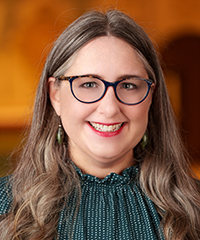 The 2024 recipient of the Vern Barnet Interfaith Service Award is Teresa Albright, Pastoral Associate at Visitation Parish, a Catholic Community. This year's gathering is planned and hosted by the Greater Kansas City Interfaith Council, the Heartland Alliance of Divine Love, and the Kansas City Pipe Circle. For
over 25 years Teresa's academic and personal focus has been religious
literacy, interfaith dialogue, and peacemaking. She has served on
nearly a dozen interfaith commissions, and is a vowed Lay Associate of
the Congregation of Notre Dame de Sion. Since July, 2019, she has been
the KCSJ Diocesan Ecumenical Officer and Chair of the
Ecumenical/Interreligious Commission, advancing the work of the past
ecumenical officers, now-Abbot Primate Gregory Polan and Father Paul
Turner, while incorporating her own interests and experiences. She has
a Master of Arts degree in Comparative Theology. She was at Westminster
College to work on the Central Missouri Interfaith Initiative, and
later for the Diocese of Jefferson City as a curriculum writer in the
Office of Religious Education. She applies her training and leadership
skills to facilitate unity and friendship among Catholics, non-Catholic
Christians, Jewish, Hindu, Muslims, Buddhist, and Tribal faith-filled
peoples. Read more about this year's honoree's work in Houston and elsewhere here. -----An annual Interfaith Thanksgiving Sunday observance was sponsored by CRES for 25 years, 1985-2009. The KC Interfaith Council was a program of CRES, 1989-2004. We are grateful to the current sponsors for perpetuating a recognition of the place of gratitude in every faith. OTHER ANNOUNCEMENTS
Having spawned several other organizations, including the Greater Kansas City Interfaith Council, we continue to offer programs initiated by and through others but we no longer create our own in order to focus on our unique work. For interfaith and cultural calendars maintained by other groups, click here. |
|||||||||||||||||

 Visit
Visit