|
FOR UPDATES, CLICK HERE |
BIO SKETCHESShorter sketches
Table of Faiths Bio
Community Leadership Assn
MLKingJr address
2007 Bio
Lyceum
Spiritual PDR
CPS 2010
Plaza Library 2014
Magazine Feature 2003
2015 general bio
2019 general bio
CBS VIDEO
TIPS FOR INTRODUCTIONS
About "Reverend"CONTACT
email:...vern@cres.org
AOL and others, please use
...vern.barnet@gmail.comQuickest Address:
Box 45414,
Kansas City, MO 64171
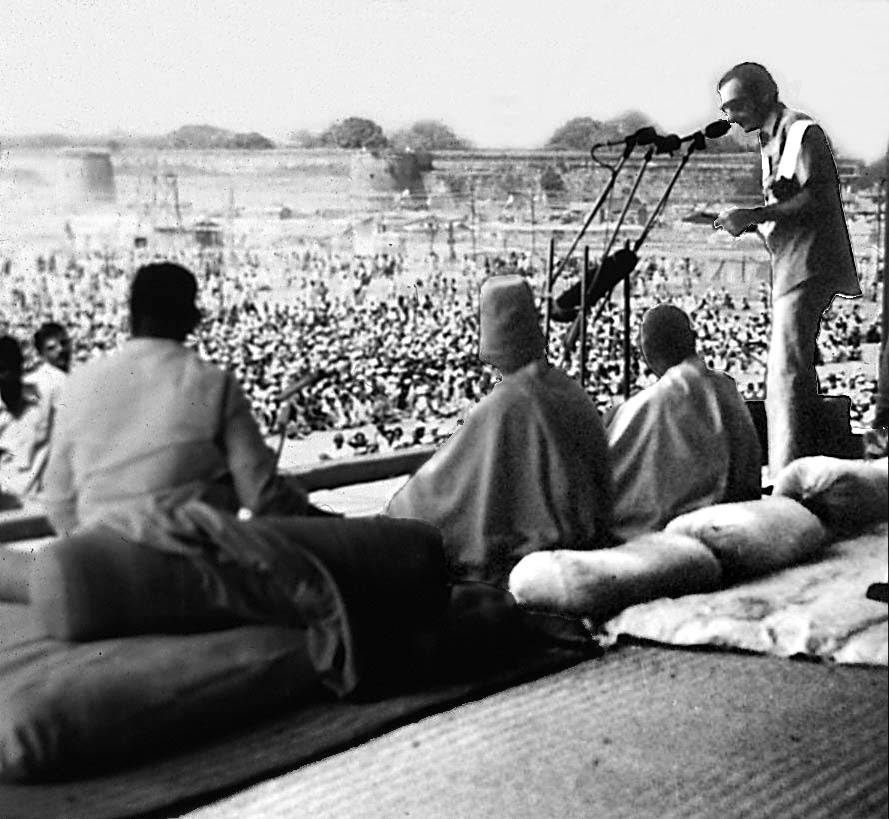
Dr Barnet addresses 500,000 on the banks of the Ganges at Prayag in 1986 at the request of Pandurang Shastri Athevale.
For Shepherd's Center, 2021NAME: The Reverend Vern Barnet, DMn
ADDRESS: Box 45414, Kansas City, MO 64171
PHONE: 816.753.1633
EMAIL: vern@cres.org
COUNTY: Jackson
AGE: 79WHAT SERVICE MEANS TO ME
Service to others, for others, is a way to express my faith and gratitude for the gift of life. The lucky encounters I've had with folks from the three families of the world’s religions — Primal, Asian, and Monotheistic — have propelled me to study and share their wisdom to heal the corresponding three interlocking crises of our era — in the environment, in personhood, and in social order. It is a joy to fulfill a duty to promote such wisdom in serving the Kansas City community and beyond.SELECTED LIST OF SERVICE TO THE LOCAL COMMUNITY
*Founded the Kansas City Interfaith Council
*Served on Mayor Cleaver’s 1996 Task Force on Race Relations
*Organized the area's main day-long observance of the first anniversary of 9/11
*Coordinated the Christian Jewish Muslim Dialogue Group
*Chaired the Jackson County 9/11 Diversity Task Force
*Wrote 947 columns for a weekly column on faith for The Kansas City Star
*Provided commentary for media such as The Kansas City Jewish Chronicle, KCPT, and KCUR
*Co-created and led the Youth Leadership Institute for the Overland Park Rotary Club
*Co-edited The Essential Guide to Religious Traditions and Spirituality for Health Care Providers
*Provided hundreds of educational programs on religion for various groups
*Board member, Friends of the Department of Religious Studies at the University of Kansas
*Board member, the American Friends Service Committee
*Board member, the ACLU (American Civil Liberties Union) local affiliate
*Board member, the Overland Park Rotary Club
*Board member, the Shawnee Mission School of International Studies
*Board member, the Kansas City Tomorrow Alumni Association
*Board member, the Shawnee Mission Medical Center's Institute for Spirituality and Health Advisory Board
*Board member, the MAINstream Coalition Board
*Board member, Mayor’s UN Day Committee
*Board member, the NCCJ (National Conference for Community and Justice (formerly National Conference of
Christians and Jews)
*Board member, the Gift of Life Foundation
*Volunteer in many capacities for church, diocese, and groups like the YMCA and the Boy Scouts.BIO MAX-WORD: 250
The Reverend Vern Barnet, DMn, completed his studies at the University of Chicago and an affiliated seminary with a doctoral dissertation applying a key Buddhist teaching to ministry. After serving parishes in Illinois, Pennsylvania, and Kansas, he was so charmed by friends of many faiths here that he decided to focus his work in Kansas City by creating the Center for Religious Experience and Study (“CRES”). Although his focus is local, he has spoken and been published internationally. With one foot in community organizing, the other has been in the academy, with adjunct teaching for Park and Ottawa universities and the Unity Institute, the Saint Paul School of Theology, Central Baptist Theological Seminary, and Sophia Retreat Center (Benedictine). Six weeks after 9/11, he presided over the area's first 3-day interfaith conference, “The Gifts of Pluralism,” which he organized with the Interfaith Council and several other organizations. He brought to Kansas City the nation’s first “Interfaith Academies for Religious Professionals and Students,” created by the Pluralism Project at Harvard and Religions for Peace at the UN Plaza. He has been honored by Buddhist, Christian, Hindu, Jewish, Muslim, Sikh, interfaith, professional, civic, and secular organizations. His book of 154 sonnets, Thanks for Noticing: The Interpretation of Desire, was published in 2015. He was the developmental editor for Binding Us Together, the autobiography of Alvin L. Brooks, published earlier this year.EMPLOYMENT AND KEY ORGANIZATIONS
I think the above may be sufficient.
SUMMARY.— In 2004, the Reverend Vern Barnet, DMn, was named minister emeritus of CRES, a Kansas City community resource for exploring spirituality in all faiths. He founded CRES in 1982, and became its minister-in-residence in 1985 with “community networking” responsibilities. He now focuses on writing, teaching, and consulting.
He is known to many Kansas Citians through the weekly "Faith and Beliefs” column published 1994-2012 in The Kansas City Star. Founder of The Kansas City Interfaith Council and its convener through 2003, he is now its convener emeritus. (CRES continued to support the Council through 2004, now renamed the Greater Kansas City Interfaith Council). He has been active in many professional and civic organizations. His articles, poems, and reviews appear in many journals.
Barnet has taught religion courses as an adjunct at the Ottawa University Kansas City campus, Park University, Avila University, and Baker University, and taught graduate ministerial students at the Unity School of Christianity, the Central Baptist Theological Seminary, and the Saint Paul School of Theology (Methodist). In 2007 he served on the international faculty of the pilot “Interfaith Academies” partnered by Harvard University’s Pluralism Project, Religions for Peace-USA at the United Nations Plaza, the Saint Paul School of Theology, and the Greater Kansas City Interfaith Council. He continues as a member of the Souljourners faculty training spiritual directors at the Sophia Retreat Center of the Benedictine Sisters at Mount St Scholastica. For six years he served on the editorial board of Unity Magazine as its only non-Unity ministerial member, and is noted as contributor to The Interfaith Observer.
HONORS AND INVOLVEMENT.— In 1979, Barnet received the Kansas City Jewish Community Relations Bureau’s first “Distinguished Community Service Award” from its Board — and in 1998 the American Muslim Council, Midwest Region, gave him its first “Distinguished Community Service Award.” In 1987 the Overland Park Rotary Club honored him as a Paul Harris Fellow with its “Distinguished Community Service Award,” and in 2002 he received the “Community Service Award” from the Crescent Peace Society. In 1989 he was selected for Kansas City Tomorrow, a year-long leadership development program sponsored by the Civic Council of Greater Kansas City; and in 1996, after serving six terms on its alumni board, he was honored as “the Star of the Kansas City Tomorrow Alumni Association,” and he was voted its “Distinguished Alumnus of the Year” ten years later.In 1990 he was honored by the Ethnic Studies Center at William Jewell College for his community work fostering understanding among faiths. In 1991 he received the Warren Dentler Religious Service Award from the Waldo-Country Club Ministerial Association. In 2005, from Kansas City Mayor Kay Barnes, Barnet received the first “Table of Faiths” award of the reorganized Greater Kansas City Interfaith Council at a luncheon in his honor. In 2006, the Midwest Sikh association presented him with its “Vaisakhi Community Service Award.” The National Community Leadership Association presented him with a “Distinguished Leadership Award” at its 2006 conference in Hartford, CT. In 2007 the Hindu Temple and Cultural Center of Kansas City honored him with an award and shawl. In 2008, he received The Abrahamic Legacy Award from Al Inshirah Islamic Center. In 2010 he received the Lifetime Achievement Award from the Crescent Peace Society and the inaugural "Vern Barnet Interfaith Service Award" from the Heartland Alliance of Divine Love.
In 1993 Vern was named Director Emeritus of the Center for All Men. In 1996 his Rotary Club Foundation recognized his work helping to found a yearly week-long Youth Leadership Institute for high school students. He supervised the development of the curriculum and later chaired the Institute. In 2000, he received the Pikes Peak [Colorado] “Interfaith Cooperation and Achievement Award.” In 2001, he received the “Bodhisattva Award” from the Rime Buddhist Center Monastery and Tibetan Institute of Studies.
He organized the Kansas City Interfaith Council in 1989 and hosted it through 2004; for its first four years, he coordinated the Christian-Jewish-Muslim Dialogue Group. A “Coming of Age” program he initiated locally won national recognition. He has been president of several clergy groups and held office in various professional organizations, and served on numerous community and national boards, such as the Mainstream Coalition, Gift of Life, Overland Park Rotary, Kansas City Tomorrow Alumni Association, NCCJ, and the American Civil Liberties Union affiliate. In 1996 he drafted the recommendation of the Religion/Spirituality Cluster of the Mayor’s Task Force on Race Relations.
He chaired the Jackson County Diversity Task Force following 9/11, which submitted its 77-page report on 2002 September 10, and led the team which organized the central 9/11 first anniversary observances for the metro area.
(These and other Kansas City area interfaith projects were featured on the network CBS-TV half-hour religion special, “Open Hearts Open Minds,” broadcast in October, 2002.)
His past and current service includes work on boards for organizations such as the the John Brown Ampitheater Association, Friends of the Department of Religious Studies at the University of Kansas, the American Friends Service Committee, the ACLU (American Civil Liberties Union), the Overland Park Rotary Club, the Shawnee Mission School of International Studies, the Kansas City Tomorrow Alumni Association, the Shawnee Mission Medical Center’s Institute for Spirituality and Health Advisory Board, the MAINstream Coalition Board and, earlier, its Advisory Board, the NCCJ (National Conference for Community and Justice — formerly National Conference of Christians and Jews), and the Gift of Life Foundation. He has also been a volunteer for organizations such as the Friends of Probationers (in Crawford County, PA), the YMCA, and the Boy Scouts (Tiger Cubs Den Leader), and was a JayCee and Kiwanian.
In 2001, he led the planning for the Kansas City area’s first interfaith conference, for which he was president. This historic event resulted in a Unanimous Declaration to the community, and led to the creation of the play, “The Hindu and the Cowboy and Other Kansas City Stories” by Donna Ziegenhorn, and a national model, The Greater Kansas City Interfaith Passport.
In 1984, he was part of the first group of Westerners in history to follow the sacred “Gyo” path on Mt Hiei, Japan. In 1986 his interest in Pandurang Athavale led to speaking to an assembly of 500,000 on the banks of the Ganges River. He has attended, spoken at, and helped organize numerous international conferences on religion around the world.
EDUCATIONAL ACTIVITIES.— Barnet has lectured at universities and churches around the country. In Kansas City, he has taught at the graduate and undergraduate levels at the Saint Paul School of Theology, Central Baptist Theological Seminary, Baker University, Ottawa University - Kansas City, Park College, and Avila University, for ministerial and lay training at the Unity School of Christianity, for students training to be spiritual directors at the Sophia Retreat Center, and community courses for Johnson County Community College. He has spoken for Jewish, Christian, Hindu, Buddhist, Muslim, Sikh, and other religious organizations, and for retreats, schools, and business and civic groups. He served on the steering committee founding the Shawnee Mission School District’s Center for International Studies. Barnet’s writings have appeared in professional journals, popular periodicals, and denominational curricula. He has appeared on, and consulted for, TV and radio around the country. Locally he has appeared on programs like KCPT’s “Kansas City Week in Review” and KCUR’s “Under the Clock” with former mayor Emanuel Cleaver, the Sunday morning show with Patrick Neas, “The Walt Bodine Show,” and Steve Kraske’s “Up to Date.” He has presented workshops at regional, continental, and international meetings. His first major article, “God is Doing His Thing: The Hippie Heresy and Liberalism,” was published in The Journal of the Liberal Ministry, Winter, 1969, before he completed his doctoral degree and was a 45-page excerpt from his dissertation. He edited and contributed to a book on worship, An Abraxas Reader (1980). He is cited or quoted in a number of works, including Robert B Tapp’s Religion Among the Unitarian Universalists (1973), Mohammad T Mehdi’s Islam and Tolerance (1990), and Neal Vahle’s The Unity Movement (2002). He drafted the text of Governor Graves’ Ramadan proclamation, quoted in Harvard Professor Diana Eck’s A New Religious America (2001).
Barnet, along with three others, wrote for, and edited, the 740-page The Essential Guide to Religious Traditions and Spirituality for Health Care Providers, published internationally by Radcliffe in 2013.
Barnet’s collection of sonnets, Love Without Desire, was published in 1992. He is now writing another book on worship and a book on world religions, and editing the memoirs of Alvin L Brooks. His second collection of sonnets, actually a prosimetrum, Thanks for Noticing: The Interpretation of Desire, was published in 2015; a second printing, with extensive corrections and revisions, is expected in 2020 or 2021.
ACADEMIC PREPARATION, PREVIOUS POSTS, and FAITH AFFILIATIONS.— Barnet completed doctoral work at the University of Chicago and the affiliated seminary, the Meadville Theological School (DMn, 1970), where he studied with Mircea Eliade, generally recognized as the world’s foremost scholar of the history of religion. There he also studied with philosopher-psychologist Eugene Gendlin of "Focusing" fame, psychiatrist-thanatologist Elisabeth Kübler-Ross, proponent of redaction criticism Norman Perrin, and noted theologian Langdon Gilkey. His training also included study at the Center for Advanced Study of Religion in an Age of Science with Ralph Burhoe, the first American to win the Templeton Prize for Progress in Religion. An undergraduate at the University of Nebraska, Barnet first encountered language analysis in religion with the philosopher and churchman O K Bouwsma. He also studied with US Poet Laureate and editor of Poetry magazine, Karl Shapiro. As a graduate student there, his early academic study of Buddhism was with visiting scholar and Bollingen Fellow Garma Chen Chi Chang. He describes his later doctoral dissertation using the Buddhist doctrine of the Void as “five hundred pages about Nothing.”
After school, he continued study in the field of world religions with scholars such as Joseph Campbell and with travel in Europe, Asia, the Middle East, and Central and South America. His friendship with Huston Smith began in 1970 and included hosting and appearing with him in Kansas City programs in 2005.Before his full-time volunteer work with CRES, Barnet served Unitarian Universalist parishes in Illinois, Pennsylvania, and Kansas. In 1975, he was one of the five founding members of the Congregation of Abraxas, a liturgical and missionary order whose mission field was the few Unitarian Universalist churches interested in worship. As the organization grew, he became a member of the Order of the Congregation of Abraxas, and served as its executive director during the years the organization flourished. In 2011 he was baptized at Grace and Holy Cathedral (Episcopal) in Kansas City. His congregational activities during previous deanships have included leading Morning Prayer, organizing Candlemas, teaching in children's formation, chairing the Worship Committee, and many other ministries; he has written over a dozen columns for the diocesan magazine and currently serves on the diocesan Commission on Ministry. A lay member of St Paul's Episcopal Church in Kansas City, he maintains status as a retired Unitarian Universalist minister and enjoys regular fellowship with area UU clergy.
DUTIES.— As minister-in-residence for CRES, Barnet was responsible for institutional operation to fulfill the mission of CRES: promoting interfaith understanding through networking, consultation, special events, and educational programs and services in Kansas City. His monthly essays in the CRES publication 1984-2009, Many Paths, along with Kansas City Star columns, are being collected for book publication. In cooperation with the Interfaith Council, he led the annual Thanksgiving Sunday Interfaith Ritual Meal which has become a key multi-faith witness in Kansas City through its 25th year, 2009. Now, as minister emeritus, his networking responsibilities are more focused. His new contributions are largely through writing, teaching, and consulting, while preserving and archiving previously produced material of lasting value. He continues to provides wedding and other rites-of-passage services for those desiring an interfaith context.
PERSONAL INTERESTS.— His electronic music has been performed at concert and modern dance events. His photography has appeared in educational and commercial publications. His interest in religious disciplines included a 1983 fast from solid food, with medical supervision, for 72 days. His early work in computer programming led to an adjunct faculty appointment at The Computer Academy in Kansas City. He also enjoys swimming, singing, and photography. His son, Benjamin, was born in 1980.
Box 45414, Kansas City, MO 64171
email:vern@cres.org
Tips for IntroductionsIf you plan to introduce Vern before he gives a speech, please select three, or at most four, items; brief introductions are best for the audience, for Vern, and for you. Long introductions try the audience, rouse unrealistic expectations, and deprive the speaker of the time allotted for his remarks.
For example, here is a normal introduction:
I am pleased to present Dr Vern Barnet, "Faiths and Beliefs" columnist for The Kansas City Star. In 1989 he founded the Kansas City Interfaith Council, and his interfaith work has been recognized by awards from many faith groups.Here is an extended introduction:The Reverend Vern Barnet did his doctoral work at the University of Chicago where he studied with Mircea Eliade. His work in Kansas City began in 1975 and he has taught world religions as an adjunct professor at several schools here. His primary interest, however, is in helping the community appreciate the many faiths represented here as resources for one's own spiritual growth. His topic today is "The World's Religions: Pieces or Pattern?"There may occasions where longer introductions might be appropriate, but unless you are giving him an award or have a particular need to place his work in some larger context, you will probably get few complaints if the introduction is short.
Fees
Honoraria or other financial recognition of services provided by CRES are normally expected. The usual fee suggestions are listed at on the page at www.cres.org/work/services.htm.
Financial recognition is usually expected as part of the organization's efforts to finance interfaith work. While Vern volunteers all his services and received no compensation for them (income from the KC Star column was assigned to CRES, for example), CRES does have expenses which include office overhead (space, phone, web site, postage, etc) and a part-time office assistant.
#shorter
BIO FROM THE 2005
"TABLE OF FAITHS" AWARD LUNCHEONThe Reverend Vern Barnet, DMn, completed his doctoral work at the University of Chicago and the affiliated Unitarian Universalist seminary in 1970. He served parishes in Illinois, Pennsylvania, and Kansas. Since 1985 he has been a full time volunteer acquainting the Kansas City area with the wonderful diversity of faiths here.
Vern organized the Kansas City Interfaith Council in 1989 as a program of the World Faiths Center for Religious Experience and Study ("CRES"), where he is now minister emeritus. He headed its unprecedented 2001 "Gifts of Pluralism" conference which fostered many interfaith initiatives, including the play, "The Hindu and the Cowboy and Other Kansas City Stories."
Among his many civic activities, he chaired the Jackson County Diversity Task Force which studied the effects of 9/11 on people of faith in the 5-county area, and co-founded the Overland Park Rotary Club's Youth Leadership Institute.
As an active and visible participant in the media, Vern is frequently invited to share his views on local radio and television. Since 1994, he has written a column each Wednesday for The Kansas City Star. His articles and poems have appeared in many regional and national publications. His own monthly journal, Many Paths, was begun in 1984.
Honored by Buddhist, Christian, Jewish, Hindu, Muslim, Sikh, and other groups, Vern has also served as president of several professional organizations. He teaches world religions at area universities and seminaries and is a popular speaker for churches and civic groups. His largest live audience was 500,000 on the banks of the Ganges River.
While he continues to travel throughout the Americas, in Europe, Asia, and the Middle East, he calls Kansas City home. "I feel very blessed to be a part of a community growing aware of itself through the arts, through civic and business life, through the other institutions of civilization, and especially through the rich personal relationships that grow when the spirit moves along varied paths that meet joyously here in the Heartland," he says.
#CLABIO BY THE NATIONAL
COMMUNITY LEADERSHIP ASSOCIATIONAs minister in residence of CRES, which he founded in 1985, and as a cull time community volunteer, Vern Barnet is an exemplary leader and servant of others. His personal mission has been to promote understanding among peoples of all faiths in Kansas City. Vern initiated the Kansas City Interfaith Council in 1989 by recruiting representatives from a full range of organized religions. He has led the IFC as its convener, moderator, energizer and mediator for fifteen years, shepherding the Council to its current, independent, viable, important status in the community. Barnet organized and led the unprecedented "Gifts of Pluralism" 3-day conference, held in Kansas City in 2001, which brought together practitioners of diverse religions to learn about each others' faiths, and fostered numerous inter-cultural activities.
#20072007 SHORT BIO The Reverend Vern Barnet, DMn, founded the Kansas City Interfaith Council in 1989 and his organization, CRES, hosted it through 2005. He has been honored by Buddhist, Christian, Jewish, Hindu, Muslim, Sikh and other groups in Kansas City and elsewhere. Among his many civic activities, he chaired the Jackson County Diversity Task Force which studied the effects of 9/11 on people of faith in the 5-county area. Since 1994, his Wednesday "Faiths and Beliefs" column has appeared in The Kansas City Star. In 2007 he was a member of the international faculty of the pilot "Interfaith Academies" which included partnerships with Harvard University's Pluralism Project and Religions for Peace - USA at the United Nations Plaza.
#mlk2007 BIO FOR ML KING ADDRESS The Reverend Vern Barnet, DMn, founder of the Kansas City Interfaith Council, is known to many through his "Faith and Beliefs" column Wednesdays in The Kansas City Star. He has been honored by Buddhist, Christian, Jewish, Hindu, Muslim, Sikh and other groups in Kansas City and elsewhere. He has spoken widely, including to a crowd of 500,000 on the banks of the Ganges River. Among his many civic activities, he chaired the Jackson County Diversity Task Force which studied the effects of 9/11 on people of faith in the 5-county area. In 2007 he was a member of the international faculty of the pilot "Interfaith Academies" which included partnerships with Harvard University's Pluralism Project and Religions for Peace - USA at the United Nations Plaza. Area seminaries have engaged him to teach "World Religions" and other courses. As a student, he met Martin Luther King Jr, preached his first Easter sermon right after King was assassinated, and has felt King's influence shaping much of his career and hope for the future.
#lyceum The Reverend Vern Barnet, DMn, is known to readers of The Kansas City Star for his weekly "Faiths and Beliefs" column, begun in 1994. Barnet founded the Kansas City Interfaith Council in 1989. He has been honored by Buddhist, Christian, Jewish, Hindu, Muslim, Sikh and other groups in Kansas City and elsewhere. His largest international audience was 500,000 on the banks of the Ganges River. Among his many civic activities, he chaired the Jackson County Diversity Task Force which studied the effects of 9/11 on people of faith in the 5-county area. He has taught as an adjunct faculty member at the Unity Institute, the Saint Paul School of Theology, and the Central Baptist Theological Seminary. In 2007 he was a member of the international faculty of the pilot "Interfaith Academies" which included partnerships with Harvard University's Pluralism Project and Religions for Peace - USA at the United Nations Plaza. His doctoral studies were completed at the University of Chicago Divinity School and the affiliated seminary, the Meadville-Lombard Theological School, where he studied with world renown scholar Mircea Eliade. He has also studied with Joseph Campbell and Huston Smith, whom he brought to Unity Village in 2005. Two Star columns this spring were about Lyceum presenter Bart Ehrman and an earlier column featured John Shelby Spong.
2008 BIO FOR UNITY LYCEUM
#PDR The Reverend Vern Barnet, D.Mn., completed his doctoral work at the University of Chicago and Meadville-Lombard Theological School in 1970. Honored by Buddhist, Christian, Jewish, Hindu, Muslim, Sikh, and other groups, he has taught world religions at several universities and seminaries. Since 1994, he has been a religion columnist for The Kansas City Star, and his articles and reviews have appeared in many national publications.
BIO FOR SPIRITUAL PDR
The Essential Guide to Religious Traditions
and Spirituality for aHealth Care Providers
After international interfaith work, [and after serving on the planning committee for the first conference of the North American Interfaith Network in 1988,] he organized the Kansas City Interfaith Council in 1989, with 13 faiths, from American Indian to Zoroastrian, [as a program of the Center for Religious Experience and Study (“CRES”), where he is now minister emeritus]. Following 9/11 he led the region’s unprecedented “Gifts of Pluralism” conference which fostered interfaith initiatives featured on a half-hour CBS-TV special. Among his many civic activities, he chaired the Jackson County government’s Diversity Task Force that studied the effects of 9/11 on people of faith in the 5-county Kansas City area.
His interfaith work led to Kansas City being chosen as the site for the nation’s first “Interfaith Academies” sponsored by Harvard University’s Pluralism Project, Religions for Peace-USA, and other groups. Ellie Pierce, principal researcher for the Pluralism Project, said, “At the Pluralism Project, we consider Kansas City to be truly at the forefront of interfaith relations. This is — in no small part — due to the tireless efforts of Vern Barnet, whose work and writings have been an inspiration to all of us at the Pluralism Project.”
With great affection, he remembers the originator of this book, the Reverend Steven L. Jeffers, Ph.D., who attracted him and others of many faiths in developing the Institute for Spirituality in Health at Shawnee Mission Medical Center.
#CPS2010CRESCENT PEACE SOCIETY, 2010 The Reverend Vern Barnet, DMn, founded the Kansas City Interfaith Council in 1989. He has been honored by local Buddhist, Christian, Jewish, Hindu, Sikh, and Muslim organizations (including the “Community Service Award” from the Crescent Peace Society in 2002) as well as by national and international professional and interfaith groups. A worker as well as a scholar, his many civic activities included chairing the Jackson County Diversity Task Force which studied the effects of 9/11 on people of faith in the 5-county area. Among his many publications, his Wednesday "Faith and Beliefs" column has appeared in The Kansas City Star since 1994.
#PlazaLibrary2014 BIO-SKETCH.— The Reverend Vern Barnet, DMn, completed his doctoral work in 1970 at the University of Chicago and the affiliated seminary, Meadville-Lombard, where he studied with his next door neighbor, the renown historian of religion, Mircea Eliade. He met and became friends with Huston Smith that year, and subsequently studied with Joseph Campbell.
PLAZA LIBRARY, 2014
AFTER serving parishes in Illinois, Pennsylvania, and Kansas, in 1989 Dr Barnet founded the Greater Kansas City Interfaith Council as a program of CRES, which he created in 1982. He has taught at area colleges, universities, and seminaries, including the nation’s first “Interfaith Academies” sponsored by Harvard University’s Pluralism Project and others, and spoken internationally. (His largest crowd was 500,000 on the banks of the Ganges River.) He chaired the multi-faith Jackson County 9/11 commission which issued a 35,000 word report. He has received awards from Buddhist, Christian, Jewish, Hindu, Muslim, Sikh and other religious groups, and from civic organizations such as the national Community Leadership Association award in 2006. Each year beginning in 2010, the Heartland Alliance of Divine Love has recognized a distinguished member of the community with the “Vern Barnet Interfaith Service Award.”
FROM 1994 to 2012 he wrote the weekly “Faith and Beliefs” column for The Kansas City Star. In 2002 his interfaith work was featured in a half-hour CBS-TV special. In 2013 Radcliffe published the 740-page Essential Guide to Religious Traditions and Spirituality for Health Care Providers, which he and three others edited. His book of 154 sonnets and glosses, Thanks for Noticing: The Interpretation of Desire, which draws upon the world’s spiritual traditions, is expected in September, 2015.
A list of publications, citations, and other biographical data can be found at www.cres.org/vern.
#2015
2015
The Reverend Vern Barnet, DMn, completed his doctoral work in 1970 at the University of Chicago and the Meadville-Lombard Theological School where among his teachers were historian of religion Mircea Eliade, philosopher-psychotherapist Eugene T Gendlin, Templeton Prize winner Ralph Wendell Burhoe, and psychiatrist Elisabeth Kübler-Ross. Ordained a Unitarian Universalist minister, he served parishes in Illinois, Pennsylvania, and Kansas before dedicating his career to interfaith understanding in the Kansas City area, where he founded the Interfaith Council in 1989.
For eighteen years the weekly religion columnist for The Kansas City Star, Vern Barnet has been honored by Buddhist, Christian, Jewish, Hindu, Muslim, Sikh, and other groups. With three others, he wrote and edited the 740-page Essential Guide to Religious Traditions and Spirituality for Health Care Providers, published by Radcliffe in 2013. His articles, reviews, and poems have appeared in many publications. His book of 154 sonnets and glosses, Thanks for Noticing: The Interpretation of Desire, which draws upon the world’s spiritual traditions, is expected in September, 2015.
He has taught world religions and related subjects at several universities and seminaries (including the Saint Paul School of Theology, Central Baptist Theological Seminary, and the Unity Institute), and served on the faculty of the nation’s first “Interfaith Academies” sponsored by Harvard University’s Pluralism Project and Religions for Peace-USA. He has studied and spoken internationally; his largest live audience was a crowd of 500,000 on the banks of the Ganges River in 1986. He has been featured in national media, including a half-hour CBS-TV special in 2002. He chaired the multi-faith Jackson County 9/11 commission which issued a 35,000 word report. His civic activities have been recognized with local and national awards, and a “Vern Barnet Interfaith Service Award” is given to a distinguished Kansas Citian each year.
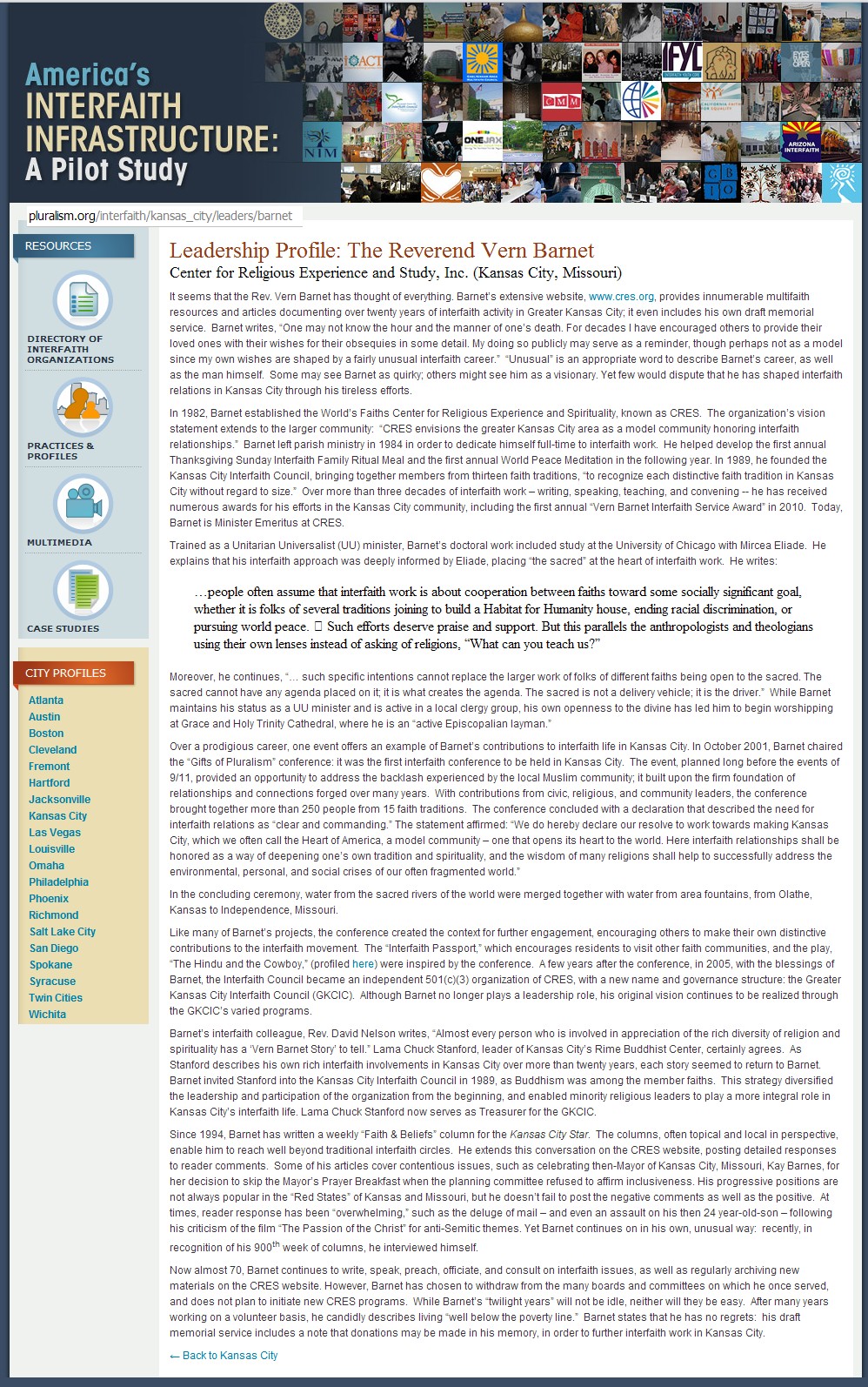
Now minister emeritus of the Center for Religious Experience and Study (“CRES”), which he founded in 1982, he is an active Episcopalian layman. Harvard’s Pluralism Project profiles him on its website: http://pluralism.org/interfaith/kansas_city/leaders/barnet. A full biography and list of publications appear at http://www.cres.org/team/vern.htm.
#2019
2019 download PDF
The Reverend Vern Barnet, DMn
*convener emeritus, the Greater Kansas City Interfaith Council
*minister emeritus, Center for Religious Experience and Study (“CRES”)
*Assistant Professor, Religious Pluralism, Central Baptist Theological Seminary
*CRES, Box 45414, Kansas City, MO 64171—8414; website www.cres.org; email vern@cres.orgVERN BARNET studied at the University of Chicago with the world-renowned historian of religion, Mircea Eliade. Barnet was awarded his doctorate in 1970. After serving churches in Illinois, Pennsylvania, and Kansas, and activities abroad, he has devoted his energies to interfaith work in metro Kansas City. In 1989 he founded the Kansas City Interfaith Council. From 1994 through 2012, he wrote a weekly religion column for The Kansas City Star, and his articles and reviews have appeared in many national publications.
Honored by Buddhist, Christian, Jewish, Hindu, Muslim, Sikh, and civic organizations, he has taught world religions and related subjects at several universities and seminaries. He currently teaches at Central Seminary which asked him to develop a course to train ministers for today’s multi-faith environment.
Following 9/11, he led the region’s unprecedented “Gifts of Pluralism” conference which fostered interfaith initiatives featured on a half-hour CBS-TV special. Among his many civic activities, he chaired the Jackson County government’s Diversity Task Force that studied the effects of 9/11 on people of faith in the 5-county Kansas City area and issued a 35,000-word report. With three others he edited the internationally-published 740-page reference book, The Essential Guide to Religious Traditions and Spirituality for Health Care Providers in 2013, with endorsements from the Mayo Clinic and the American Academy of Family Physicians. His book of 154 sonnets, Thanks for Noticing: The interpretation of Desire, was published in 2015 with countless references to themes in the religions of the world.
His interfaith work led to Kansas City being chosen as the site for the nation’s first “Interfaith Academies” sponsored by Harvard University’s Pluralism Project, Religions for Peace-USA, and other groups in 2007. Ellie Pierce, then the Project’s principal researcher, said, “At the Pluralism Project, we consider Kansas City to be truly at the forefront of interfaith relations. This is — in no small part — due to the tireless efforts of Vern Barnet, whose work and writings have been an inspiration to all of us at the Pluralism Project.”
FOR A COPY OF THE CBS RELIGIOUS SPECIAL
"OPEN HEARTS OPEN MINDS"
call 1-800-494.6007; $19.98 plus $4.95 S&H.
view excerpts on line on our video page
or obtain a professional local copy
by sending $10 to CRES
Box 45414
Kansas City, MO 64171
No extra charge for shipping.
The Reverend Vern Barnet, DMn, completed his studies at the University of Chicago Divinity School and an affiliated seminary. He served parishes in Illinois, Pennsylvania, and Kansas where he developed a Coming-of-Age program with denominational publication.
He was so charmed by friends of many faiths here that in 1982 he decided to focus his work in Kansas City by creating the Center for Religious Experience and Study (“CRES”). In 1989, he founded the Kansas City Interfaith Council as a program of CRES. Six weeks after 9/11, he presided over the area's first 3-day interfaith conference, “The Gifts of Pluralism,” concluding with a declaration outlining the resources from primal, Asian, and monotheistic traditions to resolve the environmental, personal, and social crises of our age. Following 9/11, he chaired the Jackson County (MO) Diversity Task Force which surveyed the level of religious comity in the 5-county area, and after a year of study, issued a 77-page report and recommendations.
He brought to Kansas City the nation’s first “Interfaith Academies for Religious Professionals and Students,” created by the Pluralism Project at Harvard and others, and he served on its faculty. He has also taught at Park and Ottawa universities and the Unity Institute, the Saint Paul School of Theology (Methodist), Central Baptist Theological Seminary, and the Sophia Center (Benedictine).
His weekly "Faith and Beliefs" column appeared in The Kansas City Star 1994-2012. For six years he served on the editorial board of Unity Magazine. His articles, poems, reviews, and liturgical materials have appeared in many other publcations, including the National Catholic Reporter, The Journal of the Liberal Ministry, The Interfaith Observer, the Chicago Literary Review, the diocesan magazine Spirit, and the Unitarian Universalist World. He is cited in dozens of books and articles.
He was one of four editors for The Essential Guide to Religious Traditions and Spirituality for Health Care Providers, 2013, published in the US and the UK.
His book of 154 sonnets, Thanks for Noticing: The Interpretation of Desire, was published in 2015 and a second edition is expected soon. He was the developmental editor for Binding Us Together: A Civil Rights Activist Reflects on a Lifetime of Community and Public Service, the autobiography of Alvin L. Brooks, 2021.
He has been honored by Buddhist, Christian, Hindu, Jewish, Muslim, Sikh, interfaith, professional, civic, and secular organizations. Vern has also served as president of several professional organizations.
Vern has also served as president of several professional organizations. He is a popular speaker for churches and civic groups and asked for commentary on radio and TV. His largest live audience was 500,000 on the banks of the Ganges River.
A fuller biography appears at https://www.cres.org/vern/.
Vern Barnet has spent 40 years promoting interfaith understanding in Kansas City, informed by travel and study in Europe, Asia, the Middle East, and Central and South America. He founded the Kansas City Interfaith Council and has taught at area universities and seminaries. His weekly "Faith and Beliefs" column appeared in the Kansas City Star for eighteen years, and his books and other publications stretch from 1960 to today. He has been honored by Buddhist, Christian, Hindu, Jewish, Muslim, Sikh, interfaith, civic, and secular organizations. Following the 9/11 attack, he presided over the area's first major interfaith conference, “The Gifts of Pluralism,” which focused on the resources from primal, Asian, and monotheistic traditions to resolve the environmental, personal, and social crises of our age. That led to his chairing the Jackson County (MO) Diversity Task Force, which, after a year of study, issued a 77-page report and recommendations.The following sections are under construction:
DEGREES, CERTIFICATE, ORDINATION
- 1965 BA, University of Nebraska (philosophy) (June 12)
- 1970 Certificate, Clinical Pastoral Education, University of Chicago Hospitals and Clinics (March 20)
- 1970 DMn, Meadville Theological School, affiliated with the University of Chicago; dissertation: Voidism: A Personal Theology for the Practice of the Liberal Ministry (June 9)
- 1970 Ordained "to the Ministry of Religion" according to the usage of the Unitarian Universalist Churches by the Lincoln, NE Unitarian Church (May 24)
- 1970 Priliminary Fellowship with the Unitarian Universalist Association (June 9)
- 1974 Final Fellowship with the Unitarian Universalist Association (March 4)
Numerous awards from Buddhist, Christian, Hindu, Jewish, Muslim, Sikh, interfaith, professional, civic, and secular groups. Click here for awards list
PARTIAL LIST OF PUBLICATIONS:Barnet, Vern, Thanks for Noticing: The Interpretation of Desire, La Vita Nuova Books, a special project of CRES, 2015, ISBN: 978-0692494370, LCCN: 2015911786.
Barnet, Vern, articles in Spirit: The magazine of the Diocese of West Missouri [Episcopal], 2015-
Barnet, Vern, DMn, with Steven L. Jeffers, PhD, Michael E. Nelson, MD, and Michael C. Brannigan, PhD, editors: The Essential Guide to Religious Traditions and Spirituality for Health Care Providers, 2013, Radcliffe ISBN: 9781846195600. Forewords by Perry A. Pugno; MD, MPH, FAAFP, FACPE, American Acafiemy of Family Physicians, and Carl E. Lundstrorn, MD., Mayo Clinic, Rochester, MN
——. 947 “Faith and Beliefs” columns in The Kansas City Star, 1994-2012. His column has been quoted or reprinted in other papers and magazines, including the Charlotte Observer, The Irish Independent, Australia News, The Missoulian, The Greenbay, PressGazette, Tricycle: Buddhist Review, The Lexington Herald-Leader, LaCrosse Tribune, and many others.
——. Over forty “Sacred Paths” columns in Camp, 2004-2008.
——. Over 80 essays in comparative religion in Many Paths, 1996-present.
——. “Hair and Fish,” Chicago Literary Review, Summer 1968.
——. “God is Doing His Thing: The Hippie Heresy and Liberalism,” The Journal of the Liberal Ministry, Winter, 1969, pp 2-46.
——, et al. Unitarian Universalist Views of the Sacrament, Unitarian Universalist Association, 1971.
——. “Peace Now More Than Ever,” The Meadville Tribune, January 4, 1973.
——. “Streaking in the Void.” Unitarian Universalist World, May 15, 1974.
——, et al. Our Experiencing, Believing and Celebrating: A Multimedia Curriculum Unit for Adolescents and Adults. Unitarian Universalist Association, 1979.
——. “Why Title a Caress?” Unitarian Universalist World, September 15, 1974.
——. “Presidents’ Religious Beliefs Examined.” The Kansas City Star, January 15, 1977.
——. “Something to be Concerned About.” Unitarian Universalist World, September 15, 1978.
——, ed. Worship Reader: An Anthology of Liberal Religious Worship Theory from Von Ogden Vogt (1921) to the Commission on Common Worship (1980) and Supplement, Congregation of Abraxas, 1980.
——. “Four Topics: The Situation, the Sacred, the Community, the Pilgrimage,” in Worship Reader, above, pp 88-125.
——. “Kansas City is best spot for interfaith center,” Johnson County Star, Apr 17, 1987.
——. “The World’s Religions: Pieces or Pattern?” Assembly of the World’s Religions, August 15-21, 1990.
——. Love without Desire: Sonnets about Loving Men. Moose Magic Press, 1992.
——. “Book looks at God through the eyes of the monotheistic faiths” [book review of A History of God by Karen Armstrong]. The Kansas City Jewish Chronicle, Dec 24, 1993.
——. “God: A Biography by Jack Miles” [book review], World, Sep/Oct 1995.——. “Holy city, unholy history” [book review of Jerusalem: One City, Three Faiths by Karen Armstrong]. National Catholic Reporter, Sep 6, 1996.
—— [chairman], et al. “Jackson County Diversity Task Force Report to the Honorable Katheryn Shields, Jackson County Executive, and to the Residents of the Greater Kansas City Area: September 10, 2002,” 77 pages, Jackson County, MO, 2002.
—— “Remember the God of All Nations.” Unity Magazine,Jan/Feb 2003.
____ "Harmony in a World of Differences: Interfaith Works," Unity Magazine, 2011 Mar/Apr, pp 20-22.
____. “Prologue for the Ceremony of Installation for David J. Waxse as Magistrate Judge of the US District Court for the District of Kansas,” The Barletter, 2000 January, p.9.
____. “Praying in Public," The Interfaith Observer, 2012 Oct.
——. Liturgical works, poems, and other materials in Creative Writing (Omaha Public High Schools, 1960); Grain of Sand (December 1960, May 1961, December 1961, May 1962, December 1962) University of Omaha; Scrip (Spring 1964) University of Nebraska; Encompass: A Journal of Synthesis (July 1966, November 1966); 73 Voices: Personal Wistful Hopeful (Unitarian Universalist Assn, 1971); Lyric Collection (Religious Arts Guild, Boston, 1979); God Box (Meadville Theological School Student Assn, Spring 1967, Summer 1967, Winter 1968, Winter 1971); Prism (January 1991); A Christmas Journal for the Unwashed Masses (December 1991); The 5th Street Irregulars Review (April 1992, October 1993); Tiwa (September, 1992, Spring 1993). [partial compilation.]
CITED, QUOTED, ACKNOWLEDGED,
OR APPEARS IN:MOVIE/DOCUMENTARY
- Arnason, Wayne, and Kathleen Rolenz. Worship that Works: Theory and Practice for Unitarian Universalists. Skinner House Books, 2008.
- Brooks, Alvin L. Binding Us Together: A Civil Rights Activist Reflects on a Lifetime of Community and Public Service. Andrews McMeel Publishing/Simon & Schuster, 2021.
- Brown, Daniel S., ed. Interfaith Dialogue in Practice. Rockhurst University Press, 2013. Cover endorsement.
- Blackmer, Geneva. The Ecumenical and Interfaith History of Greater Kansas City. Athens State University, 2019.
- Budd, Su, and Sally Zinman. "Reaching across: Mental health clients helping each other." California Network of Mental Health Clients, 1987.
- Chasteen, Ed. How to Like People Who Are Not Like You, 2007.
- Commission on Common Worship, Unitarian Universalist Association, Leading Congregations in Worship -- A Guide, Boston, 1983.
- Curtis, James H. Midnight Notebooks, Curtis Memorial Fund, 1974.
- Diuguid, Lewis W. Discovering the Real America: Toward a More Perfect Union. BrownWalker Press, 2007.
- Esen, Eyyup. I Am Not Colorblind: Poetic Reflections on the Human Condition. 2020.
- Foerster, L Annie. For Praying Out Loud: Interfaith Prayers for Public Occasions. Skinner House Books, 2003.
- Foster, Arthur L and Marianne Foster. Changing Pictures of God and Me: A Journey that Shapes the Soul. Art Bookbindery, 2012.
- Goldman, Paul. Journey into Oneness, O-Books, 2011.
- Harris, Mark W. The A to Z of Unitarian Universalism, Scarecrow Press 20036.
- Heckman, Bud, ed. Interactive Faith: The Essential Interreligious Community-Building Handbook. Skylight Paths Publishing, 2008.
- Jacobs, Anton. Religion and the Critical Mind: A journey for seekers, doubters and the curious. Lexington Books, 2010.
- James, Sandy. Connect with Kansas City: Ways to Engage in the Community. Sandy Coldsnow. 2001.
- Kinnaugh, Norm. ["Three Variations on a Theme of the 'Lost Chord'"]. The American Organist, May, 2013, pages 28-29.
- Mehdi, Mohammad T. Islam and Tolerance. New World Press, 1990.
- Paszkiewicz, Joshua R. Zen and Happiness: Practical Insights and Meditations to Cultivate Joy in Everyday Life. Rockridge Press, 2022.
- Robinson, Christine, and Alica Hawkins. Heart to Heart. Skinner House Press, 2009.
- Seaburg, Carl. The Communion Book. UUMA, 1993.
- Seat, Leroy. 100 Views from This Seat. 4-L Publications, 2022.
- Shabbir. Mahnaz. “The Hope of Interfaith Missions” in Kansas City Voices, 2006.
- Skinner, Donald E. “Kansas City UU minister builds interfaith bridges,” UU World March/April, 2003.
- Sloan, Richard, The Sorceress of Menlo Park, 2015.
- Smale, David. “Common Ground in Lieu of Consensus: The Exploration of Stem Cell Research,” Ingram’s, May 2005.
- Smith, Jane I. "Teaching Islam in American Thological Schools" in Mumtaz Ahmad, Zahid Bukhari, Sulayman Nyang, editors: Observing the Observer: The State of Islamic Studies in American Universities, 2012.
- Stanford, Chuck (Lama Changchup Kunchok Dorje). The Basics of Buddhism, Dharmakaya Publications, 2013.
- Tapp, Robert B. Religion Among the Unitarian Universalists. Seminar Press, 1973.
- Vahle, Neal. The Unity Movement. Templeton Foundation Press, 2002.
- ---. The Spiritual Journey of Charles Fillmore: Discovering the Power Within. Templeton Foundation Press, 2008.
- --. A Course in Miracles: The Lives of Helen Schucman & William Thetford, Second Edition. Open View Press, 2009.
- --. Eric Butterworth: His Life and Teaching, Open View Press, 2012.
- == Numerous radio, TV, and print news reports.
SAMPLE SPECIAL LECTURES, WORKSHOPS, PAPERS
- “Vision, Vocation, and Valor,” commencement address, Ottawa University - Kansas City, 2002.
- “Water,” keynote address, Phi Theta Kappa Induction Ceremony, Johnson County Community College, 2000.
- “The Heart of World Religions and the Heart of the Patient,” keynote address, Health and Spirituality Conference, 2005, Community of Christ.
- “Journey Towards Understanding,” led one-day interfaith conference for students from five high schools, Kauffman Foundation
- “Gifts of Pluralism,” 3-day interfaith conference, president and keynote speaker, 2001.
- “Saving and Savoring the World,” 5-part Lenten series, Church of the Good Shepherd, 2005.
- “The Path of Peace in World Religions,” Kansas City Annual World Peace Meditation, 2003.
- “The Idea of Work in Many Religions,” dinner remarks for The Cathedral Center for Faith and Work dinner, 2003.
- “The World's Religions: Pieces or Pattern?” paper at the Assembly of the World's Religions, 1990.
- “Issues in Inter-Faith Worship,” workshop, International Association for Religious Freedom 21st Congress, 1987.
- “The Convergence of Religion,” remarks at the Seoul Conference of the International Religious Foundation, 1987.
- “The Common Heritage of Christianity, Islam, and Judaism,” moderated panel at “Islam and the Muslim World Conference,” International Relations Council, 1986.
- Turthraj Milan address, “The Situation in America and India,” Pryag, India, 1986.
- Remarks, An American Assisi, conference of the North American Interfaith Network, 1988.
- “Remembering and Renewing after 9/11,” city-wide interfaith observance hosted at the Carlsen Center, 2001 Sep 16.
- Panel on “Pluralism” with Diana Eck, Saint Paul School of Theology, 1998.
- “Three Families of Faith,” keynote address, Interfaith Community Ministries Regional Conference, 2000.
- “Creation in the Present,” workshop, Marin, CA, 2000
- “A Neighborhood of Faiths,” Community Leadership Institute NeighborWorks Conference, 2004.
- A God Atheists Can Believe In, 2010
- == Countless other sermons, lectures, addresses, classes, workshops, tours, etc at Rotary clubs, churches, schools.
VIDEO
- Open Hearts, Open Minds, CBS-TV, half-hour special, 2002.
- Faith Perspectives and Responses to Pain and Suffering, Psychiatry Grand Rounds, University of Kansas Medical Center, 2005
- The Religions of Kansas City, Metropolitan Community Colleges - Blue River, 2006
- TalkBackLive with Steve Rose, KCPT 30-minute interview and call-in show, 2006.
- What Is Synchronicity? -- feature film in production
- Videos about Thanks for Noticing
- PARTIAL LIST -- UNDER CONSTRUCTION
COMMUNITY INVOLVEMENT (examples)* Developed curriculum for the annual week-long Overland Park Rotary Club Foundation's Youth Leadership Institute for high school students, 1994, and directed the program 1996 and 1997.
* UNDER CONSTRUCTION - - - - - -
AWARDS (PARTIAL LIST)
RELIGION AWARDS by date (Civic awards follow)
- JEWISH — Jewish Community Relations Bureau of Greater KC “Distinguished Community Service Award,” 1979 May 30.
- CHRISTIAN-INTERFAITH — Waldo Country Club Ministerial Association: “Warren Dentler Religious Service Award,” 1991 May 15.
- MUSLIM — The American Muslim Council, Midwest Region “Distinguished Community Service Award,” 20 Muharram 1418 [1998 May 16].
- INTERFAITH — Pike’s Peak Interfaith Council, Colorado Springs, CO, Award for Interfaith Achievement, 2000 June 15.
- BUDDHIST — Rime Buddhist Center and Monastery Tibetan Institute of Studies “Bodhisattva Award,” 2001 December 31.
- MUSLIM — Crescent Peace Society “Community Service Award,” 2002 December 14.
- INTERFAITH — Greater Kansas City Interfaith Council, “Table Of Faiths Award,” 2005 November 10.
- SIKH — Midwest Sikh Association “Vaisakhi Community Service Award,” 2006 April 15.
- HINDU — Hindu Temple and Cultural Center of Kansas City, 2007 June 17.
- MUSLIM — Al Inshirah Islamic Center, “The Abraham Legacy Award,” 2008 May 31.
- MUSLIM — Lifetime Service Award, Crescent Peace Society, 2010 September 26.
- INTERFAITH — the inaugural "Vern Barnet Interfaith Service Award" from the Heartland Alliance of Divine Love, 2010 November 21.
- PUBLIC SERVICE — Dialogue Institute of the Southwest "in recognition of your exemplary dedication and outstanding public services for the community," 2019 March 28.
- “Interfaith Pioneer” Award, Greater Kansas City Interfaith Council, 2019.
LEADERSHIP AND SERVICE AWARDS by date
- Rotary Foundation of Rotary International “Paul Harris Fellow” Award, 1985.
- Overland Park Rotary Club “Distinguished Service Award,” 1987.
- Hate Busters, Inc., “Don Quixote Award,” 1979 May 30.
- Youth Leadership Institute “Service Recognition,” 1995.
- Overland Park Rotary Foundation, “Service Above Self,” 1995-1996.
- Kansas House of Representatives, Topeka, KS, “Commendation,” 1998 May 2.
- Kansas City Tomorrow Alumni Association "Star of the Alumni Association" Award, 1990 April 26.
- Kansas City Tomorrow Alumni Association “Distinguished Alum” Award, 2006 Feb 16.*
- City of Kansas City Pulic Health Department Mission Possible Leadership Summit, 2007
- [National] Community Leadership Association, “Distinguished Leadership Award,” 2006, Hartford, CT.
- #KCTAAawards
*KC Tomorrow Alumni Association Distinguished Alum Award recipients:
1987 - Art Fillmore, Class I
1988 - Alvin Brooks, Class IV
1989 - Drue Jennings, Class V
1990 - Susan Stanton, Class VII
1991 - Jan Kreamer, Class II
1992 - Linda Gill Taylor, Class VII
1993 - Frank Kirk, Class I
1994 - Terry Dunn, Class III
1997 - Linda Ward, Class III and Terry Ward, Class I
1998 - David Thomas, Class XV
1999 - Randall Ferguson Jr., Class XIV
2000 - William Berkley, Class VIII
2001 - Ramon Murguia, Class X
2002 - Mary Hunkeler, Class XII
2003 - Palle Rilinger, Class IX
2004 - John Laney, Class III
2005 - Sandra Aust, Class V
2006 - The Reverend Vern Barnet, Class XII
2007 - Allan Gray, Class VIII
2008 - Laura McKnight, Class XXVII
2009 - William Hall, Class I
2010 - Thomas Hoenig, Class XI
2011 - Thomas Bloch, Class I
2012 - Angela Bennett, Class V
2013 - Jody Ladd Craig, Class I
2014 - Anne St. Peter, Class XXII
2015 - Russ Welsh, Class VI
2016 - Chris Gentile, Class XXIV
2017 - Scott Smith, Class XIV
2018 - Mayor Sly James, XIII
2019 - Carol Hallquist, XXVIII
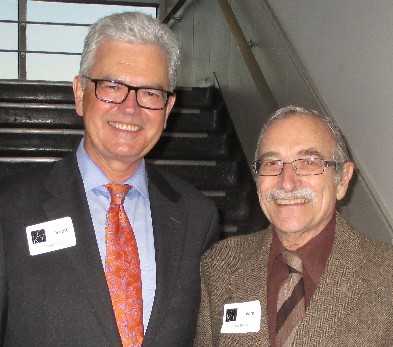
Scott Smith at the KCTAA ceremony honoring him as the 2017 Alumni of the Year, with Vern who received the award in 2006. Scott, who retired as President and CEO HNTB Infrastructure in 2013, is chair of the Civic Council and cochair of KC Rising.
Kansas City Mayor Sly James, the 2018 Alumni of the Year, is congratulated by Vern Barnet (2006) and Jody Ladd Craig (2013) at a luncheon in his honor at the Polsinelli law firm offices on the Plaza 2018 May 22.
Vern congratulates the 2019 Alumna of the Year, Carol Halquist at a celeebration in her honor 2019 May 3. At Hallmark Cards, Carol led business units and most recently, the Hallmark Corporate Foundation. She was appointed by Governor Parsons to the Missouri State Board of Education in June, 2018. Her passions include education, diversity, and women’s leadership. She is the founder of PrincipalsConnect.
http://archive.uuworld.org/2003/02/living.htmlUU World March/April 2003
living the faith
Kansas City UU minister builds interfaith bridges
by Donald E. SkinnerIt is 6 a.m. on the last day of the year, and 250 people of different faiths have gathered at a Buddhist center in Kansas City, Missouri, for the seventeenth annual World Peace Meditation. They have come to witness and participate in Native American prayers, Tibetan Buddhist chants and meditations, Sufi dancing, and a Muslim call to prayer. And, of course, to hear the Rev. Vern Barnet speak about "The Path of Peace in World Religions."
Rev. Barnet has been a Unitarian Universalist minister since 1970. In 1984 he left his last parish, in a Kansas City suburb, to take up what had become his passion — the study of world religions and the promotion of interfaith understanding. He founded the Center for Religious Experience and Study in 1982 (www.cres.org) and since then has gone on to help create or to inspire a broad array of multi-faith programs, resources, and organizations that have helped make Kansas City a national model.
When CBS went looking last summer for a city actively involved in multi-faith work, it selected Kansas City in large part because of Barnet's work — and because after 9/11 Kansas City experienced little of the aggression against Muslims that other cities reported. A film crew spent a week in Kansas City filming what would become a half-hour documentary, "Open Hearts, Open Minds," which was shown in October 2002.
The intro to the film went as follows: "A growing number of people in this heartland city are trying to send a message to the rest of America — Let's celebrate our diversity, let's get to know people of different religions and different backgrounds, respect them, maybe even love them. It's a simple message, and an old one, but since 9/11, the idea of brotherhood has gained new urgency."
CBS was initially attracted by a program that one of Barnet's groups launched last year. It printed thousands of thirty-two page passport-size booklets and distributed them to congregations to hand out. Holders of these "interfaith passports" are encouraged to visit other religious groups and in the process collect a stamp, sticker, or signature just as they would in crossing international borders. The program, and other initiatives that Barnet helped create, are helping Kansas City-area residents appreciate each other's religious diversity in several ways:
* Since 1994 Barnet has written weekly "Faiths and Beliefs" column in the Kansas City Star about the value of diversity. The column appears to have changed people's attitudes. "In the beginning," he says, "I'd get calls and letters about how I was sending people to hell and why was I diverting people from the one true religion? But the responses I get now are more focused on trying to understand something I've written. That's one way I know we're making a difference here." * MOSAIC, a newly formed group that Barnet helped organize, is, in addition to developing the passport project, collecting "life stories" of religious involvement and plans to dramatize them this year as a way of expanding appreciation of various faiths. It also sponsors a book club. One of the first titles discussed was Why Religion Matters, by Huston Smith. The Rev. Kathy Riegelman, a Unitarian Universalist community minister, is helping with that work.
* Hospitals and schools increasingly call Barnet for interfaith resources. Prayers at his Rotary club no longer end "in Jesus' name."
Barnet's days are a round of speaking engagements, organizational meetings, teaching, and writing. His appointments for a recent two-week period included speaking to students at Unity School of Religious Studies on "The Various Forms of Prayer," at a Roman Catholic church on "How Other Faiths Respond to the Scripture for the Day," and on "Religious Stereotypes" at a PeaceJam youth workshop at a Roman Catholic university. He also gave "A Brief History of the Christian Denominations" to an interdenominational marriage group at a Roman Catholic church, spoke on "The Heart of Every Faith" to a Baptist men's group, and discussed interfaith topics on a local National Public Radio station talk show.
Barnet had always intended to be a parish minister. And he was for fourteen years. But he noticed that whenever he talked about world religions "there was great resonance in my congregations. I got a very noticeable response." That encouraged him to learn more about world religions and to explore his own community. As he became aware of the broad array of religious groups in Kansas City he decided to take up interfaith work. "I saw this as a mission field," he says. "And it's every bit as demanding as parish work."
He lives simply, or as he says, "low to the ground." He receives no salary for his interfaith work. Last year he earned about $5,000 from teaching at local colleges. He supplements that income with early withdrawals from his pension. Friends help with living expenses, including donating clothing and an occasional automobile. "It's a quasi-monastic model," he says. "I have learned what it is like to live under the poverty level. I am very aware of economic injustice." Barnet is often called on to give inclusive prayers at public events and he has developed a guide for that purpose. He has also developed Earth Day resources that explain the ways in which various faiths regard the Earth. Both are available on the CRES Web site.
One of the first things Barnet did when he began his interfaith work was to help organize a comprehensive metro interfaith council, giving not only Christians, Jews, and Muslims a way to talk together, but also Baha'is, Sufis, Wiccans, Zoroastrians, Native Americans, and others. A multifaith speaker's bureau has also been created, and it has been much in demand since 9/11. An annual interfaith dinner is held on the Sunday before Thanksgiving, placing Thanksgiving in a worldwide religious context and celebrating the many ways that various religions express gratitude. More than 150 were in attendance at last November's dinner.
The interfaith council was instrumental in organizing multi-faith memorial services after September 11, 2001, and its one-year anniversary, and also organized Kansas City's first interfaith conference, "The Gifts of Pluralism," in October 2001. More than 250 people from fifteen faith groups attended.
One of Barnet's close associates in interfaith work is Kansas City Mayor Pro Tem Alvin Brooks. "Vern has taken interfaith work to a new level," says Brooks. "He reaches out not only to the major faiths, but to others. He helps keep them all connected, and he provides a great service for the metro area."
Barnet is heartened by the growing interest that he sees in learning about other religions. "People are hungry for knowledge about other peoples' faiths," he says. "And they end up deepening their own faith when they have encounters with other faiths. This is what has to happen if the human race is going to survive."
SPIRITUAL VIEWPOINT IN BRIEF Many people have asked about my own spiritual perspective.
In 1998, I wrote a column explaining my concerns about responding,
and a second column placing my hesitation aside and setting forth my view.
Both columns follow:1998 July 22 This column has now appeared more than 200 times. You, dear readers, have shaped it in ways I did not anticipate.
Judging by your calls and the comments I hear as I work around the community, the vast majority of you are Christians interested in understanding your faith and the faiths of others more deeply.
Since 1994 many of you have asked, "What do you, Vern Barnet, believe?" I have hesitated to respond for four reasons:
1. The purpose of this column is not to further my own views but to explore spiritual issues as they appear on the many paths of faith.
2. A good teacher respects the independence of students' views and does not want his or her own opinions to short-circuit the maturation process. Similarly, I'd prefer to model such respect rather than suggest that I have answers that will work for others. As exposure to many ideas in the classroom helps us develop our own, so encounter with the diversity of traditions can stimulate the deepening of our own faith.
3. I seldom agree with myself two days in a row. Well, perhaps that's a bit exaggerated, but the Truth is so large I see only tiny parts, and every day brings a fresh evaluation.
4. Words may be fine, but the real test is how they are lived. Since we learn more by example than by catechism, my own failures become painful evident when I compare what I say with what I do. It is embarrassing.
Nevertheless, next Wednesday I will honor the requests. You, dear readers, have a right to such disclosure.
I know I'm bound to disappoint. But I hope my failure will move you to compose a statement of your own faith and share it with others.1998 July 29 Since this column began in 1994, I've often been asked to disclose my own beliefs. Today I respond. While I personally use terms like "sin" and "salvation," here I search for fresh ways to express such concerns.
I believe that when we encounter the Holy, we naturally feel awe; that awe matures into gratitude; and that gratitude is complete only in service to others.
I believe that we are born to love unconditionally, but rewards and punishments place conditions on the Holy and distort us, dividing us within ourselves, from each other and from the world of nature.
I believe such conditioning puts us in a secular trance, deepened by perverted desires for pleasure, status, power and wealth; and that as this fragmented trance obscures the Holy, we are numbed to the suffering of others, to our own inborn natures and to the environment.
I believe that religions, through story, ritual and compassion, can restore us to the embrace of the Infinite, but that often religions have justified the trance with fear, greed and violence.
I believe we may be emerging from this trance as the process of spiritual evolution unfolds in atom, cell, person and society; and that the universe, making many mistakes, may yet come to behold itself though us.
I believe this process includes today's concourse of the world's religions and offers their mutual purification; that this free nation, where most of us are children of immigrants, is the best place for authenticity; and that honoring differences can extinguish the selfish, addictive trance, awaken us to the Holy and call us to service together.
I believe there's a lot of work and play and loving to do.
Religion does not begin with words. Faith does not originate in a box of beliefs. Faith arises from experiences of the sacred, of transcendence, of a sense of the holy. Such experiences say “Life is worth living” and are available to all people, whether they think themselves religious or not. Words, stories, rituals, beliefs, communities and religions arise from sharing such precious experiences. But when beliefs become detached from these experiences, you get fundamentalism. Such literalism, whether "religious" or atheistic, is the very opposite of the experience of the sacred.
- It may be a solitary walk through the woods,
- or holding an infant, or gazing at the stars,
- or hearing music performed so well you are astonished,
- or seeing an athlete achieve an unparalleled feat,
- or giving aid to someone in need,
- or a conversation in which you understood your friend as never before, or your friend understood you,
- or communing with a Higher Power
- or joining as a beloved religious community in a ritual of faith, heritage and commitment.
--adapted from The Kansas City Star, 2010 August 12Important Terms: sacred, analogical, isomorphic, homologize, recursive, congruence, pattern, map, metaphor, myth, valence, assimiate, valorize, syncretism, epiphany, kratophany, solarization.
I belong to a strange ancient Middle-Eastern cult of a dying and resurrected savior-god, a cult that has morphed over 2,000 years in many ways into many forms, influenced by other cultures and subsequent history into what is often now known as Christianity. These ways are often harmful and even dangerous, but in some inflections they are wholesome and life-giving, enhancing paths of learning, justice, and peace. I value the stories of this cult not as scientific or historical facts, but rather as myths -- paradigms for how to approach the mysteries of existence with gratitude, compassion, charity, and service as one moves through a world with beauty mixed with horror, love along side disappointment and destruction. Such a myth is a present reality.
I wish that others cherish their faiths as much as I cherish mine, and that their commitments to their faiths are strong and deep and open to appreciating fully the commitments of others as we do our bests to live with one another fruitfully, celebrating and sharing the mystery and miracle of life.
My Christian faith is profoundly deepened by other traditions. For example, with the mere Enlightenment categories of thought and sensibility available to me as an English speaker in the 21st Century, I could not penetrate what reality the 4th Century Greek theologians could possibly have been pointing to in writing the Trinitarian Nicene Creed without accessing the Buddhist insight of pratityasamutpada. But I honor others living wholesome lives who say that they take the Creed "literally." I simply am not smart enough to tell others how they should experience, much less approach or understand or talk about, the most sacred mysteries intimated to any of us.
My specific tradition is Episcopalian, an imperfect but open and growing heritage within a strand of Christianity with recently recovered virtues (two examples: women priests, same-sex marriage), with a liturgical form of worship -- for me best suited to the enhancements of beauty in place, sight, sound, motion, smell, taste, touch, text, and such -- as the best way to render thanks in ceremony for the gift of life and to model the highest intentions on how to live forward, given my cultural background. The manner by which the bread and wine are shared -- whether the table/altar is open to all or confined to the select -- is a metaphor for how we participate in sharing God's grace. (I recognize that the idea of drinking blood and eating flesh may be abhorrent to some Jews and Muslims for whom blood is forbidden; and religious and secular vegetarians may understandably be troubled; in fact the idea of eating human flesh and drinking blood is cannibalistic.)
The Episcopalian- Anglican tradition itself is expressed in many ways -- I tend toward the liturgically conservative, "high church." When one prepares for a distinguished guest, one gets out one's good china, so to speak. Since God is the audience of worship, it is fitting for us to offer our best to recognize God's glory. Gorgeous windows, music, words, gestures, vestments, and such indicate our desire to offer the best in ourselves to God. I thrill not only at the Mass itself but also by knowing that those with whom I share the Eucharist understand it in so many different ways; yet we are mystically united with Christ as his Body, a union of "races," economic and social conditions, sexual expressions, ages, physical abilities, and so forth at Grace and Holy Trinity Cathedral in downtown Kansas City, MO. So few places bring such diversity together.
My dissatisfaction with the present transitional situation at the Cathedral keenly reminds me how even the Church at its best is a human as well as a transcendent institution, an unending opportunity for formation. Thus I remain in faithful worship attendance and increased congregational involvement.
2020
While I continue to worship faithfully, even remotely during the pandemic, my dissastisfaction continues. My involvement is now greatly limited.
My dissatisfaction is deepened by the unanimous adoption of a mission statement for the Cathedral:"As the Episcopal Cathedral Church in the heart of Kansas City, we seek and serve Christ in all people, loving our neighbors as ourselves while striving for justice, peace, and respect for every human being. Our worship, prayer, and formation support the restorative strength of our community, reconciling all people to God and one another through Christ." Except for the identifying initial phrase, almost any church could adopt such a statement. The distinctive heritage and the future possibilities of the Cathedral are unmentioned. I might as well belong to any church. The beauty of our sacred space, the quality of our worshipful music, the diversity of the congregation are ignored as unimportant features of who we are as a manifestation of our mission.
The mission statement is not accommpanied by a statement of vision out of which a mission statement should grow, and there is no enumeration of values shared by the community.
And the mission statement was produced, to the best of my knowledge, without any significant comment or participation from the congregation at large. That in itself suggests a top-down governance where some people are more important members of the Body of Christ than others, not like the hand and eye of St. Paul's First Letter to the Corinthians. Very disturbing.
A Postmodern Religious Catalog -- unfinished
I am a Christian, whose holy Trinity
explains all things beyond utterance.
I also follow Krishna, eternal, one and the same,
and utterly different, both genuine, both real.
And Lord Buddha within is my guide
and my empty full life, and my admiration for
Muhammad whose one God with many names,
blows fervantly through my being and my becoming.
My way is the way of Confucius, bowing south,
in order and rite,
and that way is also the Tao,
time like water flowing into the present with no effort.
Yoruba Orishas many and multiple and connecting,
bring ashe,
and as the ancient Romans I beware
the numina
A WORKING BOOK LIST
a starting place for theology embracing many fields
for people interested in Vern Barnet's perspectives
and folks who want to argue with the benefit of a sufficiently common background
Catherine L. Albanese: America: Religions and Religion
Karen Armstrong: A History of God
Karen Armstrong: Fields of Blood
Ian G Barbour:Religion and Science
Robert N Bellah: Religion in Human Evolution*
Rutger Bregman: Humankind: A Hopeful History
Joseph Campbell: The Hero with a Thousand Faces
Francis H. Cook: Hua-Yen Buddhism: The Jewel Net of IndraWendy Doniger (O'Flaherty): Other People's Myths
David Eagleman: The Brain: The Story of You (companion to PBS series)
Mircea Eliade:Cosmos and History: The Myth of the Eternal Return
Mircea Eliade:A History of Religious Ideas, 3 volumes
Mircea Eliade: The Sacred and the Profane: The Nature of Religion
The Episcopal Church:The Book of Common PrayerPeter Farb: Humankind
Anton Jacobs: Religion and the Critical Mind: A journey for seekers, doubters and the curious
Charles Hamden-Turner: Maps of the Mind
Bud Heckman: InterActive Faith: The Essential Interreligious Communinty-Building Handbook
Douglas Hofstadter: Godel Escher Bach**
Jim Holt: Why Does the World Exist? An Existential Detective Story
Michael Kaplan and Ellen Kaplan: Chances Are . . .: Adventures in Probability
Daniel Kahneman: Thinking, Fast and Slow
Carl Kerenyi: The Religion of the Greeks and Romans
Martin Luther King Jr: "Letter from a Birmingham Jail"
Thomas Kuhn: The Structure of Scientific Revolutions
John C Lilly: Programming and Metaprogramming in the Human Biocomputer:
Theory and Experiments (1967/1972)Louis P Masur: The Sum of Our Dreams
Stephen Prothero: God Is Not One
John Rawls: A Theory of Justice
Roger Schmidt: Exploring Religion
Lynda Sexson: Ordinarily Sacred
Huston Smith: The World's ReligionsPierre Teilhard de Chardin: The Phenomenon of Man
Lewis Thomas: The Lives of a Cell
Al Truesdale: If God is God, Then Why? -- Letters from Oklahoma CityHenry Nelson Wieman: Man's Ultimate Commitment
Ludwig Wittgenstein: Philosophical Investigations
Theodore Zeldin: An Intimate History of Humanity
*BELLAH: Chapters 1,2 and 10 are most important. The needlessly repetitive book should have been edited more carefully and condensed to half its size. But the ideas about the sense of the sacred, the "suspension of disbelief," the centrality of play and ritual, the four stages of representation (1. unitive, 2. enactive [mimetic], 3. symbolic [narrative, myth], and 4. theoretic [conceptual]), and his discussion of empathy, ritual fighting, and human development are put together in a way I've not seen others do, even though it is a bit clumsily done. He omits Teilhard and Henry Nelson Wieman in chapter 2, but he is a sociologist, not a theologian -- still not a good excuse. His one citation of a major figure in the study of the history of religions, Mircea Eliade, is based on a secondary source. But these chapters form a good basis for understanding why liturgical worship is so meaningful to so many. He fails to see that his aim to demonstrate the dawn of the "axial age" (800-200 BCE) is frustrated by his own qualifications and hedges. If anything, his book actually documents how fuzzy, if suggestive, the Jaspers speculation is about how rationality and morality entered human history. His insight that morality may arise from play is worthy. This brilliant but maddening book would have been more useful if Bellah had also surveyed the wasteland created by the Reformation, with its loss of the very sacramental sense he often praises. For critical commentary by Wendy Doniger, University of Chicago; Luke Timothy Johnson, Emory University; and Jonathan Z. Smith, University of Chicago, see this panel discussion with Bellah: https://vimeo.com/45146240 which includes the suggestive distinction between ethics of appreciation v. ethics of obligation, the question of ethics becoming universal, changing the individual (India) v changing the world (Marx), and the idea that evolutionary selection happens with the relaxed field we call play. Here is the book review Bellah discounts: The Origins of Religion, Beginning With the Big Bang By ALAN WOLFE, SEPT. 30, 2011, NYTimes
#GEB
**1998 01 07
THE STAR'S HEADLINE:
Pulitzer winner’s tome is a favorite“Your favorite book?” a reader asks.
In 1979 a book appeared which expressed a religious vision using examples from mathematics, art, music, psychology, biology, physics and other fields so amazingly that I placed it with my collection of world scriptures. It remains there today.
Written by artificial intelligence researcher Douglas R. Hofstadter, the book, Godel, Escher, Bach, won a Pulitzer Prize. It has been called the “best non-fiction book of the 20th Century.” It received enthusiastic reviews. No theologian of any age — not Aquinas, not Tillich, not Samkara — has written more ingeniously about Reality and the mystery of consciousness.
Its 800 pages are difficult but fun.
Even if you don't do math or Zen koans, you can follow the book's development because before each chapter is a story which illustrates the chapter's theme. These stories are themselves written as pieces of contrapuntal music. “Crab Canon,” for example, appears about the same whether you begin at the first or the last sentence.
One theme of the book is recursion, which can be described as a procedure which contains a smaller version of itself, like a story within a story. This theme prepares the reader to see how DNA, for example, is information which copies itself through generations — DNA as both “software” and “hardware.”
In this light, the book itself becomes a recursive revelation, a self-extracting document which the universe has brought forth. This suggests that the universe, too, is recursive. This book illustrates how can we decode its sacred meaning from every and any situation.
I've been through the book a dozen times, often with a study partner, once with three others. When I met H.for lunch three years after I read the book for the first time, he mentioned meeting a woman he found intriguing. As I later learned, he married her and, after two kids, lost her in a sudden death he describes in a much later book, I am a Strange Loop, which is much easier to read and far more personal about half-way through, than GEB, But it contains the key idea about consciousness. If you are intimidated by GEB, among his many books. I am a Strange Loop is the one to read.
The GEB PDF "cover" is not the original cover 1979 and the page numbers differ. This would be a problem if you use the Contents or Index which gives the numbers from the original printing. Thus the Index first item AABB directs to page 130, but in the PDF AABB actually appears on page 138. Some of the fonts seem to differ as well, though I don't think this will cause most readers too much trouble, but I mention this because Hofstadter specifically discusses using different fonts for different purposes.
One example of the many instructive games he plays: Note that the first word of the book proper (page 11 in the PDF) is Author:
You have to go to the end of the book proper to see that the Author is a character in the book responding to a question in the final dialogue, making the book loop into itself. As to who the real Author is, well, I'm ready to have a theological debate about that!
I'm glad to add the PDF to my other copies of the book because, among other virtues, the text is comprehensibly searchable in a way the Index is not.
Three years after I first read the book, I had a chance to hear Hofstadter lecture. I remember it, or at least the point he made and how he made it, better than any other lecture I ever heard.
My repeated readings of the book convince me it is a Hwa Yen Buddhist sutra in disguise, through Hofstadter told me in 1983 at lunch he knew nothing about Hwa Yen Buddhism (a philosophical foundation of Zen), and his 20th anniversary Preface to the book minimizes the importance of Zen in his book.
P u b l i c i t y p h o t o s f o r d o w n l o a d i n g
The Kansas City Star photo
BELOW: Click on marked photos for High-Resolution image. Email vern@cres.org for hi-res sketch by Michael McQuary.
#Dada to page index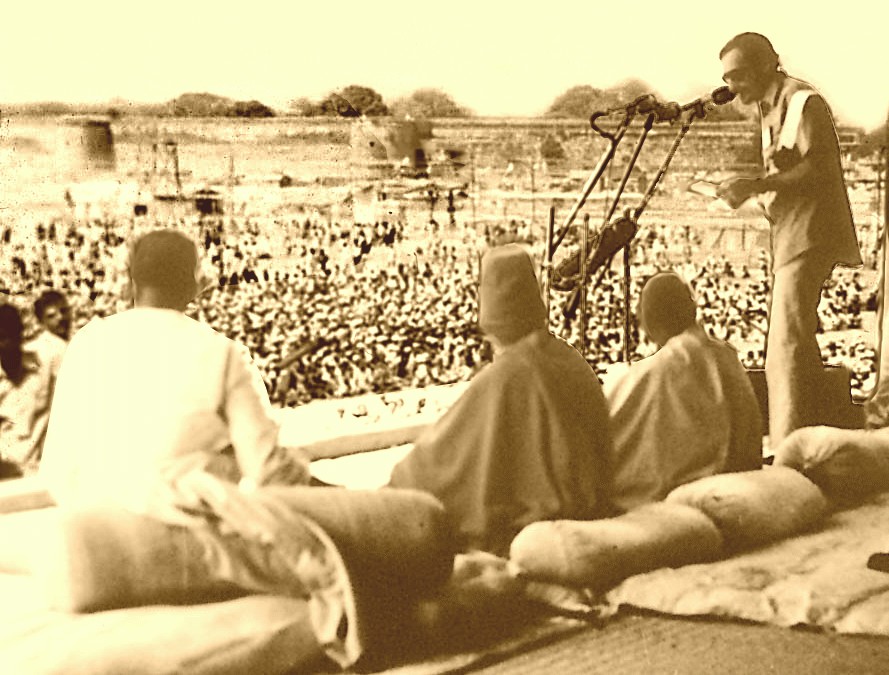
Dr Barnet addresses 500,000 on the banks of the sacred Ganges in Prayag in 1986
at the request of Pandurang Shastri Athavale.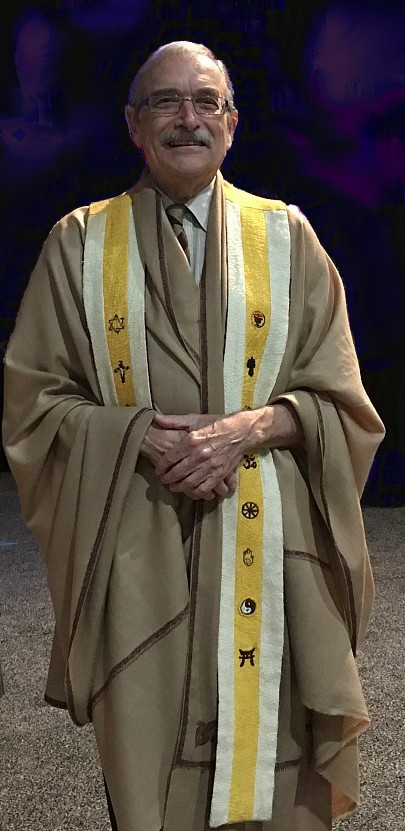
At a retirement ceremony.
In study with "COVID beard" on Zoom.
Harvard University's Pluralism Project Kansas City Leadership Profile (Image from pluralism.org)

|
to be organized by topic AWE and GRATITUDE
and SERVICE
AWE and GRATITUDE and SERVICE * From wonder to wonder existence opens. —Lao-Tzu * Where there is no sense of awe, there will be disaster. —Tao Te Ching * Awe is the salve that will heal our eyes. —Rumi * I’m astounded by people who want to “know” the universe when it’s hard enough to find your way around Chinatown. —Woody Allen * Infinite gratitude toward all things past;
* Rejoice in the Lord always: and again I say, Rejoice.
INTERBEING * All things are interdependent. -- Meister Eckhart * Things derive their being and nature by mutual dependence and are nothing in themselves. —Nagarjuna * To see a World in a Grain of Sand
* Flower in the crannied wall,
* When you understand one thing though and through, you understand everything. —Shunryu Suzuki * The Universe is an interconnected whole in which no part is any more fundamental than any other, so that the properties of one part are determined by those of all the other. —Fritjof Capra * When we try to pick out anything by itself, we find it hitched to everything else in the universe. —John Muir * You can never do merely one thing. —Garrett Hardin * The community stagnates without the impulse of the individual. The impulse dies away without the sympathy of the community. —William James, from an 1878 critique of Herbert Spencer * We are caught in an inescapable network of mutuality, tied in a single garment of destiny. Whatever affects one directly, affects all indirectly. —Martin Luther King Jr. * You are a drop:
*To preserve a drop of water, throw it into the ocean. —The Buddha * We drink from wells we did not dig; we are warmed by fires we did not kindle, we enjoy fruit from trees we did not plant, we have the joy of cities we did not build. —paraphrasing Deut. 6.11 * I am a part of the whole, and I cannot find God apart from the rest of humanity. —Gandhi * The whole of nature is a sacrament pointing to a reality far beyond itself. —Henri Nouwen:(Seeds of Hope, 1989, p. 100) * Jesus said, “When the Son of Man arrives blazing
in beauty, and all the angels with him, then he will sit on the throne
of his glory. All the nations will be gathered before him, and he will
separate people one from another as a shepherd separates the sheep from
the goats, and he will put the sheep at his right hand and the goats at
the left.
* It is interesting to
contemplate an entangled bank, clothed with many plants of many kinds,
with birds singing on the bushes, with various insects flitting about,
and with worms crawling through the damp earth, and to reflect that
these elaborately constructed forms, so different from each other, and
dependent on each other in so complex a manner, have all been produced
by laws acting around us. —Charles Darwin, Origin of Species, conclusion THE VOID [GOD] and ENLIGHTENMENT 1. Zen “pushes contradictions to their ultimate limit where one has to choose between madness and innocence.” —Thomas Merton 2. If you cannot find the truth right where you are, where else do you expect to find it? —Dogen 3. The only Zen you find on the tops of mountains is the Zen you bring up there. —Robert Pirsig 4. Zen is the unsymbolization of the world. —R H Blyth 5. Everything the same; everything distinct. —Zen proverb 888. God is a being beyond being and nothingness beyond being, God is nothing. No thing. God is nothingness. --Meister Eckhart 16. When an ordinary man attains knowledge, he is a sage; when a sage attains understanding, he is an ordinary man. —Zen saying 21. The holiest of holies is empty. —Sam Keen 22. The highest purpose is to have no purpose at all. —John Cage 31. I laugh like a flower, not just mouth laughter. / From non-being I burst forth with gaiety and mirth. / But love taught me another way of laughter. / The neophyte laughs according to profit and gain. / Like a shell, I laugh when broken. — Jalal-uddin Rumi 39. God reveals himself by veiling himself and veils himself by revealing himself. —Suhrawardi 40. Nothingness is being, and being is nothingness. —Azriel of Gerona 41. Form is void, and the Void is form. —Prajna Paramita Hridaya Sutra 44 . . . [V]oidness does not mean nothingness, but rather that all things lack intrinsic reality, intrinsic objectivity, intrinsic identity or intrinsic referentiality. Lacking such static essence or substance does not make them not exist — it makes them thoroughly relative. —Robert F. Thurman “How could God be anything less than everything and still be God?” —William Least Heat-Moon, Celestial Mechanics, 2017, p.96. We shall see that when the left hemisphere was less cultivated than it is today, what we call "God" was neither aa "being." God was, rather, Reality itself. —Karen Armstrong, The Lost Art of Scripture, p9. "spirit" nor God is being-itself. —Paul Tillich, Systemmatic
Theology, SPEAKING TRUTH 6. A painting of a rice cake does not satisfy hunger. —Ancient saying 7. The map is not the territory. —Alfred Korzbyski 19. The world is one, namely many. —Kitaro Nishida 15. How can you think and hit at the same time? —Yogi Berra 23. Don’t believe anything. —Buckminster Fuller 28. One never knows, does one? —Fats Waller 24. No one’s mouth is big enough to utter the whole thing. —Alan Watts 25. There are people doing everything, and I just don’t think that anything’s It. —Jerry Garcia 88. It is as meaningless to ask whether one believes or disbelieves in Aphrodite or Ares as to ask whether one believes in a character in a novel; one can only say that one finds them true or untrue to life. To believe in Aphrodite and Ares merely means that one believes that the poetic myths about them do justice to the forces of sex and aggression as human beings experience them in nature and in their own lives. —W H Auden 20. The final belief is to believe in a fiction, which you know to be a fiction, there being nothing else. The exquisite truth is to know that it is a fiction, and that you believe it willingly. —Wallace Stevens: Opus Posthumous: Poems, Plays, Prose, p 163. 34. Any universe simple enough to be understood is too simple to produce a mind capable of understanding it. —John D Barrow 36. There are no whole truths; all truths are half-truths. It is trying to treat them as whole truths that plays the devil. —Alfred North Whitehead. Language disguises thought. —Ludwig Wittgenstein, Tractatus Logico-Philosophicus We can know more than we can tell. —Michael Polanyi, The Tacit Dimension If the kind of controversy which so often springs up between modernism and traditionalism in religion were applied to more commonplace affairs of life, we might see some strange results. . . . [Let us take as an example] a passage in an obituary notice which mentions that the deceased had loved to watch the sunsets from his peaceful country home. A. writes deploring that in this progressive age few of the younger generation ever notice a sunset; perhaps this is due to the pernicious influence of the teaching of Copernicus who maintains that the sun is really stationary. This arouses B. to reply that nowadays every reasonable person accepts Copernicus's doctrine. C. is positive that he has many times seen the sun set, and Copernicus must be wrong. D. calls for a restatement of belief, so that we may know just how much modern science has left of the sunset, and appreciate the remnant without disloyalty to truth. E., in a misguided effort for peace, points out that on the most modern scientific theory there is no absolute distinction between the heavens revolving around the earth and the earth revolving under the heavens; both parties are (relatively) right. F. regards this as a most dangerous sophistry, which insinuates that there is no essential difference between truth and untruth. G. thinks that we ought now to admit frankly that the revolution of the heavens is a myth; nevertheless such myths still have a practical teaching for us at the present day. H. produces an obscure passage in the Almagest which he interprets as showing that the philosophy of the ancients was not really opposed to the Copernican view. . . . It is forgotten that what the deceased man looked out for each evening was an experience and not a creed. -- Sir Arthur Eddington, Science and the Unseen World, p 84. 211. What I have now discussed, namely confusion
surrounding the uses of the word “belief,” is connected with another misunderstanding,
namely, that Christianity is a set of doctrines, of propositions, a theory,
an explanation. And what can one do with those? Prove them. And who will
show you how to do that? Well, Aristotle was a prover and Euclid has been
teaching us for 2,000 years.
"RELIGION" Men make their religion a historical religion. They see God in Judea and in Egypt, in Moses and in Jesus, but not around them. We want a living religion. As the faith was alive in the hearts of Abraham and Paul, so I would have it in mine. I want a religion not recorded in a book, but flowing from all things. When we have broken our God of tradition and ceased from our God of rhetoric, then may God fire the heart with his presence. —R W Emerson 26. True religion is a movement, not a position; a process, not a result; a growing tradition, not a fixed revelation. —S Radhakrishnan Those who say religion has nothing to do with politics do not know what religion means. -Gandhi “So, while those who were called Papists ate God but not bread, the Lutherans ate both bread and God. Soon after there came the Calvinists who ate bread and did not eat God.” 102 —Essai sur l’histoire, and is quoted by A. J. Ayer in his Voltaire (N.Y.: Random House, 1986). Only by remaining in one's confession, and by deepening and broadening it that one can work towards universalism or super-confessionalism. —Nicholas Berdyaev, Freedom and the Spirit, 1935 We cannot ultimately specify the grounds (either metaphysical or logical or empirical) upon which we hold that our knowledge is true. Being committed to such grounds, dwelling in them, we are projecting ourselves to what we believe to be true from or through these grounds. We cannot therefore see what they are. We cannot look at them because we are looking with them. —Michael Polanyi, Meaning [A] religion exists for us only if, like a piece of poetry, it carries us away. It is not in any sense a "hypothesis." —Michael Polanyi ADVICE and INSIGHT [W]e have lost the yearning for God which comes when we are faced with the sufferings of people. --Jean Vanier, Followers of Jesus, 2976, p7. Compassion means justice. . . . The person who understands what I have to say about justice understands everything I have to say. -- Meister Eckhart 8. In walking, just walk. In sitting, just sit. Above all, don't wobble. —Yun-men 12. One day Chao-chou fell down in the snow, and called out, “Help me up!” A monk came and lay down beside him. Chao-chou got up and went away. —Zen story 27. Teach us to care, and not to care. —T S Eliot 32. One day a man approached Ikkyu and asked: “Master, will you please write for me some maxims of the highest wisdom?” Ikkyu took his brush and wrote “Attention.” “Is that all?” asked the man. Ikkyu then wrote: “Attention. Attention.” “Well,” said the man, “I really don’t see much depth in what you have written.” Then Ikkyu wrote the same word three times: “Attention. Attention. Attention.” Half-angered, the man demanded, “What does the word ‘Attention’ mean, anyhow?” Ikkyu gently responded, “Attention means attention.” —Zen story 37. Eventually, all things merge into one, and a river runs through it. The river was cut by the world's great flood and runs over rocks from the basement of time. On some of the rocks are timeless raindrops. Under the rocks are the words, and some of the words are theirs. I am haunted by waters. —Norman Maclean 38. It’s hard to know when to respond to the seductiveness of the world and when to respond to its challenge. If the world were merely seductive, that would be easy. If it were merely challenging, that would be no problem. But I rise in the morning torn between the desire to improve (or save) the world and a desire to enjoy (or savor) the world. This makes it hard to plan the day. —E. B. White, quoted in The New York Times 1969 July 11, page 43. 43. Nothing that is worth doing can be achieved in a lifetime; therefore, we must be saved by hope. Nothing which is true or beautiful or good makes complete sense in any immediate context of history; therefore we must be saved by faith. Nothing we do, however virtuous, can be accomplished alone; therefore we are saved by love. No virtuous act is quite as virtuous from the standpoint of our friend or foe as it is from our standpoint. Therefore we must be saved by the final form of love which is forgiveness. —Reinhold Niebuhr, The Irony of American History -. The slightest intention to pursue Buddhahood is cause for shame. --Tung-shan Liang-chieh 46a.To be hopeful in bad times is not ... foolishly romantic. It is based on the fact that human history is a history not only of cruelty, but also of compassion, sacrifice, courage, kindness. What we choose to emphasize in this complex history will determine our lives. If we see only the worst, it destroys our capacity to do something. If we remember those times and places — and there are so many — where people have behaved magnificently, this gives us the energy to act, and at least the possibility of sending this spinning top of a world in a different direction. And if we do act, in however small a way, we don’t have to wait for some grand utopian future. The future is an infinite succession of presents, and to live now as we think human beings should live, in defiance of all that is bad around us, is itself a marvelous victory. —Howard Zinn 49. The doctrine is compassion.
50. Follow, poet, follow right
With the farming of a verse
In the deserts of the heart
48a. Our revels now are ended. These our actors,
48b. All the world's a stage,
48c. To-morrow, and to-morrow, and to-morrow,
Vanity of vanities, says the Preacher, vanity of vanities! All is vanity. —Ecclesiastes, 1:2; English Standard Version Bible translation In my opinion, nothing is worthwhile; everything is futile. —Ecclesiastes, 1:2; Message Bible translation Emptiness and futility, said Ecclesiastes; emptiness and futility, yea, everything is empty and futile. —Ecclesiastes, 1:2; Wycliffe Bible translation Work out your salvation with fear and trembling,
for it is God who works in you to will and to act in order to fulfill his
good purpose. —Philippians 2:12-13
UNSORTED
For I was hungry and you gave me food, I was thirsty and you gave me drink, I was a stranger and you welcomed me, I was naked and you clothed me, I was sick and you visited me, I was in prison and you came to me. -- Matthew 25:35-36 When we say God is eternal, we mean He is eternally young. -- Meister Eckhart X. A psychotic is a guy who's just found out what's going on. —William S Burroughs 9. To study Buddhism is to study the self. To study the self is to forget the self. To forget the self is to be enlightened by all things. To be enlightened by all things is to drop off our own body and mind, and to drop off the bodies and minds of others. No trace of enlightenment remains, and this no-trace continues endlessly. —Dogen 11. The most terrifying thing is to accept oneself completely. —Carl Jung 13. The self says, I am; the heart says, I am less; the spirit says, you are nothing. —Theodore Roethke 14. Life is what happens when you're busy making other plans. —John Lennon xx. Our joy comes by another's blood and from wounds we open all our lives. --Robert Farrar Capon in his 1982 Beyond Noon and Three, p78. 00. Rewards and punishment is the lowest form of education. —Chuang-Tzu 000. I am convinced that men hate each other because
they fear each other. They fear each other because they don’t know each
other, and they don’t know each other because they don’t communicate with
each other, and they don’t communicate with each other because they are
separated from each other. -- Dr. Martin Luther King, Jr
35. Music is the wine that fills the cup of silence. —Robert Fripp 42. People like us, who believe in physics, know the distinction between the past, present and future is only a stubbornly persistent illusion. —Albert Einstein 46. If one part suffers, every part suffers with it; if one part is honored, every part rejoices with it. —1 Corinthians 12:25 47. Remove duality and do away with all disputes;
Capitalism is unthinkable as a "sacred" economy. It is the result of the secularization of economic life, and by it the hierarchical subordiation of the material to the spiritual is inverted. —Nicholas Berdyaev, The End of Our Time, 1933 Shall we receive the good at the hand of God, and not receive the bad?" —Job If God is God He is not good,/ If God is good He
is not God . . . . —Archibald MacLeish
VERN IS QUOTED: a. The purpose of a Vital Conversation is not to win an argument, but to win a friend and advance civilization. b. For enlightenment may be the freedom of knowing there is no enlightenment to seek. Enlightenment is knowing there is no Enlightenment. c. Spirituality is what energizes us with significance.
|
|
Please do not expand.
Vern Barnet This might be the most appropriate photo for an obit in the paper, used for years with my KC Star column, Faith and Beliefs.
|
| The Vern Barnet Interfaith Service
Award
This award was initiated by Heartland Chapter of Divine Love in 2010 with the continuing cooperation with the Greater Kansas City Interfaith Council, presented at the annual Interfaith Thanksgiving Dinner, run by CRES for the event's first 25 years. The receipients are |
Some Googling . . . .
gives sites such as these including Vern Barnet:
http://www.allrivers.org/VOD-Vern_Barnet.html
http://www.readthespirit.com/interfaith-peacemakers/vern-barnet/
http://goldenageofgaia.com/2010/04/22/vernet-barnet-prayer-for-mother-earth/
http://www.campus-watch.org/docs/author/Vern+Barnet
http://www.kcfs.org/id/VBEvolPanl.pdf
http://www.meetup.com/skeptics-137/events/59915622/
https://www.mcckc.edu/PDF/commed/mw/MW_50_Forward_Nov-Dec_2014.pdf
http://www.kcinterfaith.org/about-us/our-history
http://redeemerkansascity.org/2011/09/22/announcing-the-katz-drugstore-purchase/
http://www.psduua.org/heritage/bring/updates/ks_shawnee_mission.html
http://www.robertbrumet.com/role-technology-spiritual-evolution/
http://www.uumeadville.org/uutemple.htm
http://www.ucopmensgroup.org/inspiration-past-meetings/confessions-of-a-religion-columnist
http://pressreleases.kcstar.com/release/messages/28797/
http://whatissynchronicitythemovie.com/cast.htm
http://article.wn.com/view/2012/04/03/Vern_Barnet_We_need_to_learn_about_Islam/
http://culturallyspeaking.net/2011/03/18/congressional-hearings/
http://huuweb.org/committees.htm
http://www.catholickey.com/index.php3?gif=news.gif&mode=view&issue=20021220&article_id=2180
http://tonywoodlief.com/category/theology/
http://www.mountosb.org/ministries/faculty
http://billtammeus.typepad.com/my_weblog/2009/10/103409-1.html
http://www.fairnessproject.org/Kansas%20City%20Star.html
http://www.communityofreasonkc.org/page/9/
http://vmehta.conforums3.com/index.cgi?board=Religions&num=1150555879&action=display&start=3007
http://www.rockhurstpress.org/Testimonials.php
http://www.abc-usa.org/2013/04/23/common-ground-a-baptist-muslim-conversation/
http://www.uupuertorico.org/Values/Ecology.htm
http://www.sbnr.org/the-fun-theory-sbnr-daily-1-27-11.html
http://www.htccofkc.org/home-detail.html
http://ncronline.org/news/spirituality/author-look-church-history-crowds-perspective
http://www.pitch.com/kansascity/unholy-roller/Content?oid=2173646
http://www.irckc.org/?350
http://statemigration.com/2d64a2a7471fc9d5.html
http://ceciliaferris.ourwedding.com/view/9697000267350921/34952562
http://www.islamgate.org/?tag=music
http://talkwisdom.blogspot.com/2006/03/brokeback-mountain-christian-response.html
http://paulturner.org/wp-content/uploads/2012/08/canvas3.htm
http://www.kctaa.org/s/647/index.aspx?sid=647&gid=1&pgid=395
http://www.practicalbioethics.org/files/compassion-sabbath/1-CompassionSabbathKitKC.pdf p12
http://www.kansascity.com/living/religion/article2133271.html
http://www.crescentpeace.org/newsletter--resources.html
http://www.cityofinvernessonline.com/heard-on/the-meaning-of-the-word-hero-689.asp
http://archives.religionnews.com/tags/tag/vern+barnet
http://www.humanagenda.com/newsletters.html
http://www.wopular.com/vern-barnet-so-why-are-you-arguing-vern
http://www.biblestudyguide.org/articles/pantheism/pantheism-the-new-world-religion.htm
http://interfaithmeditation.com/wordpress/?page_id=17
http://www.westportpresbyterian.org/our-history/
https://www.bc.edu/content/dam/files/centers/boisi/pdf/s12/thestateofislamicstudiesinamericanuniversities.pdf
http://www.alzheimer.mb.ca/images/1E%20-%20Spirituality%20-%20A%20Foundation%20for%20Strengthening%20Relationships%20in%20Dementia%20Care.pdf
http://vividlife.me/ultimate/14833/kansas-city-home-of-the-2012-shift/
http://www.baptistboard.com/showthread.php?t=59985
http://issuu.com/sunflower_publishing/docs/fcm13-14_web/108
http://archive.constantcontact.com/fs070/1104002974534/archive/1111104162599.html?keepThis=true&TB_iframe=true&height=500&width=675
http://www.examiner.com/article/christianity-and-shawnee-indian-mission-the-kansas-city-area
http://www.examiner.com/article/christianity-and-shawnee-indian-mission-the-kansas-city-area
http://www.jewishworldreview.com/0511/bin_laden_anti_obituary.php3
https://library.wustl.edu/wp-content/uploads/2016/06/als-19990113-miles-from-barnet.jpg
https://www.ncronline.org/news/spirituality/author-look-church-history-crowds-perspective
https://www.htccofkc.org/page/a-perspective-on-kansas-city-hindu-temple.html
https://readthespirit.com/interfaith-peacemakers/vern-barnet/
https://www.amazon.com.mx/Religion-Critical-Mind-Journey-Doubters/dp/0739147749
https://www.uurockford.org/our-history.html
http://www.mosquitonet.com/~prewett/onecitythreefaiths.html
https://www.bc.edu/content/dam/files/centers/boisi/pdf/s12/thestateofislamicstudiesinamericanuniversities.pdf
https://www.uufcm.org/uufcm-enews/april-13th-2016
https://fgulen.com/en/gulen-movement/1336-fgulen-com-english/videos-on-fethullah-gulen
https://art.nelson-atkins.org/objects/16195/rumi
https://hometownreads.com/city/kansas-city
http://www.kccathedral.org/2012/wp-content/uploads/2016-0814-AM-Pentecost13-PrayerA-Combined.pdf
https://www.wikiwand.com/en/Themes_in_Avatar
http://kep.org.sa/?lang=en&paged=11
https://www.umkc.edu/commu/catalog_winter/inner.pdf
https://www.revscottwells.com/2014/06/24/opening-worship-thoughts-from-von-ogden-vogt/
http://www.uularamie.org/wp-content/uploads/2016/02/UULaramie-News-March-2016.pdf
http://journals.sfu.ca/cjbs/index.php/cjbs/article/viewFile/97/94
https://docplayer.net/94036600-D-r-a-f-t-motto-epitomizing-texts-2-chief-seattle-s-letter-3-the-heart-sutra-4-lincoln-s-second-inaugural-address.html
wr notes complete set
https://sites.google.com/site/ucmlifelonglearning/Past
http://allsoulskc.org/wp-content/uploads/JULY-FLAME-2019.pdf
https://paulturner.org/wp-content/uploads/2012/08/Articles.htm
https://www.afsc.org/sites/default/files/documents/KC%20AFSC%20Peace%20and%20Justice%20Alerts%20August%2015%20%2C%202014.pdf
https://practicalbioethics.org/about-us/impact-stories.html
https://wikimili.com/en/Interfaith_Voices
Some Points of Personal
and Intellectual Development
of hundreds of sermons,
speeches, etc, only first or major markers listed (just beginning to make
a list)
(notes toward a proper
draft)
1942 May 25 born Clarkson
Hospital, Omaha, with no name on birth certificate
1951 Dec 24 saw the first
performance of Gian Carlo Menotti's “Amahl and the Night Visitors” on the
first Hallmark Hall of Fame program, presented on Christmas Eve on NBC.
1950s I loved to hear my
grade school violin teacher play, Beethoven's minuet in G.
She once took me to hear
Nathan Milstein, who she thought was a better violinist than Jascha Heifetz.
I was gob-smacked. I also remember her raving about a solo saxophonist
who came to town.
1957? read Tom Paine's
Age
of Reason and Bertrand Russell's "Why I am Not a Christian."
1960 graduated from Omaha
South High School
1960 summer US Naval Reserves,
Active Duty for Training
1960 joined Omaha First Unitarian
Church
1962 Jan 24 and Feb 20 wrote
Bureau of Navel Personnel requesting discharge for moral, philosophical,
and religious reasons
1962 saw the movie "Billy
Budd" and could not speak for a couple hours
1963? studied with Oets Kolk
Bouwsma who had worked with Ludwig Wittgenstein, University of Nebraska
1963 Mar 3 sermon "Science
and Religion"
1964 Apr 26 sermon setting
forth the religious basis for Klinde, "Four Heavens in Search of
Hell"
1965 graduate study
with Chang Chen-Chi, visiting University of Nebraska from Penn State, an
expert in Tibetan and Chinese Buddhism
1965 graduate study with
Michael Durrant, visiting from what is now Cardiff University, a specialist
in the philosophy of religion indebted to Wittgenstein
1966-67 wife taught at Millikin
University, Decatur, IL where we had a Victorian house; divorce followed
1967 studied with Mircea
Eliade and became next-door neighbor (he came to my 1970 wedding)
1970 March 7 about 12:20
pm -- 72% solar eclipse in Chicago -- Brad Carrier and I brought the sun
back 100% with our ritual outside of Rockefeller Chapel
1970 met Huston Smith for
first time, led to numerous exchanges including taking Smith to parents'
graves in 2005
studied with Joseph Campbell
in Santa Barbara
1970 awarded Doctor of Ministry
degree with 500-page dissertation,
1970 May 24 Ordained by the
Lincoln, NE Unitarian Church
1970 June 6 Married Carole
Wilson High
1970-1971 interim minister,
Unitarian Church, Rockford IL
1971 Europe: Italy, Germany,
France, Holland, England
1971- 1975 minister, Independent
Congregation (Unitarian) Church, moved to 278 DeVore Dr, Meadville, PA
16335
1972 July 10 about 2 pm --
about 70% solar eclipse in Meadville, PA. with ritual outside the Unitarian
Church
19?? Mexico, Guatamala, Honduras
Charlie
Kriner
--------
-
`
Institute of Cultural Affairs
turning points and glide paths
Calling All Teens ,
Th Paine B Russell / science
Teilhard de Chardin /science+rlgn
Unitarian Church
Kuhn Stru Sci Revolutns
2nd semCollege librar science+rlgn=myth,ritual
grad work ChenCiChang; Void
Sunya Hwa Yen Budd
UChgo Eliade Ency Rlgn phenomenlogy
of religion :what is sacred
Maundy Thursday eucharist
understood in life-changing way
Dr Diss: Blake : Enlightenment
suspecious
parishes: WR great responses
(qja
travel: Europ Central Scouth
Am MidEast Asia: 500,000
KC: A-Z interfaith work Ja
County 001 1 commisison
Star hire 18 years 947 new
way of acq with community
Natl Cath Reporter, Jewish
Chronicle
theory-practice colleges
and seminaries seminaries as well
relgn and the arts .
Worship / WRlgn / Rlg&Medicne
KUMed, UMKC Med lectureB00
WR: 3 crises what is sacred
GHTC 2001 Mayor Gov Symp
Opera, Ballet, CBS TV
2010 decide to practice 1
rlgn deeply chose Episc
to immerse myself in one
tradition V
fav recent acamedic assigment
create a new course for‘Central
Seminary
ministry in an age of Pluralism
_
Unitve, ritual, mythic, conceptual
merlin donald
Al Brooks racism
Want others to love their
faith as much as I love mine.
chaplaincy teaching
Heart to Heart
By Christine Robinson and Alica
Hawkins
https://books.google.com/books?id=TcW23iXbHYYC&pg=PA113&lpg=PA113&dq=VERN+BARNET&source=bl&ots=PZ52qcIyXR&sig=mEXGqWqS35rSbIQdji37uyKv1oY&hl=en&sa=X&ei=9EgkVcyDPZfWoASS_YHQBw&ved=0CEQQ6AEwBjgy#v=onepage&q=VERN%20BARNET&f=false
The A to Z of Unitarian Universalism
By Mark W. Harris
https://books.google.com/books?id=6XEPjO1-4e0C&pg=PA124&lpg=PA124&dq=VERN+BARNET&source=bl&ots=UX7ojdQTyM&sig=NVjF-mcaGaf4984F_8UkpBEGKsI&hl=en&sa=X&ei=9EgkVcyDPZfWoASS_YHQBw&ved=0CE0Q6AEwCTgy#v=onepage&q=VERN%20BARNET&f=false
KCTAAawards
AlumAwardPhoto
Rarely do I add a book to my list
of essential reads for those who wish to engage me in controversy and others
who want hints about how I see the world. But now I am adding Daniel Kahneman's
Thinking, Fast and Slow. A Nobel laureate in economics, Kuhman is better
described as a decision theorist. The book deals with how to decide questions
affecting personal happiness, and in job, medical, legal, and many other
realms. His book shamed me as I realized how I still am sometimes misled
by statistics and the way an argument is framed. And our current political
climate makes it clear that others may be even more beset with fallacies,
misrepresentations, and conceptual illusions. The 38 chapters require concentration.
You will find critical insights all the way to the last period. But, 37
years after reading Douglas Hofstadter's Godel Escher Bach for the first
time, I still place it at number 1 in explaining reality.