07.08.01.
under construction


Memorial Observances for Vern Barnet

click here for PDF with proper formatting

See below for unformatted, under construction, text and congregational music.


COPYRIGHT 2008, Vern Barnet at CRES, Box 4165, Overland Park, KS 66204.


First Draft (Vern’s not dead yet!) — see www.cres.org/memorial for the latest version. Please see PDF file for proper formatting.

NOTE FROM VERN:
One may not know the hour and the manner of one’s death. For decades I have encouraged others to provide their loved ones with their wishes for their obsequies in some detail. My doing so publicly may serve as a reminder, though perhaps not as a model since my own wishes are shaped by a fairly unusual interfaith career.

Venue: Founders Hall, Grace and Holy Trinity Cathedral with circular seating with cremains and the collection of sacred waters used at Kansas City  interfaith events in its container in the middle of the room on a table.

Presiding: The Rev David E Nelson, DMin, CRES associate minister, who has additional details planned for this event. Other Participants include a   pianist, a string quartet, a Hindu musician, ballet dancers, and American Indian chanters.

Gifts “in Vern’s memory” may be directed to CRES, Box 45414, Kansas City, MO 64171. Your tax-deductible gift will further Vern’s interfaith work.


Prelude                                           pianist: see insert
Beethoven: Piano Sonata 28 in A Major, Op 101, 
First Movement, Allegretto ma non troppo

1. Entering

Prelude                                             pianist: see insert
Beethoven: Piano Sonata 28 in A Major, Op 101, 
First Movement, Allegretto ma non troppo

%
Words of Arrival                        Standing, spoken together
From a world broken, corrupt, and suffering, we enter sacred time, which is to say: the procession of the ages. From a world broken, corrupt, and suffering, we enter sacred space, which is to say: the space embedded in every place. We sojourn on the path of life, which is to say: above the slopes of death.

Invocation                                     Dr Nelson, presiding
Faith is not belief in a particular book or allegiance to a single tradition or obedience to any establishment, but rather faith is the determination to make life worth living. Spirituality is not immersion in obscure or spooky things, or the accumulation of trinkets or charms or private thoughts; spirituality is breathing with a sense of the sacred. 
     Civilization is made out of the lives of people. Culture is the essence of the lifetimes of a thousand generations. Under variable skies, religion is an inheritance, not of theologies, or of sacraments, or psalms, but of human beings.

Hindu Sacred Song: Sarva Dharma         singer: see insert
Gist of the text: Oh preserver of Truth, guardian of Righteousness, and embodiment of Peace, Thou art the personification of Love and grantor of Good Millions of salutations to Thee. / The light of Truth burns spreading its light; Every part (of the body) and every cell sings your Glory. / May every mind be peaceful and every life (exist) as beautiful as the Lotus Millions of salutations to Thee. / May Hindus, Muslims, Sikhs, Christians, Buddhists, Zoroastrians, Jains, and Jews progress in the path of righteous life as brothers. Following your generous path, for you are the Love of our lives. / Millions of salutations to Thee. / You are the ultimate teacher. May there be the showers of infinite happiness. / May the Lamp of Love burn with the fuel of our discipline and devotion. Grant us the boon of  happy and peaceful  lives.  Millions of salutations to Thee.

Meditation                                       reader: see insert
Millions, and millions of millions of years ago, life began.
Changes, and in many changes, life came to us.
We change life, and life changes us.
And death, that final change, reaches into all life,
and all the changes of the past;
to say that in death’s dark passage and loss,
meaning survives, which shines in memory, beats in our hearts, 
and moves in our bones, for they touched us.

Millions, and millions of millions of years from now,
when the earth falls into the sun, and all is forgotten,
the majesty and meaning of those lives, and all of ours, 
will be enscripted with cosmic dust.

Our celebration of the gift of their lives, 
even when death calls afresh, cannot be restrained.
No fact or future will deny us of our holy word:
They lived, they loved, and we give praise.

Hymn Every Night and Every Morn  — Wm Blake/Ralph Vaughn Williams, The Call


2. Joining
% [bell]
Our Company                          Spoken together
We are one with each other, mixed together as we remember one member of our company now dead, passed into the past, whose features are forwarded mainly in ways that cannot be named, in us as we weave our own paths from the encounters. 

Considerations
     Reader 1. — The universe alternates in complex rhythms.  The tides rise and fall. The day turns to night. The seasons progress, each with its own dignity and dangers. The joy of spring brings the threat of floods. The refulgent summer can turn to drought. The gorgeous colors of autumn can easily fade into depression.  The pure beauty of winter can bring isolation and freezing death.  %
     Reader 2. — The single process of nature is both wondrous and defective. The clear, peaceful sky can quickly cloud, giving threat and disaster. The beautiful summer hills and the raging tornado are from the same alternating source. %
      Reader 3. — It is difficult to see the sunshine and the storm as varied aspects of the same atmospheric engine when we ourselves are devastated and bereft, broken and denied, shattered and made waste. %
     Reader 4. — There are no words to form an answer to this alternation. We are finite human beings. We love intensely, but our small vision finds it hard to encompass, and even harder to accept, the larger patterns of the universe.  %
     Reader 5. — Only when we experience the darkness, and come at last to face the terror of the void, are we ready for that larger perspective, to see that the universe’s support for the fragile gift of life is both beautiful and fallible. %
     Reader 6. — Religion searches not for faults but rather  embraces our limitations and conditions, and produces compassion.  %
     Reader 7. — Religion is not in certitude, but in confidence, confidence in healing, in restoring, in renewing, in the face of public and private grief and calamity and severance, as we celebrate that larger perspective which embraces all sorrows, but which also calls us, irrepressibly, to thanksgiving and wonder, to give praise for the gift of their time with us, and the time given to us.  %
     Reader 8. — The flow of the universe is uncertain, but we give thanks for the flow. Death is painful, but we give thanks for life. Even in loss meaning survives.  %
     Reader 9. —  Our celebration of those gone before us, into the dark abyss, cannot be restrained. The human spirit, in loves, in desires, in hopes, in joys, lives on in the cherished memories of friends, in the secret and public meanings of their names.  %
 

Hymn adapted by Vern Barnet from “In Memory of W B Yeats” — W H Auden /
Ralph Vaughn Williams, The Call  [same tune as first hymn]

Follow, poet, follow right To the bottom of the night, 
     With your unconstraining voice Still persuade us to rejoice; 

With the farming of a verse Make a vineyard of the curse, 
     Sing of human unsuccess In a rapture of distress; 

In the deserts of the heart Let the healing fountain start, 
     In the prison of our days Teach us freely how to praise. 


3. Venturing
%
Reading  reader: see insert  —Vern Barnet, The Kansas City Star, 1989 July 29
I believe that when we encounter the Holy, we naturally feel awe; that awe matures into gratitude; and that gratitude is complete only in service to others.
     I believe that we are born to love unconditionally, but rewards and punishments place conditions on the Holy and distort us, dividing us within ourselves, from each other and from the world of nature.
     I believe such conditioning puts us in a secular trance, deepened by perverted desires for pleasure, status, power and wealth; and that as this fragmented trance obscures the Holy, we are numbed to the suffering of others, to our own inborn natures and to the environment.
     I believe that religions, through story, ritual and compassion, can restore us to the embrace of the Infinite, but that often religions have justified the trance with fear, greed and violence.
I believe we may be emerging from this trance as the process of spiritual evolution unfolds in atom, cell, person and society; and that the universe, making many mistakes, may yet come to behold itself though us.

     I believe this process includes today’s concourse of the world’s religions and offers their mutual purification; that this free nation, where most of us are children of immigrants, is the best place for authenticity; and that honoring differences can extinguish the selfish, addictive trance, awaken us to the Holy and call us to service together.

     I believe there’s a lot of work and play and loving to do. 

Interlude Beethoven: Quartert #13 in B-flat, Op 130, 
4th movement, Alla Danza Tedesca, Allegro assai
The members of the Quartet are listed on the insert. 

Dance Excerpt from “Sentinel”        David Berkey, choreographer
Brahms: Violin Concerto in D Major, Op 77, 2nd movement, Adagio (recorded)                                                  The dancers are listed on the insert

CoMingling Water and Ash 

Dr Nelson
With this ladle, we transfer a portion of the Holy Waters of the World, blessed by many previous interfaith occasions, and pour it into this smaller vessel, placed near the container of cremation ashes. With words we now shall hear, members of various faith traditions each add a pinch of ashes to the extract of Holy Waters, later to be poured upon the earth.

American Indian 
O Great Spirit, may the Thunderbeings’ cleansing rains caress our Mother the Earth.  Aho, mitakuye oyasin.

Bahá’í
All men and women are waves of one solvent sea.

Buddhist
The stream is purified as the waters of awareness flow. Metta.

Christian, Orthodox 
With Noah, as the flood receded, the promise of the rainbow was given. Amen.

Christian, Protestant 
The parting of the sea that Moses knew is ours as well when we seek freedom. Amen.

Christian, Roman Catholic 
The baptism of Jesus in the Jordan bespeaks the life ever renewed by faith. Amen.

Jewish 
At this moment and at all times, let us hear the prophet: “Let justice well up like fresh water, and honesty roll in full tide.” Shalom.

Hindu 
From the mountain to the sea, from the sea to the sky, from the sky to the mountain, the pilgrimage of water unites every domain. Shanih.

Muslim 
As water cleanses us before prayer, so may our lives wash one another with kindness. Salaam.

Pagan 
The gurgle of the river stream is Gaia singing. May we join in that song. Blessed be.

Sikh 
As water removes stains, so may Truth wash away our illusions. Sat Nam.

Sufi 
As the bucket dances above the well, so are we ready to be filled by what is beyond our reach.

Unitarian Universalist
Water yields its level and its shape; so now we yield to death’s dispersal. 

Zoroastrian 
As the Wise Lord made rain for parched soil, so may the drops and dust from this life refresh the community soul.

Free-Thinker
We are made of water; we flow as many, yet we are one. 


4. Returning
Hymn Brief our Days,  K L Patton/Bach, Werde Munter, Mein Gemüte
Brief our days, but long for singing, When to sing is made our call,
For a million stars now flinging Light upon this earthly ball.
In a setting of what splendor Are we given chance to render
Tribute for the whirling sky Where we live and where we die.

Planet earth for all us dwelling, Cool in wind and warm in light,
In its praise our song is swelling, Grateful for this day and night.
We, the citizens of heaven, Riding earth as it is driven
Down the spangled course of space, Know the glory of this place.

Antiphon                                                   [Kitaro Nishida, William Blake, Vern Barnet]
Dr Nelson.— The world is one; Its name is also many.
     All.— Now is eternal; here, infinity.
From the gallery of the abyss we return from our exploring.
     We are bound with soil and sun, water and ash made breathing.
We trust the life that gives us being for a time
     And relax in its ultimate motion.
For life is a gift, our estate is sacred, and love endures forever.
     The ease we praise and shake unites us all.

Benediction    [Tao Te Ching]                               Dr Nelson and All
Dr Nelson— As we depart, we leave the slopes of death to live on those slopes.
ALL— We leave this place with thanksgiving and promise. 
Dr Nelson— Behold: Even as we return to a world broken, corrupt, and 
                 suffering, we say: From wonder to wonder existence opens. 
ALL— Behold: From wonder to wonder existence opens. 

Postlude       Beethoven: Quartert #13 in B-flat, Op 130, 6th movement      Finale: Allegro

Those who wish may remain to share memories.

Acknowledgements

Please see the program insert for a list of participants


Committal 


Friends who wish 
may gather in fair weather 
to pour the  extract of mingled water and ash 
onto the ground near “Sheep Piece” 
on the South Lawn of the Nelson-Atkins.


Although innumerable beings have been 
led to Nirvana,  no being has  been led to Nirvana.
—Diamond Sutra 

Before one goes through the gate
one may not be aware there is a gate
One may think there is a gate to go through
and look a long time for it
without finding it
One may find it and
it may not open
If it opens one may be thru it
As one goes thru it
one sees that the gate one went thru
was the self that went thru it
no one went thru a gate
there was no gate to go thru
no one ever found a gate
no one ever realized there was never a gate
—RD Laing, Knots


Water— An Interfaith Symbol

Water, used for its spiritual significance in many faiths, has become a symbol of interfaith cooperation here, drawing on our “City of Fountains” designation. (Kansas City is said to have more fountains than any city in the world except Rome.)
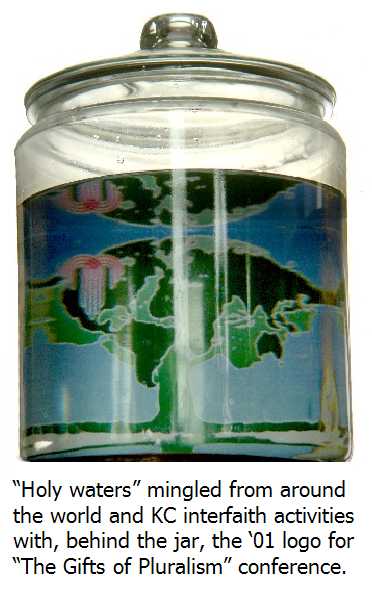
     For years I have been collecting water, from my journeys and from friends as they travel. Into a jar I have poured water drawn from the Rhine, Seine, Tiber, Danube, Nile, Jordan, Thames, Mekong, Amazon, Ganges, St Lawrence, Yangtze, Volga, Colorado, Mississippi, Missouri, Euphrates, Kaw, the Bosporus, the Sea of Japan, and many other rivers, lakes, puddles, and such around the world. This collection has been the basis of the waters described below.

In 2001, at Kansas City’s first interfaith conference, “The Gifts of Pluralism,” water was collected from 14 area fountains — from Independence to Lenexa — and 14 representatives of different faiths poured the waters together to emphasize that our many faiths make one community. These were added to the collection of waters of the world noted above, just as folks from around the world have come to Kansas City and blessed us with their traditions. 
     When the 250 participants unanimously adopted a Concluding Declaration, and came forward to sign it, each person received a vial to dip into the mingled waters to take home to pour on something to grow, as a reminder of the growth we experienced by mingling with one another. This added meaning to the logo for the “Gifts of Pluralism” conference.

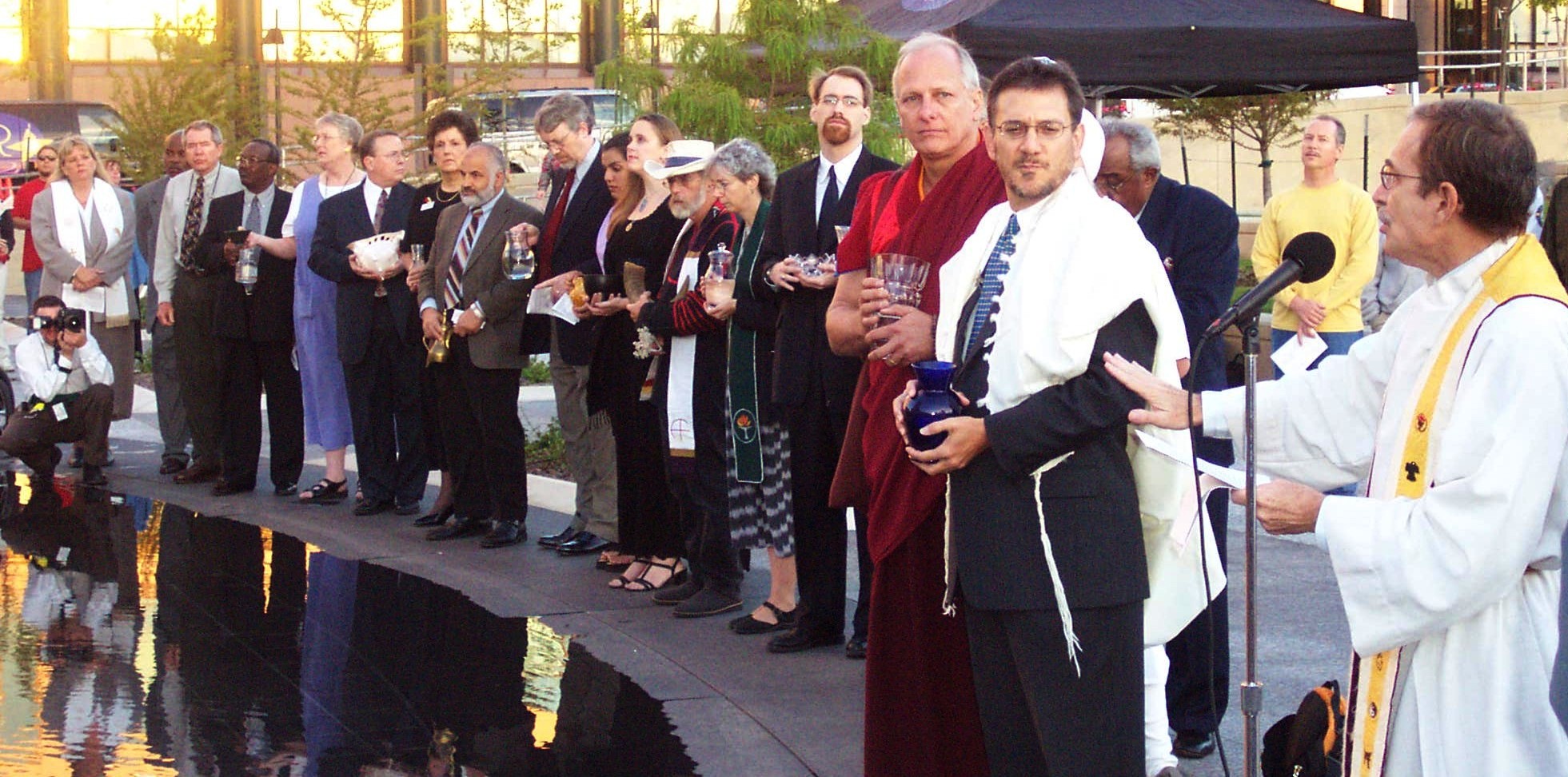
On the morning of September 11, 2002, members of many faiths gathered for an observance on the anniversary of the 9/11 terrorist attacks by pouring waters from their own religious centers into the pool at Ilus Davis Park, between City Hall and the Federal Justice Center, to represent the tears we have offered for those who have suffered because of the violence, and for all who have been injured in any way. CBS-TV showed a portion of the ceremony in a nation-wide broadcast.
     The waters thus joined were taken to Grace and Holy Trinity Cathedral where the city’s central observance was held that evening. There each member accepted a portion of the mingled water to take to each respective religious community.
     It was said, “Peoples of many faiths were killed by the terrorists. Tears are an honorable part of our response to the horrors. In our common grief, we are united. But now it is time to transform the water of tears into waters of purification, renewal and refreshment. Holy waters can extinguish the fires of hatred, wash away our self-righteousness, and well up as healing fountains of the heart.”
     The waters were also taken to sites around the metro area for use in other interfaith services that evening. For example, St Mark’s Catholic Church liturgist Susan Walker, with her interfaith ritual team, used the water to speak the best of America at the Community of Christ Auditorium.
     Water as an interfaith symbol speaks of cleansing, renewal, rebirth, and refreshment. But it also recalls the countless people who found ways to respond to the tragedy, including the emergency workers. (It evokes memories of frontier America: if the barn caught fire, the entire community came out, formed a bucket brigade from the nearest water source, and did their part to put out the fire.)
     The fountain on the rostrum was silent until Independence Mayor Ron Stewart and Raytown Mayor Sue Frank received buckets of water being passed the entire length of the north aisle, hand to hand, by more than 50 uniformed police officers, fire fighters, emergency medical personnel and others. As the fountain filled, the water began speaking, circulating and spilling from an upper basin to the larger lower pool.
     With the physical act of handing off buckets, the brigade volunteers became members of each other, and those who were witnesses gazed deeper into the best of humanity, and found comfort and consolation.
     Something as ordinary as water, transformed by the intentions of those of many faiths in ritual reminder, can speak to us as words cannot. A simple action like handing a bucket of water to another person, deepening community, helped us face a tragedy that is unspeakable.

The waters have also been part of interfaith explorations of students. For several years, high school students gathered at the Kauffman Foundation for a day of encountering students from other schools and other faiths. American Indians, Catholics, Protestants, Jews, Muslims, FreeThinkers, and others have brought water collected from their institutions to share with the others, and taken a vial of the mingled waters home with them as a reminder of the shared experience of growth.
     One more example, an important one, a national one. In 2007 Kansas City hosted the nation’s first Interfaith Academies, with international scholars and students. As they assembled here  to learn about doing interfaith work, they brought water. And each also brought a rock.
     Ceremonially, one by one, they poured their water into the 3-gallon clear glass jar, dropped their rocks into it and voiced their hopes as the Interfaith Academies began. At the end of the fortnight, the participants retrieved a rock someone else had brought, washed but undiluted by the mingled waters gathered from previous KC interfaith events and from the waters each of them brought here, and celebrated the gifts of learning from one another and from the spiritual richness of Kansas City, to take home, and beyond.

Jews may bathe in a mikvah, Christians practice baptism, Muslims observe ablutions, the Shinto tradition includes misoge —  almost every faith has some way of using water to develop a sense of transcendent reality, as the Water Ceremony above demonstrates. While the different ways the various faiths use water should not be confused, water is a natural symbol of the spirit in interfaith settings. Without water, we die.
     About misoge —At the Tsubaki Grand Shrine in Mie Prefecture some years ago, I came to understand what encountering kami might be like. After dressing in a white loincloth and headband, clapping and bowing, some physical exercises, and a drink of sake with salt, I was placed under a waterfall so strong that I felt I merged with the stream, itself considered kami. My skin vibrated as much as the water, it seemed. This ritual cleansing aims to restore the union of kami and human.
     The rush of the water and the loss of my sense of personal identity in its flow helped me understand why sometimes kami is considered more a verb than a noun. The divine is not so much a being as a process. Kami is less a way of saying that there are gods and more an affirmation that the universe is “god-ing,” like water flowing onward, outward, inward. 
—VERN BARNET ON HOLY WATER 

Some Favorite Water Quotations

Eventually, all things merge into one, and a river runs through it. The river was cut by the world’s great flood and runs over rocks from the basement of time. . . . I am haunted by waters. —Norman Maclean, A RIVER RUNS THROUGH IT
You could not step twice into the same river; for other waters are ever flowing on to you. —Heraclitus
And he showed me a river of water of life, clear as crystal, proceeding from the throne of God . . . . —Revelation 22:1-2
How do you preserve a drop of water? Throw it back into the ocean. —the Buddha
The best is like water. Water is good; it benefits all things and does not compete with them. It dwells in [lowly] places that all disdain. This is why it is so near to Tao. —Lao-tzu 
The fall of dropping water wears away the stone. —Lucretius
Even foul water will quench fire. —British proverb