Two
types of problems, year 2000
click here for 2024
¶ What are the Commandments?
¶ How important have they been in the history of Christianity?
This
is not about the March 17 fire
in Kanungu, Uganda, where 530 members of the Movement for the
Restoration
of the Ten Commandments of God perished, trapped in their cultic
beliefs
about the end of the world, but this essay is a response to the
fanaticism
of those in these United States who seek to impose a particular sacred
text on minority faiths without understanding the problems raised by
this
revered scripture portion.
This is
also not an attempt to demean the Ten Commandments or those whose faith
holds them precious. We hope the issues outlined here will assist
citizens
of all faiths as they consider the injection of a central religious
teaching
of one particular tradition into the secular domain. We question
whether
the state is the proper vehicle to advance specific religious doctrines.
Two types
of problems are presented here. The first is the difficulty in
establishing
agreement on the ancient text and numbering of the Commandments — even
from within the groups that accept the authority of the Decalogue. The
second arises from the present, with practices and beliefs so different
from the ancient situation as to question calls for the government to
honor
the Decalogue.
Constitutional
arguments against a
publicly supported display of the Ten Commandments are important but
the
legal issues are not directly weighed here. However, the following
points
should at least be considered in the Constitutional debate:
(1) As the
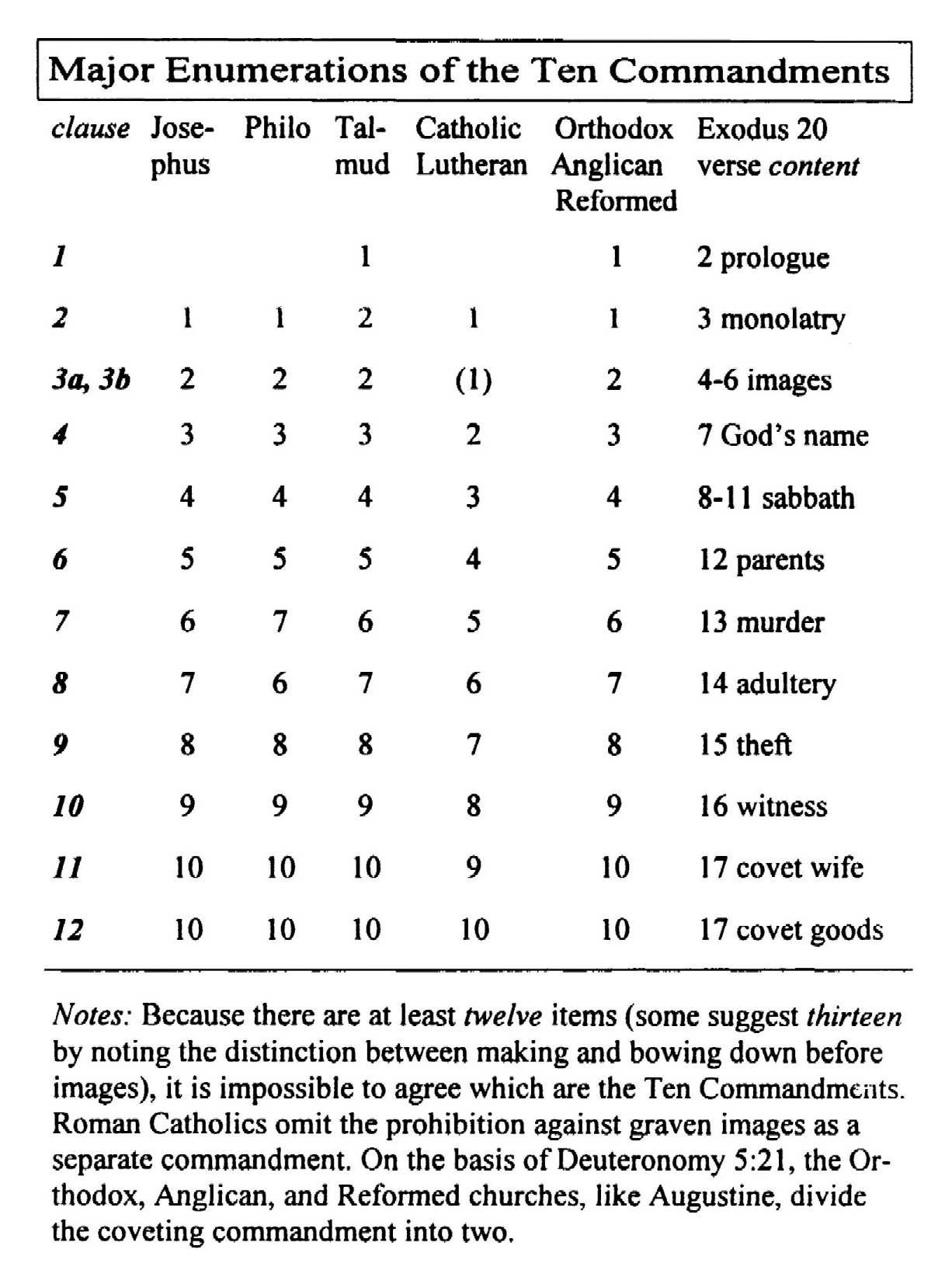
chart here shows, Jewish and Christian groups do not agree among
themselves
on what the Ten Commandments are.
(2a) Government
sponsorship of the commandments would be political and rhetorical in a
society which clearly does not honor the Ten in practice.
(2b) Several
of the commandments are specific to particular faiths (worship only one
god, make no graven images, keep the sabbath) and violate the ways of
others.
Although some
claim that the US Constitution is based on the Ten Commandments, no
reference
to the Decalogue can be found in it; US citizens, for example, may make
graven images and work on the sabbath.
To
make the texts easily accessible,
especially for those whose scriptures are from other traditions, many
relevant
passages are provided below. The text which follows the passages
summarizes
concerns about the biblical text — about their usurpation for political
purposes, and the legal role they must not have in a pluralistic
society.
See the blue column to the right
for the biblical and texts from other faiths
 What are
the Commandments?
Tradition
calls the dozen or so found
in Ex 20 and Deut 5 “Ten,” though the phrase “ten commandments” does
not
occur there, but rather in Ex 34:28, where the last of the commandments
is “Thou shalt not seethe a kid in his mother’s milk.” Like the
received
set, these words constituted a covenant and were written on two tables
which Moses brought down from Mt Sinai. The phrase “ten commandments”
also
occurs in Deut 4:13 which focuses on images, and in Deut 10:4. It never
occurs with the accepted list.
Scholars
note that the Decalogue is shaped in Hittite treaty form and contains
elements
of earlier traditions.
As this
comparison chart shows, there is disagreement about what constitutes a
commandment and how to number them, even supposing “Thou shalt not
seethe
a kid in his mother’s milk” does not belong to the proper list.
If a list
is to be posted by the state, which list — Ex 20, Deut 5 (which differs
in several respects), Ex 34 (the “seething” list) or some other list?
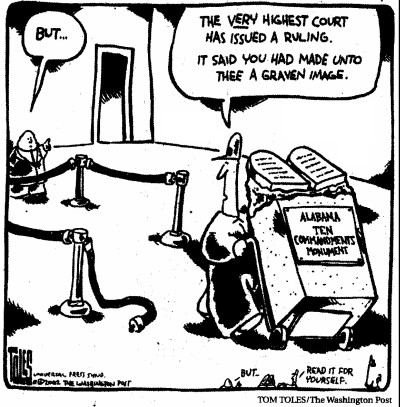
Is
it right to edit the commandments as is done on the monument on the
lawn
of the Wyandotte County Court House?
How important
have they been in Christianity? —
Let’s look at
the sabbath
commandment. The early Christian church did not recognize the sabbath.
By the 4th Century, Sunday, the first day of the week, was designated
for
worship, but not as an imitation of the sabbath, the seventh day. The
phrase
“Christian sabbath” dates from the 12th Century.
The Decalogue
had no particular significance in Christianity until the 13th Century
when
a list was made part of handbooks for confession. Later, Protestants
used
their versions of the Ten in Christian education. When they were
incorporated
into catechisms, especially for the young, they began to take on the
prestige
they have in modern Christianity.
For some
Christians, emphasizing the Ten Commandments neglects the theology of
salvation
by grace. For them, posting only the Decalogue is an insufficient and
misleading
guide to spiritual life.
Hypocrisy
and ignorance are two possible
explanations for the movement to place the Ten Commandments in public
places.
Some of
the proponents are themselves often guilty of taking the Lord’s name in
vain. It might be better to clean themselves up and inspire by example
than show their disrespect for what they say the rest of us should
follow.
Since the
commandment for Israel to worship only one particular God was made in
the
context of belief in many gods, do Christians really want the
government
to post a document that allows for the existence of many gods?
The prohibition
of images would make Kodak illegal, pictures on our coins sinful, and
outlaw
statues of saints, Thomas Jefferson, and Vietnam soldiers. Our museums
would close.
Most Christians
do not honor the seventh day of the week as the sabbath. Do those who
promote
the Ten Commandments really want the suffering and economic disruption
caused by the closing of hospitals, police and fire departments,
communication
operations, hotels, filling stations, theaters, and shopping malls to
observe
the sabbath?
Should a
daughter honor her father who molested her?
While few
defend adultery, some might wonder why fornication is not also
prohibited.
Attitudes have changed somewhat since the days of Moses. For instance,
we no longer stone adulterers to death, as Deut 22:24 instructs us to
do.
It’s hard
for guys not to covet what the neighbors have when advertising
encourages
us to acquire and possess. But is it okay for a wife to covet her
neighbor’s
husband or goods?
And do we
really want to teach that the children of those who violate these
commands,
unto the third and fourth generations, will be punished for their
parents’
iniquity?
America
protects the religious liberty
of peoples of all faiths. Governmental sponsorship of the Ten
Commandments
would infringe on Hindus who worship many gods, on Buddhists who
worship
no god, force the sabbath on Muslims who have other strenuous
obligations,
and deny Navajos the right to make the images used in healing
ceremonies.
The Ten Commandments were clearly prepared for a special people, the
children
of Israel, at a particular time, and were not intended to be a
universal
law code.
In Judaism,
the Ten Commandments are placed in the context of the 613 Rabbinic
laws.
Wonderful work has been done to reinterpret the Ten Commandments for
our
time, but these are best studied without the enforcement of government.
Certainly
all faiths condemn (1) murder, (2) theft, (3) sexual misconduct, and
(4)
falsehood, and, with specific meaning, so already does American law.
#2024wapo
The
2024 Disputehttps://www.washingtonpost.com/opinions/2024/07/03/ten-commandments-louisiana-bill-education/
Opinion
Ten Commandments in classrooms? Consider these
posters instead.
The Louisiana law mandating the commandments’ display fails to further
historical education.
By Kate Cohen
Contributing columnist
July 3, 2024
“I can’t wait to be sued,” said Louisiana Gov. Jeff Landry, before
signing a bill requiring every classroom in the state to display the
Ten Commandments.
He didn’t have to wait long. One week after the signing, a coalition of
civil liberties groups filed Roake v. Brumley on behalf of nine
Louisiana families who contend that the law “unconstitutionally
pressures students into religious observance, veneration and adoption
of the state’s favored religious scripture.”
This should be an easy case. After all, the Supreme Court ruled in 1980
that classroom displays of the Ten Commandments were unconstitutional.
Since children are legally required to attend school, they will be
captive to the state’s promotion of a particular passage from a
particular holy book.
State Rep. Dodie Horton (R), who introduced the bill, admitted as much
in the House debate. “I’m not concerned with an atheist, I’m not
concerned with a Muslim,” she said, “I’m concerned with our children
looking and seeing what God’s law is.”
Smells like establishment of religion to me. But the Louisiana law is
sneaky. It pretends the Ten Commandments, the first four of which
prescribe whom and how to worship, has nothing at all to do with
religion. No, it’s just one of “certain historical documents” — you
know, like the Mayflower Compact! After all, James Madison said
something about the Ten Commandments once ... And, furthermore,
Louisiana schoolchildren used to learn about it, so that’s part of
history too.
Oh — and they can put up the Mayflower Compact too, if they want.
Whatevs.
Federal judges might well see through this “Ten Commandments as an
American historical document” ploy. But if the case gets to the Supreme
Court, it’s not hard to imagine conservative justices gratefully
embracing the sham reasoning in their continuing effort to turn our
secular nation into a conservative Christian one.
In the meantime, I suggest Louisiana schoolteachers note that nothing
in the law prevents them from putting other documents on the wall
around the Ten Commandments.
After all, Act 676 aims to educate Louisiana students and put U.S.
history in context. Right?
I suggest some (actual) documents from the colonial era, such as the
Maryland Act of Toleration, which protected the “free exercise” of a
range of Christian denominations; the Providence Agreement, whose
signatories pointedly promised to subject themselves to majority rule
“only in civil things”; and the pioneering Virginia Statute for
Religious Freedom. Heck, why not throw the Bill of Rights up there too?
Students will be fascinated by the First Amendment.
If teachers feel the spirit of the law leans more toward providing
students with rules to live by — after all, Horton did say, “It’s so
important that our children learn what God says is right and what he
says is wrong” — there are plenty of other ethical codes to read along
with the Decalogue. How about the Analects of Confucius or the Ten
Precepts of Taoism or — to save wall space — the three Delphic maxims
that were carved into the Temple of Apollo?
Rep. Candace Newell (D) suggested the 42 Laws of Ma’at (from the
Egyptian Book of the Dead), which was a precursor to the Ten
Commandments. So were the Babylonian Code of Hammurabi and the Sumerian
Code of Ur-Nammu, both of which prohibited murder, theft and lying
about one’s neighbor about a millennium before the Book of Exodus.
Excellent historical context, I’d say.
All that verbiage could be a bit much for the elementary school set,
though. It’s bad enough they have to learn about adultery and wonder
what a “manservant” and “maidservant” are (hint: enslaved people).
Perhaps some wisdom from more recent fictional characters like Yoda
(“Do or do not. There is no try”) or Dory (“Just keep swimming”) would
make a kid-friendlier commandment wall.
Even better, the children themselves could decide on 10 good rules for
how people should behave. What a thought-provoking display that would
be!
I know, I know. Despite the law’s disingenuous wording, its sponsors
may not approve of placing the Ten Commandments in a context that
suggests it shouldn’t be posted in public school at all — or that a
third-grade class could come up with a better list. They might even
take offense.
To them I would respond as Louisiana Rep. Lauren Ventrella (R)
responded when CNN’s Boris Sanchez asked her, “What do you say to
parents of students — or even teachers — who don’t share your religious
views?”
“Don’t look at it.”
|
Bible
Passages
[all six biblical excerpts
taken from King James version]
Exodus,
Chapter 34
10 And he said, Behold, I make
a covenant: before all thy people I will do marvels, such as have not
been
done in all the earth, nor in any nation: and all the people among
which
thou art shall see the work of the LORD: for it is a terrible thing
that
I will do with thee.
11 Observe thou that which I
command thee this day: behold, I drive out before thee the Amorite, and
the Canaanite, and the Hittite, and the Perizzite, and the Hivite, and
the Jebusite.
12 Take heed to thyself, lest
thou make a covenant with the inhabitants of the land whither thou
goest,
lest it be for a snare in the midst of thee:
13 But ye shall destroy their
altars, break their images, and cut down their groves:
14 For thou shalt worship no
other god: for the LORD, whose name is Jealous, is a jealous God:
15 Lest thou make a covenant
with the inhabitants of the land, and they go a whoring after their
gods,
and do sacrifice unto their gods, and one call thee, and thou eat of
his
sacrifice;
16 And thou take of their daughters
unto thy sons, and their daughters go a whoring after their gods, and
make
thy sons go a whoring after their gods.
17 Thou shalt make thee no molten
gods.
18 The feast of unleavened bread
shalt thou keep. Seven days thou shalt eat unleavened bread, as I
commanded
thee, in the time of the month Abib: for in the month Abib thou camest
out from Egypt.
19 All that openeth the matrix
is mine; and every firstling among thy cattle, whether ox or sheep,
that
is male.
20 But the firstling of an ass
thou shalt redeem with a lamb: and if thou redeem him not, then shalt
thou
break his neck. All the firstborn of thy sons thou shalt redeem. And
none
shall appear before me empty.
21 Six days thou shalt work,
but on the seventh day thou shalt rest: in earing time and in harvest
thou
shalt rest.
22 And thou shalt observe the
feast of weeks, of the firstfruits of wheat harvest, and the feast of
ingathering
at the year's end.
23 Thrice in the year shall
all your menchildren appear before the Lord GOD, the God of Israel.
24 For I will cast out the nations
before thee, and enlarge thy borders: neither shall any man desire thy
land, when thou shalt go up to appear before the LORD thrice in the
year.
25 Thou shalt not offer the
blood of my sacrifice with leaven; neither shall the sacrifice of the
feast
of the passover be left unto the morning.
26 The first of the firstfruits
of thy land thou shalt bring unto the house of the LORD thy God. Thou
shalt
not seethe a kid in his mother's milk.
27 And the LORD said unto Moses,
Write thou these words: for after the tenor of these words I have made
a covenant with thee and with Israel.
28 And he was there with the
LORD forty days and forty nights; he did neither eat bread, nor drink
water.
And he wrote upon the tables the words of the covenant, the ten
commandments.
29 And it came to pass, when
Moses came down from mount Sinai with the two tables of testimony in
Moses'
hand, when he came down from the mount, that Moses wist not that the
skin
of his face shone while he talked with him.
Exodus,
Chapter 20
1
And God spake all these words,
saying,
2
I am the LORD thy God, which
have brought thee out of the land of Egypt, out of the house of bondage.
3
Thou shalt have no other gods
before me.
4
Thou shalt not make unto thee
any graven image, or any likeness of any thing that is in heaven above,
or that is in the earth beneath, or that is in the water under the
earth:
5
Thou shalt not bow down thyself
to them, nor serve them: for I the LORD thy God am a jealous God,
visiting
the iniquity of the fathers upon the children unto the third and fourth
generation of them that hate me;
6
And showing mercy unto thousands
of them that love me, and keep my commandments.
7
Thou shalt not take the name
of the LORD thy God in vain; for the LORD will not hold him guiltless
that
taketh his name in vain.
8
Remember the sabbath day,
to keep it holy.
9
Six days shalt thou labour,
and do all thy work:
10 But the seventh day is the
sabbath of the LORD thy God: in it thou shalt not do any work, thou,
nor
thy son, nor thy daughter, thy manservant, nor thy maidservant, nor thy
cattle, nor thy stranger that is within thy gates:
11 For in six days the LORD
made heaven and earth, the sea, and all that in them is, and rested the
seventh day: wherefore the LORD blessed the sabbath day, and hallowed
it.
12 Honour thy father and thy
mother: that thy days may be long upon the land which the LORD thy God
giveth thee.
13 Thou shalt not kill.
14 Thou shalt not commit adultery.
15 Thou shalt not steal.
16 Thou shalt not bear false
witness against thy neighbour.
17 Thou shalt not covet thy
neighbour's house, thou shalt not covet thy neighbour's wife, nor his
manservant,
nor his maidservant, nor his ox, nor his ass, nor any thing that is thy
neighbour's.
18 And all the people saw the
thunderings, and the lightnings, and the noise of the trumpet, and the
mountain smoking: and when the people saw it, they removed, and stood
afar
off.
19 And they said unto Moses,
Speak thou with us, and we will hear: but let not God speak with us,
lest
we die.
20 And Moses said unto the people,
Fear not: for God is come to prove you, and that his fear may be before
your faces, that ye sin not.
21 And the people stood afar
off, and Moses drew near unto the thick darkness where God was.
22 And the LORD said unto Moses,
Thus thou shalt say unto the children of Israel, Ye have seen that I
have
talked with you from heaven.
23 Ye shall not make with me
gods of silver, neither shall ye make unto you gods of gold.
24 An altar of earth thou shalt
make unto me, and shalt sacrifice thereon thy burnt offerings, and thy
peace offerings, thy sheep, and thine oxen: in all places where I
record
my name I will come unto thee, and I will bless thee.
25 And if thou wilt make me
an altar of stone, thou shalt not build it of hewn stone: for if thou
lift
up thy tool upon it, thou hast polluted it.
26 Neither shalt thou go up
by steps unto mine altar, that thy nakedness be not discovered thereon.
Deuteronomy,
Chapter 5
1
And Moses called all Israel,
and said unto them, Hear, O Israel, the statutes and judgments which I
speak in your ears this day, that ye may learn them, and keep, and do
them.
2
The LORD our God made a covenant
with us in Horeb.
3
The LORD made not this covenant
with our fathers, but with us, even us, who are all of us here alive
this
day.
4
The LORD talked with you face
to face in the mount out of the midst of the fire,
5
(I stood between the LORD
and you at that time, to show you the word of the LORD: for ye were
afraid
by reason of the fire, and went not up into the mount;) saying,
6
I am the LORD thy God, which
brought thee out of the land of Egypt, from the house of bondage.
7
Thou shalt have none other
gods before me.
8
Thou shalt not make thee any
graven image, or any likeness of any thing that is in heaven above, or
that is in the earth beneath, or that is in the waters beneath the
earth:
9
Thou shalt not bow down thyself
unto them, nor serve them: for I the LORD thy God am a jealous God,
visiting
the iniquity of the fathers upon the children unto the third and fourth
generation of them that hate me,
10 And showing mercy unto thousands
of them that love me and keep my commandments.
11 Thou shalt not take the name
of the LORD thy God in vain: for the LORD will not hold him guiltless
that
taketh his name in vain.
12 Keep the sabbath day to sanctify
it, as the LORD thy God hath commanded thee.
13 Six days thou shalt labour,
and do all thy work:
14 But the seventh day is the
sabbath of the LORD thy God: in it thou shalt not do any work, thou,
nor
thy son, nor thy daughter, nor thy manservant, nor thy maidservant, nor
thine ox, nor thine ass, nor any of thy cattle, nor thy stranger that
is
within thy gates; that thy manservant and thy maidservant may rest as
well
as thou.
15 And remember that thou wast
a servant in the land of Egypt, and that the LORD thy God brought thee
out thence through a mighty hand and by a stretched out arm: therefore
the LORD thy God commanded thee to keep the sabbath day.
16 Honour thy father and thy
mother, as the LORD thy God hath commanded thee; that thy days may be
prolonged,
and that it may go well with thee, in the land which the LORD thy God
giveth
thee.
17 Thou shalt not kill.
18 Neither shalt thou commit
adultery.
19 Neither shalt thou steal.
20 Neither shalt thou bear false
witness against thy neighbour.
21 Neither shalt thou desire
thy neighbour's wife, neither shalt thou covet thy neighbour's house,
his
field, or his manservant, or his maidservant, his ox, or his ass, or
any
thing that is thy neighbour's.
22 These words the LORD spake
unto all your assembly in the mount out of the midst of the fire, of
the
cloud, and of the thick darkness, with a great voice: and he added no
more.
And he wrote them in two tables of stone, and delivered them unto me.
23 And it came to pass, when
ye heard the voice out of the midst of the darkness, (for the mountain
did burn with fire,) that ye came near unto me, even all the heads of
your
tribes, and your elders;
24 And ye said, Behold, the
LORD our God hath showed us his glory and his greatness, and we have
heard
his voice out of the midst of the fire: we have seen this day that God
doth talk with man,and he liveth.
Mark,
Chapter 10
19 Thou knowest the commandments,
Do not commit adultery, Do not kill, Do not steal, Do not bear false
witness,
Defraud not, Honour thy father and mother.
20 And he answered and said
unto him, Master, all these have I observed from my youth.
21 Then Jesus beholding him
loved him, and said unto him, One thing thou lackest: go thy way, sell
whatsoever thou hast, and give to the poor, and thou shalt have
treasure
in heaven: and come, take up the cross, and follow me.
22 And he was sad at that saying,
and went away grieved: for he had great possessions.
[cf Matthew 19:16-22, Luke
18:18-30]
Mark,
Chapter 12
28 And one of the scribes came,
and having heard them reasoning together, and perceiving that he had
answered
them well, asked him, Which is the first commandment of all?
29 And Jesus answered him, The
first of all the commandments is, Hear, O Israel; The Lord our God is
one
Lord:
Mark
30 And thou shalt love
the Lord thy God with all thy heart, and with all thy soul, and with
all
thy mind, and with all thy strength: this is the first commandment.
Mark 12:31
And the second is like
namely this, Thou shalt love thy neighbour as thyself. There
is none
other commandment greater than
these.
[cf Luke 10:27]
Romans,
Chapter 13
8
Owe no man any thing, but
to love one another: for he that loveth another hath fulfilled the law.
9
For this, Thou shalt not commit
adultery, Thou shalt not kill, Thou shalt not steal, Thou shalt not
bear
false witness, Thou shalt not covet; and if there be any other
commandment,
it is briefly comprehended in this saying, namely, Thou shalt love thy
neighbour as thyself.
10 Love worketh no ill to his
neighbour: therefore love is the fulfilling of the law.
Other candidates for
the Decalogue studied by scholars
are a curse ritual, Deut 27:15-26; sexual prohibitions, Lev 18:6-18;
crimes
and prohibitions, Lev 20:2-16; the righteous person, Psalm 15; and
ordinances,
Ez 18:5-9.
Islamic
Law
The three great Abrahamic
traditions are Judaism, Christianity, and Islam. Rooted in the Qur’an,
Islamic law includes many elements in common with Jewish practices.
Surah
17 Al Isra’ 23-39, for example, includes commands to serve only God, to
care for parents and orphans, to keep promises, to be fair in trade,
and
against waste, adultery, murder, and pride.
An example of a non-Abrahamic
code:
Five
Buddhist
Moral Precepts
1. Honor
and respect all sentient
beings; act not out of hatred or aversion; cause no harm to any living
being.
2. Respect
the rights and property
of all beings; do not take what is not freely given.
3. Refrain
from sales speech; say
what is true and useful; speak wisely, responsibly, and appropriately.
4. Be
conscious of sexual energy.
It is powerful and can be creative or destructive. Use the energy to
express
compassion, love, and genuine intimacy.
5. Refrain
from the needless use of
intoxicants. They could the mind and cause more pain than they cure.
|


 Relevant
biblical passages
Relevant
biblical passages