746.
081231 THE STAR’S HEADLINE:
A wish list for faiths in 2009
A growing number of folks are, like me,
convinced that one’s spiritual life is deepened by knowing about the faiths
of others, and that our community is strengthened by mutual respect.
In various ways over twenty
organizations in the metro area are now putting these sentiments into action.
Good. And to move forward, here is my 2009 wish list for the Heartland.
* Form a Council of Congregations.
Since 1989, we have been served by an Interfaith Council with members of
more than a dozen faiths, from A to Z, American Indian to Zoroastrian,
one member per faith. This may be the ideal arrangement for education.
But we also need a metro-wide
organization through which all religious groups are able to exchange information,
respond to urgent or long-term social needs, co-ordinate resources, and
co-operate on issues of mutual interest.
The creation of such a group
was the chief recommendation of the 30-some religious leaders of the Religion
/ Spirituality Cluster of then-Mayor Emanuel Cleaver’s 1996 Task Force
on Race Relations.
In their opinion, a body
organized through denominational offices would be ineffective. Each congregation,
of whatever faith, needs to be represented.
* Create an interfaith
chapel at KCI. A non-profit group should lease space at the airport
so that we, like other great cities, can offer travelers a place for prayer,
meditation and reflection. It would also enhance our city’s reputation
far beyond the members of the North American Interfaith Network who will
come here for their convention in June.
* Welcome Freethinkers
into the interfaith conversation. In the US, atheists, agnostics, secular
humanists, Deists and others, often called “Freethinkers,” number more
than any religion except Christianity. These folks care deeply about humane
values. They work as much as those of any faith to make a better world.
They have much to contribute to, and learn from, interfaith dialogue.
* Access art to grow spiritually.
Several groups are appropriating the Nelson-Atkins Museum of Art as part
of their interfaith explorations. There and at other facilities as well,
they are discovering that even works with seemingly secular subjects often
elevate the spirit.
Kansas City offers ballet,
opera, chamber, symphony and club music, as well as theater, film and other
arts that help us understand the world afresh, and awaken and deepen the
basic spiritual capacity to wonder, to sense the sacred where we might
not have expected it.
May you, dear reader, and
our beloved community be blessed in 2009.
745. 081224 THE STAR’S
HEADLINE:
Let us proclaim the child
The oohs and aahs of the Plaza lights,
the tree bestrewn with ornaments, the obligatory kiss under mistletoe,
and other surprises, delights and excesses of holiday celebrations are
secular devices to reawaken us, if we are not already dead in spirit, to
nothing less than the wonder of existence.
Yes, I know the season’s
catalogue of frustrations: waiting in lines, worrying about selecting an
appropriate gift, disrupted schedules. There are plenty of opportunities
for aggravation.
Still, the reason for a holiday—a
holy day—is to have our eyes and ears and hands open for greeting and embracing
the mysteries from which even the tinsel arises.
Resting from routine and
entering a time set apart from the ordinary, we may remember things that
truly matter. And when the holiday is over, if we have been renewed and
refreshed, we are able to see the miracle even in the everyday.
For many years I have puzzled
why theologians often rate Easter the highest and holiest day of the Christian
calendar while the culture, at least in the last hundred years or so, has
made Christmas the favorite sacred feast.
I don’t think it is simply
because Christmas has been colonized commercially. That answer is too easy.
I think the reason is deeper.
I think it has something
to do with the story of the birth of a child.
Sunday friends at an
open house told me they had just become grandparents for the first time.
I asked to see a picture of their grandchild, but no photo was handy. I
insisted. So the granddad left the room, found his coat where a print was
stowed, and then he produced the image I sought.
I like looking at newborns,
even photos of newborns. And I liked this picture, which included the beaming
dad with the baby. The dad himself appeared newborn. And I remembered
holding my own infant son in my arms.
The Christmas stories, with
no photos, no video, with different texts in only two of the four Gospels,
removed by two thousand years from our own time, still invite us to behold,
to cherish, to protect our highest hopes.
A babe awakening infinite
love within us may be less complicated than Easter theology.
Our culture is broken. We
may have thrills but little genuine wonder. Without an enduring child-like
sense of wonder, we focus selfishly on the bottom line which is actually
the edge of disaster.
If the holiday about the
babe in the manger prepares us for divine life born afresh within us, then
each day, trivial or tragic, can be filled with holy oohs and aahs.
744. 081217 THE STAR’S
HEADLINE:
One plan would change Christmas
While Christmas is holy for most Christians,
Mike McKinney, pastor of the Leawood Baptist Church, finds the blending
of pagan and commercial themes with Christianity troublesome. He suggests
a reformation that respects both the secular fun and the sacred meanings
that have been blended into today’s Christmas traditions.
He says, “I like . . . the
lights, the decorations, the music, . . . the stories, the pageantry and
the atmosphere — but as a Christian I am frustrated” with the celebration
of the birth of Jesus Christ mixed with what he calls “a winter festival.”
He says it is “not right
to sing ‘Silent Night’ and ‘Jingle Bells’ as if they belong to the same
holiday. It is not right to honor the birth of Christ the Lord and to celebrate
the arrival of Santa Claus, the jolly old elf, within the context of the
same holiday.”
Last year late in the season
he wrote me with his solution, and I thought it deserved discussion. So
this year he has posted it on his church website,
www.leawoodbaptist.com — click on “Fixing
Christmas” to read his entire recommendation.
He outlines how to “unblend”
what he considers a “non-religious Winter Holiday” from the “sacred Christian
Holiday.” He wants to keep both, but to keep them distinct.
He provides a history of
how Christmas has, and has not, been observed. For example, he notes that
New England Puritans outlawed Christmas, and that Christmas was not declared
a federal holiday until 1870.
This year his comment on
the commercialization of Christmas is especially interesting. He writes
that President Franklin Roosevelt moved Thanksgiving to a week earlier
in the calendar “in order to lengthen the Christmas shopping season and
hopefully help the depressed economy.”
His history says that “Rudolph
the Red Nosed Reindeer” was part of a 1939 Christmas promotion by Montgomery
Ward department store, and that “Frosty the Snowman” appeared in 1950.
Even if you disagree with
McKinney’s proposal, you’ll see that what we call tradition is relatively
recent.
He says he is “already pleased
by more favorable responses than (he) anticipated.”
His may be a worthy remedy
within Christendom. But will greeting everyone with “Happy Holidays” honor
all faiths?
I know I will still goof
up this month sorting out wishes for my friends: Merry Christmas, Happy
Hanukkah (Jewish), Blessed Yule (pagan), Eid Mubarak (Muslim), Habari Gani
(Kwanzaa) or Season’s Greetings. It will take a while for us all as America
learns to celebrate the blessings of our religious pluralism.
743. 081210 THE STAR’S
HEADLINE:
Faith is bigger than beliefs
Jewish, Christian, and Muslim friends said
I should see the Bill Maher movie, “Religulous,” so I did.
I understood the title to
be a fusion of “religious” and “ridiculous,” which did not give me much
of a thrill.
Although it is a light-hearted,
even comic, look at faith, I found the movie surprisingly depressing. My
dismay takes three forms.
*The first is that Maher,
religion’s critic, often seemed to know more about the religion claimed
by the person he was interviewing than the interviewee.
Granted, you don’t have to
understand quantum mechanics to turn on a TV, and you don’t have to be
a theologian to live a moral life.
But it is disconcerting to
see folks presuming to know more about the Almighty than any mortal with
a modicum of modesty should assert, not to mention their failures to understand
their own traditions.
*A second reason for my chagrin
is that the film’s association of religion with superstition, narcissism,
self-righteousness and violence is too often accurate.
I want to say it doesn’t
have to be this way, that faith uplifts us and helps us care about each
other, but the history books and the news offer too much support
for the film’s thesis to ignore.
Superstition, of course,
is what the other person believes, not what I believe. And my faith is
loving and uses force only when necessary. It is other religions
that are fanatic and violent.
*My biggest problem with
the film is that it treats religion mainly as a matter of belief. Many
of the “atheist” books published recently also identify religion with beliefs.
The film is especially depressing
because this flaw, underling the film, reveals the shallowness of our culture’s
approach to faith. Religion does not begin with words. Faith does not originate
in a box of beliefs.
Faith arises from experiences
of the sacred, of transcendence, of a sense of the holy.
It may be a solitary walk
through the woods, or holding an infant, or gazing at the stars, or hearing
music performed so well you are astonished, or seeing an athlete achieve
an unparalleled feat, or giving aid to someone in need, or a conversation
in which you understood your friend as never before, or your friend understood
you, or communing with a Higher Power.
Such experiences say “Life
is worth living” and are available to all people, whether they think themselves
religious or not.
Words, stories, rituals,
beliefs, communities and religions arise from sharing such precious experiences.
But when beliefs become detached from these experiences, you get religulous.
Vern Barnet does interfaith
work in Kansas City. Reach him at vern@cres.org.
742. 081203 THE STAR’S
HEADLINE:
Waiting and arrival of Advent
Waiting can be a hard thing to do. If you
are a parent who celebrates Christmas, you know how eager children can
be for the gifts under the tree to be opened.
Last Sunday many Christian
liturgical churches in the West began a period of waiting called Advent,
a time of expectation and preparation for Christmas.
This year it may be difficult for
preachers to speak about the promise of a savior without arousing a subconscious
analogy with the period of waiting for a new President to assume office.
Strict theology might regard
identifying a political figure with the Christ as blasphemous. But popular
religion can be compared to advertising, where examples provide the power
to pull on the spirit, sometimes in untoward directions, sometimes bringing
an ancient story to new life.
In America, this is a frequent
phenomenon.
John James Barralet’s 1802
engraving, “Apotheosis of George Washington,” presents our first President
as a semi-divine figure with angels assisting him into heaven.
When Abraham Lincoln was
shot on Good Friday in 1865, his death was compared with Christ’s. Popular
oratory of the time proposed that while Christ’s death prepared humanity
to enter heaven, Lincoln’s sacrifice was to bring people together to make
a better world.
Martin Luther King, Jr, used
language that echoed the Mosaic vision of a promised land. He said, “I
might not get there with you,” and his death tragically paralleled Moses,
dying before he reached the destination.
Especially because of today’s
financial crisis, many Americans are waiting anxiously with hopes that
the incoming administration will move us toward relief. A theological term
for relief is “salvation.”
New York Times columnist
Thomas L. Friedman has written about our situation in moral language: “This
financial meltdown involved a broad national breakdown in personal responsibility,
government regulation and financial ethics.”
He calls the results “the
wages of our sins.”
This period of Presidential
transition certainly seems more orderly than the impatient Wal-Mart shoppers
at a Long Island store who trampled an employee to death last Friday while
they presumably were eager to buy gifts to celebrate the birth of the Prince
of Peace.
I am not sure we understand
the virtue of waiting, and Advent is a season to test us with its paradox.
The paradox is that Advent
means both waiting and arrival. Only in us and through us, as we wait in
the present, can the eternal arrive. If, awaiting, we do the work of the
healer, then the savior is now come.
741. 081126 THE STAR’S
HEADLINE:
Give thanks for the gift of life
The auction was concluding. Finally a freshly
baked pie was announced. It was bid up and up. Sold for $1,400! The buyer
then donated the pie, and the bidding began again, with the pie selling
for $900.
The auction was last spring,
but I thought of Thanksgiving. Not because the holiday and pie go together,
but because of the story behind the pie and the reminder that every day
is a day for giving thanks.
The pie was baked by then-ninth-grader
Cole Harbur in honor of his younger brother, Luke, who 11 years ago was
a dying infant. Luke, healthy now, needed a liver transplant.
The pie was ultimately given
to Melody and Kris Drake, whose son Aaron died from an allergic reaction
while camping in the Ozarks. The Drakes gave their son’s organs to save
the lives of others, including Luke’s.
Aaron’s father later said,
“We felt as a family that if we could save other parents and grandparents
the heartache of losing a child or relative by donating Aaron’s organs,
then that is what we should do.”
I had known Luke’s parents
from the Rotary Club where Luke’s father, Nate, and I are members. I remember
him and his wife, Kim, in their prayerful anxiety as they awaited help
for their baby.
Several years ago my best
friend’s wife needed a kidney transplant. I went through the preliminary
testing to see if I could qualify as a donor. Her sister was a better match,
but that got me to thinking about how difficulties and tragedies can be
partly redeemed through organ and tissue donation.
Full disclosure: I now serve
on the board of Gift of Life, the charity for which the auction was held.
Gift of Life promotes organ and tissue donation, inspired by the Harburs’
experience.
One of the things that impresses
me about the organization is that it is full of lifesaving stories and
that it is energized by donors and recipients and their families in continuing
thanksgiving.
Dave Jetter, for example,
a heart recipient and a board member, has initiated a mentorship program,
coordinated with medical facilities, to help guide prospective recipients
and their families through the uncertainties of waiting for a transplant,
the transplant procedures and the difficulties of recovery.
But to know Dave is to know
joy in the gift of life he has received, as I have found throughout the
transplant community.
So Cole’s pie in honor of
his brother Luke — and of Aaron Drake — becomes for me a spiritual symbol
of transforming tragedy into the gift of life, a cause for great thanksgiving.
740. 081119 THE STAR’S
HEADLINE:
The History of Marriage
Last Saturday several hundred people gathered
near the Plaza to protest the vote in California against gay marriage.
Sometimes people say that
marriage has always been between one man and one woman who love each other.
But there are many
contrary examples. Consider Solomon with his 700 wives and 300 concubines.
Are we talking political alliances, procreation, property rights, honored
servants, companionship, sexual opportunities — or love?
Producing offspring was very
important to early societies. In the Bible, Onan’s father forced him to
have sex with his dead brother’s wife to perpetuate the family line. This
custom, the “levirate” marriage, continued into Jesus’ time.
Love is fickle, and what
society needed was stability. Marriage did not originate in love between
partners but as a compact between families or groups.
This is why in the Bible,
most marriages were arranged by the parents, sometimes when the children
were infants, though Isaac was 40 years old when Rebecca was selected for
him.
Women were like property.
But David did not buy King Saul’s daughter; instead he proved his worthiness
by presenting Saul with the foreskins of 200 Philistines.
In the Christian era, Paul
prohibited bishops from having more than one wife (1 Tim. 3:2), but Christians
experimented with marriage in many forms.
Marriage was not declared
a sacrament within the Roman Catholic Church until 1215. Before then, weddings
were often held outside the church because they were less about love than
about social stability.
The late Yale historian John
Boswell documented Christian practices through the 18th Century of church
unions of men in love. Male couples pledged fidelity for life, joined right
hands before the altar, shared a cup of wine, heard biblical passages (such
as Psalm 133), and received the priest’s blessing.
In America, the Church of
Jesus Christ of Latter Day Saints (Mormons) of Utah practiced polygamy
until it was outlawed, and some break-away groups still favor it in practice.
The 19th Century experiment
in Oneida, N.Y., led by John Humphrey Noyes, prohibited monogamy. The community
practiced complex marriage: every man was the husband of every woman, and
every woman was the wife of every man. Exclusive relationships were forbidden
because members of the “body of Christ” should love each and all.
Laws against blacks and whites
marrying continued in the US until 1967.
Increasing numbers of clergy
in the US and in Kansas City now perform same-sex ceremonies, and
same-sex couples are asking for legal, as well as religious, recognition
of their love and commitment.
739. 081112 THE STAR’S
HEADLINE:
City on a hill for others to see
The idea that America is special, “a city
on a hill” seen by other nations, is often associated with a right-wing
Christian perspective that God has chosen the United States for special
blessings.
The phrase was recently used
by Republican vice presidential candidate Sarah Palin, who attributed it
to President Ronald Reagan who included it in his farewell address. The
phrase had been employed earlier by President John Kennedy. Its ultimate
source is Jesus’ “Sermon on the Mount” in the Gospel of Matthew.
In colonial America, the
phrase originated with a problematic figure, John Winthrop, governor of
the Massachusetts Bay Colony. Winthrop was sometimes criticized by his
fellow Puritans for failing to enforce the law. One time Winthrop excused
a destitute man who had been stealing from Winthrop’s own firewood pile.
Instead of punishing him, Winthrop told him to take what he needed for
the rest of the winter. This, he told his critics, was how he cured the
man of thieving.
Winthrop’s “American
exceptionalism” was the idea that America can offer the world a model of
righteousness to inspire other nations.
President-elect Barack Obama,
after winning the election Nov. 4, alluded to the original motto of the
United States, “Out of many, one,” and affirmed America as the place “where
all things are possible.”
After enumerating many kinds
of differences among us, he asserted that Americans “have sent a message
to the world,” an implicit recognition that other nations see the United
States in a special light.
We came of age with a Constitution
that embraced religious diversity. Over the centuries that diversity has
grown and deepened.
On Oct. 19, retired General
and former Secretary of State Colin Powell, addressed the false rumors
that Obama is a Muslim by asking, “Is there something wrong with being
a Muslim in this country? The answer’s No. That’s not America.”
In contrast to that inclusive
conception of America, North Carolina Senator Elizabeth Dole tried to brand
her Christian opponent as an atheist. Echoing Powell, I would ask, Is there
something wrong with being an atheist in this country?
If America is exceptional
in fact as well as in aspiration, it may arise from our having become the
most religiously pluralistic of any nation on earth, a “city on a hill”
for others to see.
We are not without religious
problems and tensions, but we are all Americans. Blessed by exceptional
diversity, we astonish other nations with our usual comity, now reaffirmed.
738. 081105 THE STAR’S
HEADLINE:
Sacred a source of meaning
Sometimes I think the simplest question
of faith—any faith—is this: Is life worth living?
It is a question of faith
because no scientific analysis or chain of logic can yield an answer better
than what one finds in one’ soul.
But another question, not
so simple, may be more fundamental. It is the question asked by the opening
event of the 2008 Festival of Faiths, a series of eight events from this
Friday through Nov. 23.
That question—What is sacred?—will
be answered through original works of art displayed from 6:30 to 9:30 p.m.
Friday only, at the Rime Buddhist Center, 700 West Pennway. The exhibit
is free. (For Festival information, visit www.festivaloffaithskc.org.)
The word “sacred” has many
meanings, and I’m glad the Festival planners invited answers through art
because ordinary language is often inadequate to express the sacred.
You, dear reader, may think
of rituals, or sites, or persons, or smells, or sounds, or texts, or times,
or relationships that are so extraordinary that you consider them sacred.
But what underlies all these
examples or inflections of the sacred?
Among the many possible definitions
of “sacred,” the one I like best is this: the sacred is the source of ultimate
meaning. It is what our life depends upon and, also, for which we are willing
to die.
The religions of the world
tend to find the sacred in different realms.
Primal traditions (like those
of the American Indian) locate the sacred in the natural world where even
the ground which produces food, what life literally depends upon,
is considered holy.
Asian faiths (like Hinduism
and Buddhism) find the sacred by looking within, often through techniques
such as yoga and meditation.
Monothesistic religions (like
Judaism, Christianity and Islam) identify God as the source of ultimate
meaning, revealed in the history of covenanted community moving toward
justice.
Comparing Judaism and Islam
can lead us to a curious paradox about the sacred. In some Jewish thought,
the sacred is what is set apart. The sabbath, for example, is separate
from the ordinary work week.
In Islam, the sacred is not
what is separate but rather what pulls everything together.
While the words are different,
the effect may be the same. We may need to separate out something as sacred
because it remind us, or reveals to us, that the entire universe is sacred,
for everything is interwoven and mutually dependent.
The tiniest thing
may be sacred because it is a door opening us to the fullness of cosmic
mystery and wonder.
737. 081029 THE STAR’S
HEADLINE:
Telling the tale of Judith
Judith was so upset with the cowardly men
in her city ready to surrender to a besieging army that she pretended to
betray her own and, with her feminine wiles, seduced the enemy general,
Holofernes, to trust her. To save her people, she cut his head off.
The story is told in scripture,
though Protestant versions of the Bible either omit it or consider it apocryphal,
and it is not part of the Tanakh, the Jewish Bible, though it was first
written in Hebrew.
Judith is not the first heroine
in scripture. Many scholars consider the Song of Deborah (Judges 5) to
be the oldest poem in the Bible. As a military commander, Deborah orders
Barak to lead a coalition army to victory against the Canaanites; and another
woman, Jael, pounds a tent peg into the enemy general’s head.
Yale University professor
Harold Bloom argues that the oldest textual layer of Genesis and Exodus,
which scholars call “J,” was written by a woman almost three thousand years
ago.
Women seem to have been equal
to men in ancient Israel until the Babylonian exile, about 2580 years ago,
when women’s abilities were debased. The book of Judith, written perhaps
400 years later, thus is an ironic comment on the patriarchy of the time
in such masterful writing it has been called the world’s first historical
novel.
Virginia Blanton teaches
an Anglo-Saxon version of the story, in which Judith is a Christian, to
her English students at UMKC. Blanton notes that Judith appears in paintings
variously, from a “robust maid horrified by what she must do” to “a shameless
slut.”
Linda E. Mitchell, professor
of history and women’s and gender studies at the University of Missouri-Kansas
City notes that Judith was “as an iconic figure of independence and dissent”
in the Renaissance, so the paintings were “political statements as much
as aesthetic ones.”
The Friends of Chamber Music
brings a dramatic staging of a Croatian version of the story with musical
idioms from medieval Dalmatia to Kansas City’s Grace and Holy Trinity Cathedral
Nov 8.
Amity Bryson, chair of the
music department and director of women’s studies at Avila University, says
the composer, Katarina Lavljanic´, draws materials from the earlier
musical period “dominated by male composers,” but the feminine experience
“adds a unique perspective” to this “21st century composition.”
These three scholars have
lots to say about Judith’s morality and gender roles. They will speak at
6:30 p.m. in Founders Hall before the 8 p.m. performance in the Cathedral
sanctuary. For more information visit www.chambermusic.org.
736. 081022 THE STAR’S
HEADLINE:
Enriching talks set
I first met retired Episcopal Bishop John
Shelby Spong, author of Why Christianity Must Change or Die, in
2001 in California, and four years ago had a dinner table conversation
with him here in Kansas City whether Jesus and Mary Magdalene were married.
Whether you agree with him
or not, you can depend upon his eloquence and provocative passion for updating
the church for the world today and tomorrow.
I also had a dinner table
conversation with scholar Bart D. Ehrman this spring when he was speaking
in Lawrence, his home town, where he wowed his audience with his methodical
analysis of the problem of an all-good and all-powerful God permitting
unmerited suffering in the world. His Misquoting Jesus is a New
York Times best seller. He teaches at the University of North Carolina,
Chapel Hill.
Each of these men have written
over 20 books.
Whatever your faith, or none,
I am confident that you will find both of these men challenging and enriching
your spiritual life when they come to the Unity Village for its Lyseum
2008 educatinal symposium, Nov. 3-6.
Spong’s speech, scheduled
for Nov. 4, is expected to reflect on the religious significance
of the election results.
But the speech I am most
looking forward to hearing is “Chimpanzees, Bonobos and the Future of Theological
Reflection” by Nancy R Howell, professor at Kansas City’s own Saint Paul
School of Theology.
Howell’s own publications
include work on feminist and process theology and the interface between
science and faith.
She told me that the “religious
puzzle that I’m addressing is the problem of human uniqueness, a concept
we’ve used to distance ourselves from nature and our nearest genetic kin
among animals.”
Howell says that while Christian
thought has focused on the relationship between humans and God, it has
neglected how God relates to animals like chimpanzees and bonobos who “demonstrate
remarkable social and intellectual skills” and seem to exhibit some precursor
level of “moral behavior and religion.”
She says that asking the
question, “How does God relate to bonobos?” may help us better answer the
question, “How does God relate to humans?”
The opening evening is free,
and Unity Institute faculty member Paul Hasselbeck and I, your faithful
columnist, are scheduled to debate, “Is God a Problem?”
Unity’s Thomas Shepherd notes
that the Lyceum’s many presenters come from many religions and from as
far away as Nigeria.
For information and fees,
visit www.lyceum2008.com.
735. 081015 THE STAR’S
HEADLINE:
Infuse economy with values
If economics and religion are not images
of each other, they at least interact in profound and often unacknowledged
ways. Max Weber’s The Protestant Ethic and the Spirit of Capitalism (1905)
and R.H. Tawney’s Religion and the Rise of Capitalism (1926) are classics
exploring this thesis in Christianity.
Islam is friendly to business
and encourages trade. Government interference with the markets is prohibited
save for exceptional circumstances.
As a young man, Muhammad
himself was a merchant with such integrity and industry that a widow aware
of his reputation hired him for her commercial affairs and later asked
him to marry her.
Abdalla Idris Ali, twice
president of the Islamic Society of North America whose Center for Islamic
Education is located in Kansas City, notes that the Qur’an is a book of
guidance with general principles, elaborated differently in different cultures.
During our conversation,
he recommended Islamic Banking and Finance (1999) edited by Imtiazuddin
Ahmad, following the “greed” and “fear” Ahmad found at the root of
the Southeast Asian financial crisis when funds managers “panicked”
in 1998. The book suggests the crisis could have been avoided with Muslim
financial practices, which he summarized as “an interest-free, equity based,
profit-sharing arrangement.”
Here are three general principles
derived from the Qur’an:
1. Usury is forbidden. Out
of compassion, one may lend money but may not charge interest. Money itself
should not be treated as a commodity because it can lead to an unfair concentration
of wealth.
However, one may help finance
another’s business by becoming an investment partner and sharing the gain
or loss equitably. Islamic banking is based more on a relationship than
on collateral. Islam envisions an equity-based rather than a debt-based
economy.
In purchasing a car, this
principle may be adapted to arrange installments with both buyer and seller
seeking a satisfactory purchase price in a free market.
2. Futures trading is a form
of gambling, prohibited in Islam. One cannot sell anything one does
not own or does not yet exist. I cannot sell what my olive trees may produce
until the fruit is actually on the tree.
3. Transparency is required.
I may not sell a property or product without disclosing its defects or
liabilities. Derivatives can be so complicated they are hardly transparent
and may impair one’s moral obligation to honor one’s contract.
With the globalization
of world finances, we may hear more about Islamic values.
734. 081008 THE STAR’S
HEADLINE:
When catholic is universal
“Integrity is more important than profits,”
said Steve Roling last Friday as the Center for Spirit at Work began its
program year with its first breakfast.
Roling, now President &
CEO of the Health Care Foundation of Greater KC, illustrated his point
with a story from Ewing Kauffman, as Kauffman was developing what was to
become a pharmaceutical giant.
“Mr K” had sent his negotiator
to Europe to arrange a deal. The negotiator returned with extremely favorable
results, but the gist of Mr K’s response was, “You are here boasting of
your success, but how do you think your counterpart in Europe feels as
he reports to his boss? Go back and make the deal fairer for his company.”
Later the trust established
between the two businesses benefited both greatly.
Roling, formerly senior vice
president of the Ewing Marion Kauffman Foundation, publisher of The Kansas
City Business Journal and staff member for Senator Thomas Eagleton, had
story after story illustrating the spirit at work.
Begun by Catholics, the Center’s
programs feature civic leaders from all faiths — Irv Hockaday, Peggy Dunn,
Henry Bloch, Mahnaz Shabbir, for example — addressing how their
spirituality affects the workplace.
Two years ago Vince Sabia
of Right Management, Inc., showed up with several colleagues for
one of the Center’s breakfasts, only to discover the series adjourns in
the summer.
He had looked forward to
another opportunity “to reflect about the spirit in our work world and
hear from leaders in our community and how these folks make good decisions
involving spiritual principles.”
From his disappointment
that day and “realizing how uplifting” these sessions were to him, he joined
the organization’s board and is now its president.
For information,
visit centerforspiritatwork.org.
Catholic Sister Annie
Loendorf, SCL, founded another organization open to those of all faiths,
especially women, the House of Menuha, 801 East 77th St.
A two-hour program last Thursday
led by Marlene Wine Chase, illustrates Loendorf’s view that “it takes a
village to grow a woman’s soul.”
She says the “village” is
a “circle of trust” in which “each woman shares her story with others.
Hearing each woman’s story is part of the sacred work of moving into the
wisdom and compassion of deeper spirituality.”
Last Saturday the House hosted
a “roundtable” for area interfaith organizations.
The House may also be used
for individual retreats.
For information, visit menuha.org.
0801001 The column does not appear today
but will return.
081001
unpublished
because of space limitations
Last
Wednesday I mentioned the Christian Foundation for Children and Aging,
a relief agency founded locally by lay Catholics, now serving impoverished
people of all faiths in 25 countries.
Today I write about two more organizations founded by Catholics with an
interfaith approach, both now beginning this season’s programs.
The first is the Center for Spirit at Work. Its meetings feature area civic
leaders addressing how their spirituality affects the workplace with Protestant,
Catholic, Jewish and Muslim leaders in their fields, with names such as
Irv Hockaday, Peggy Dunn, Henry Bloch and Mahnaz Shabbir.
Two years ago Vince Sabia of Right Management, Inc. showed up with several
friends for one of the organization’s monthly breakfast meetings, only
to discover the series adjourns in the summer.
He had looked forward to another opportunity “to reflect about the spirit
in our work world and hear from leaders in our community and how these
folks make good decisions involving spiritual principles.”
From his disappointment that day and “realizing how uplifting” these sessions
were to him, he joined the organization’s board and is now its president.
Friday at the 7:30 breakfast at the Westin Crown Center, Steve Roling,
President & CEO, Health Care Foundation of Greater KC, is the first
speaker of this program year.
Roling’s career has included positions as publisher of The Kansas City
Business Journal, head of the Missouri Department of Social Services and
senior vice president of the Ewing Marion Kauffman Foundation.
Anne Canfield, now vice president for communications at the Kansas City
Art Institute, worked with Roling at Kauffman and says he “is an active
listener and invites diverse opinions” and “creates an atmosphere of trust
and respect in the workplace.”
For information, visit centerforspiritatwork.org.
The second organization, founded by Sister Annie Loendorf, SCL, is the
House of Menuha, 801 East 77th St., open to women of every faith.
A two-hour program this Thursday beginning at 10 a.m., led by Marlene Wine
Chase, illustrates Loendorf’s view that “it takes a village to grow a woman’s
soul.”
She says the “village” is a “circle of trust” in which “each woman shares
her story with others. Hearing each woman’s story is part of the sacred
work of moving into the wisdom and compassion of deeper spirituality.”
The House may also be used for individual retreats.
For information about a variety of programs, visit menuha.org.
733. 080924 THE STAR’S
HEADLINE:
The paradox in a paradise
Two minutes after I met local singer/songwriter
Barclay Martin at a party before I ever heard him play, he was talking
about paradox. The logo on his business card is a lion with butterfly wings,
a rather paradoxical creature.
Paradox,
equating things that seem opposite, is found in many religions. For example,
the paradox of the incarnation, God become human in Jesus the Christ, is
at the heart of Christianity.
But what did Martin mean
about paradox?
I listened to his new CD,
“Dawn,” and began attending performances of the Barclay Martin Ensemble
around town.
One paradox is that, like
much great art, his folk-jazz-world music transforms the ordinary thud
of life, or even its horrors, into beauty and healing.
Take his song, “Are You Listening?”
One of my friends said the song could have been written for President George
Bush, but I think it addresses the paradoxical and confused energies in
all of us.
Except for the musical frame
around its text, the song’s questions about the “religion of war” would
be too much to bear. It pleads, “Please won’t you say there’s a better
way to lead the world to freedom?” and hints at the paradox of “singing
hymns” while the world is being destroyed.
Which takes me to a paradoxical
phrase that appears in a preview of the documentary for which he is creating
the sound track: “This is paradise in hell.”
The movie is “Zamboanga:
Poverty/War/Music,” filmed in a poor region of the Philippines where terrorist
groups are active. While the film still being edited, you can see the preview
at zamboangathemovie.com.
Martin was invited to go
to the Philippines by the Christian Foundation for Children and Aging,
the agency producing the film. Founded locally by lay Catholics, CFCA helps
impoverished people of all faiths in 25 countries.
Martin’s assignment was to
help create a concert to celebrate the beautiful community spirit that
paradoxically is found among the people of the Zamboanga area, with its
mix of Christian, Muslim and indigenous religious practices.
At an early call for musicians,
some teens showed up with electric guitars. Martin connected them with
Filipino folk musicians who taught them traditional instruments.
A year later, ten thousand
people showed up for the concert.
The ultimate paradox is too
big for this column and all the volumes of theology, but Martin’s music
hints at it, that even in the hell we have made, we may make a heaven if
we listen and see what we have done, and help one another.
732. 080917 THE STAR’S
HEADLINE:
Giant left a legacy of unity
Last week the world lost one of the most
transformative figures in the recent history of Islam, Warith Deen Mohammed,
sometimes called “America’s Imam.” He was the first Muslim to offer the
invocation for the U.S. Senate.
He had been scheduled speak
in here last May, but at the last minute was called to an international
consultation.
I cherish a photo I have
when he was here in 1997 for the dedication of Al-Inshirah Islamic Center
at 3664 Troost. He and the Center made it a point to invite non-Muslim
leaders to the event, and I wrote a column about that.
I had lived in Chicago when
his father, Elijah Muhammad of the Nation of Islam, was regarded as a separatist
Black Muslim leader.
But his son, who changed
the spelling of his name, brought members of his father’s group into mainstream
America and mainstream Islam, and spoke not about separation, but about
relationships.
At the dedication, Mohammed
said, “We are connected with all human beings. We all came from the same
parents. God wants us to respect each other.”
Rabbi Joshua Taub, then of
Congregation B’nai Jehudah, applauded Mohammed’s theme and compared it
with Jewish thinker Martin Buber’s statement that “all life is meeting.”
Last Friday I found myself
at the Islamic Center again. Imam Hanif Khalil had just returned from the
funeral in Chicago with about 40 members of the mosque. Speaking about
Mohammed’s death, Khalil noted that time consumes all things—“except good
works, except the truth,” a reason for celebrating the leadership of Mohammed.
Al-Inshirah’s Sheik Aasim
Baheyadeen called Mohammed “a reformer as well as a teacher” and said Mohammed
was the first to emphasize world-wide interfaith relations, which indeed
led to the congregation’s Bilal Muhammed meeting the late Pope John Paul
II in Rome.
Local Muslim leader Ahmed
El-Sherif had meet Mohammed at international meetings in Copenhagen, Rome
and other sites. “He always emphasized engagement with people of all faiths
in doing good works,” said El-Sherif.
Resident Imam Rudolph Muhammad
said he was “an example of patriotism to our country” and led the group
to do “interfaith community development projects.”
Muslims are now observing
the holy month of Ramadan. Based on the lunar calendar, it takes 33 years
to rotate throughout the seasons.
Chairperson Zareff Osman
noted that Mohammed began his work in Ramadan 33 years ago, now fully completing
this sacred cycle.
731. 080910 THE STAR’S
HEADLINE:
It is time to break bread together
I’ll come to Córdoba and Kansas
City in a few paragraphs.
In both major political parties,
we have heard candidates saying, “I will fight for you!”
I am sick of fighting. I
don’t want anybody fighting for me. I want healing. I want healing for
our nation and the world. I’d rather break bread together than break faith
with each other.
I know that passages in the
scriptures of several great religions use military metaphors in advising
us how to deal with evil, even though other passages counsel peace. I know
that religion has often been the excuse, if not the cause, for many actual
wars.
There may be times when battles
are necessary. Still, I worry that our presumably civil discourse has lost
its balance and that we forget that the pugnacious language we use deepens
our divisions instead of lifting us above them. Metaphors may be figures
of speech but they can also foment lasting acrimony.
The great Hindu text, the
Bhagavad Gita, is itself the scene of armies readying to destroy each other.
Yet we read, “If you want to see the brave, look at those who can forgive.
If you want to see the heroic, look at those who can love in return for
hatred.”
Conflict has frequently visited
the Iberian peninsula. Yet a thousand years ago, a multi-racial, religiously-diverse
society flourished there. Muslim, Jew and Christian found respect and protection.
While Christian Europe still
slumbered in the Dark Ages, Córdoba, the greatest city in the West,
was opulent with gardens and fountains. Its libraries transmitted learning
from the ancient world to the rest of Europe. Its science, medicine and
engineering made the Renaissance possible. Distinguished Muslim and Jewish
theologians were born there, Ibn Rushd (known also as Averroes) in 1126
and Maimonides in 1135.
The Cordoba Mezquita,
the mosque, is famous for more than 850 columns, none of identical height,
supporting rows of double horseshoe, red-and-white-stripped arches, like
a fantasy.
We need more examples today
like those found so many years ago in Córdoba.
On the seventh anniversary
of a day of horror, 9/11, Jew Allan Abrams and Muslim Ahmed El-Sherif will
join with Christians to break bread at 7 p.m. Thursday at Community Christian
Church, 4601 Main St.
The organizers say the event
is inspired by the Córdoba bread fest, “drawing upon the role of
bread in the three Abrahamic religions and celebrating the historic period
of religious tolerance in Spain during the Middle Ages.”
Folks will be invited to
a table with many kinds of bread. I think breaking bread together is much
better than even merely metaphorical fighting.
730. 080903 THE
STAR’S HEADLINE:
A window on world's religions
I met Jill Carroll three years ago in Turkey.
I think she is one of the America’s most energetic young teachers of world
religions. She will speak here this month.
Carroll is professor and
executive director of the Boniuk Center for the Study and Advancement of
Religious Tolerance at Rice University. The latest of her three books,
A
Dialogue of Civilizations, looks at the ideals of Fethullah Gulen,
a modern Turkish Muslim.
In a phone interview last
week, Carroll said that after 9/11 she was frequently asked, “Who are these
Muslims and why do they hate us?”
Since then, she has seen
a “polarization” develop. On one hand, many folks “now have an understanding
that the vast majority of Muslims are just like everybody else. They want
to work, play, raise families and live in peace.
“But there are others who,
no matter how much evidence is presented, are convinced that Muslims are
evil and dangerous.”
She said this prejudice can
be reinforced by religious and political backgrounds, but she does not
think religious groups are behind the continuing mischaracterization of
Barack Obama as a Muslim.
Her assignment here is to
discuss the “basic categories” of Judaism, Christianity, Islam, Buddhism,
Hinduism and other faiths. In the process, she will explain why Platonism
is a philosophy but Confucianism is a religion.
She says these basic categories
of faith—scriptures, founders, rituals, ethics and so forth—help people
see both parallels and differences among religions.
When I asked her for an example
of differences, she contrasted the Dalai Lama’s Buddhism “which never says
everyone should be a Buddhist” with a traditional Christian position that
“Jesus is the only way.”
Carroll noted that Marxists
who thought religion would wither are now obviously mistaken. On the contrary,
because religions are so important in our interconnected world, we must
“find ways to live together even though we will never all pray to the same
God.”
The Rev. Patricia Bass, whose
church will host Carroll, and who knew her when Bass ministered in Houston,
told me she appreciated Carroll’s “ability to see the virtues of every
religion. She helps you fall in love with whatever religion
she is teaching.
“She combines her extensive
knowledge with her deep passion and great sense of humor.”
Carroll’s two-hour workshop,
“The Worlds of Religion,” begins Sept. 14 at 1:30 pm at the Unity Church
of Overland Park, ucop.org.
729. 080827 THE
STAR’S HEADLINE:
Let politics convene with honesty
Minneapolis | The Twin Cities are preparing
for the Republican National Convention, but I’m thinking of the Democratic
convention 40 years ago as my host tunes in a TV replay of Hubert Humphrey’s
1968 acceptance speech.
Telling the truth is a virtue
in all faiths, but discerning the truth in political affairs is not always
easy and can be costly.
In 1968 I was preparing for
the ministry at the University of Chicago. Just before the convention,
an administrator who knew how furious I was with what I thought was an
immoral war in Vietnam gave me the keys to a cabin in Wisconsin and told
me to get out of town.
Otherwise I might have been
one of the injured in the notorious battles between the protestors and
Mayor Richard J. Daley’s police.
The admixture of faith and
politics for me began earlier, at the end of 1962 when my pastor asked
me, then an undergraduate in Omaha, to take a turn in the pulpit to reflect
on how I saw the future. Most of what I said was about the need for our
society to recover a sense of the sacred. And although Vietnam was not
much of an issue then, I also said that I saw disaster there unless we
changed course.
It was a naïve opinion
uninstructed by political concerns. I felt that a minister must be an informed
citizen, so I read the papers carefully but had not learned that policy,
politics and patriotism can be a jumble. I had never met a politician.
After the service, I was
told someone wished to speak with me. It was then-Senator Roman Hruska,
Republican of Nebraska.
Although President Kennedy
was a Democrat, Hruska condescendingly told me in words I can never forget,
“You need to shut up and support your President.”
When President Johnson misconstrued
events in the Gulf of Tokin in 1964 and widened the war, I worried that
politics and honesty might be opposites.
It seemed to me in 1968 that
the Democratic Party Convention was, by its contempt of those who urged
facing the tragic mistakes of the war, saying again, “Shut up and support
your President.”
I see all that a bit differently
now, and I have come to know a number of politicians I consider truly honorable.
But I still think honesty
is a religious duty as we share with one another our best perspectives
on matters that affect our community and nation. We need not agree, but
from an open conversation, the truth is more likely to emerge than if we
shut up.
May this year’s conventions
teach us anew our need for each of us to fulfill what our forebears spoke
of as “our sacred honor.”
728. 080820 THE STAR’S
HEADLINE:
Honoring an Interfaith Pioneer
The Kansas City area has lost one of its
most persistent and energetic voices for interfaith understanding, Steven
L. Jeffers, director of the Institute for Spirituality in Health at the
Shawnee Mission Medical Center. He was killed last Thursday in an automobile
accident.
Largely because of his work,
the Greater Kansas City Interfaith Council had selected the hospital to
receive its institutional “Table of Faiths” award this Nov. 13.
Early in our friendship,
he pumped me for names of folks from various faiths who might serve on
the board of his Institute. But this was not window-dressing. In order
to provide the best patient care, he felt honoring each patient’s spiritual
path was essential.
This was clear as he worked
with physicians, nurses and other health-care workers, and in the many
talks he gave around the community and nation as well as his publications.
Realizing that most health-care
workers, including clergy, do not have a handy source of information about
how the different faiths approach disease and accident, he initiated conferences
and other programs.
A gargantuan project, over
500 pages as it neared completion, was “An Interfaith Resource for Physicians
and Other Healthcare Providers.”
Each of some 60 chapters
sketched religious and free-thinker traditions from American Indian to
Zoroastrian and detailed issues affected by faith from diet to care for
the body at death. The manuscript was endorsed by an official of the American
Academy of Family Physicians and others.
Several members of the Interfaith
Council, of which he was an at-large member, wrote me about Steve. Kathy
Riegelman, Council convener, said Steve “was kind, generous, enthusiastic,
patient, funny and incredibly intelligent. Steve had an easygoing way of
being with people that made everyone feel comfortable.”
Sheila Sonnenschein noted
the many exclamation points following the word, “Blessings” with which
he closed his emails. To her it “meant life, happiness, giving blessings
to everyone, that he felt blessed, that he loved life.”
Chuck Stanford wrote that
“Steve was as passionate about his work of integrating interfaith understanding
in health care as he was for life in general.”
Barb McAtee said, “We can
honor him by following his example and continuing his interfaith work.”
Steve attributed growth in
his own Christian faith from learning about other faiths and loving the
folks in interfaith work. Among other things, Steven L. Jeffers was
an interfaith pioneer.
727. 080813 THE STAR’S
HEADLINE:
Chinese Plurality is a singular process
The opening ceremony for the Beijing Olympics
combined pride in China’s heritage with its assertion of new global and
technological prowess.
With its GDP nearly tripling
in the seven years since it won the contest to host the games, one senses
the tension between both rapid change and cultural preservation.
How much of the West will
China imitate and how much of its own religious tradition will the new
China claim?
The first thing to
know is that China has long been pluralistic. Just as Americans feel no
cognitive dissonance in shopping at Sears one day and Dillards the next,
so the Chinese have often drawn spiritual life from more than one religion.
This is because the faiths
have often been seen as supplementing each other rather than exclusive.
They offer partially overlapping world views, not competing theological
statements. It is often difficult for Westerners to comprehend this, with
our heritage of disputatious and violent church councils, religious wars
and denominations splitting over the exact wording of creeds and interpretations
of scripture.
In contrast, Taoist scripture
says, “He who knows does not speak. He who speaks does not know.” This
makes it hard to fight over theological formulations.
While distinct religions
can be identified (Confucianism, Taoism and Buddhism are the most important),
some scholars prefer to talk about Chinese religion in the singular because
even the import from India, Buddhism, was naturalized by a pervasive Chinese
ethos.
In rough comparison with
the West, this spiritual ethos emphasizes process over thing and relationship
over independence. It often honors nature (including human nature) as good
rather than considering the world fallen and humans born depraved.
The Chinese notions of process
and conditions are becoming familiar in the West as yang and yin, complimentary
energies always in flux. This contrasts with the Western conception of
an independent, changeless God.
Not until the 20th Century,
when some American theologians adapted Alfred North Whitehead’s philosophy,
was the idea of God as process much entertained within Christianity.
Chen-Chi Chang, teaching
in the US, saw modern physics, from which Whitehead drew his views, as
a confirmation of the Chinese instinct that nothing stands alone.
Chinese religion has been
disrupted by more than a century of political turbulence during which time
the West has become acquainted with China’s faiths. Ultimately, will Chinese
spirituality affect us more than ours will affect them?
726. 080806 THE STAR’S
HEADLINE:
New look at fundamentalism
I grew up a fundamentalist Christian, as
I called myself proudly. Although I no longer regard the King James translation
of the Bible as the very word of God, I retain an enormous respect for
the integrity and vision of those who follow the spiritual path of my youth.
But my faith of those years
is not the fundamentalism about which the Rev. Leroy Seat writes in his
book, Fed Up with Fundamentalism: A Historical, Theological, and Personal
Appraisal of Christian Fundamentalism.
Like me, Seat respects the
fundamentalism of his early life, but says that around 1980, his Southern
Baptist affiliation was deserting its heritage for a “militaristic” and
“political” twist he thought debased the Gospel.
Although the term “fundamentalism”
is often used pejoratively, it can be simply descriptive, a way of identifying
a set of beliefs first published as The Fundamentals from 1910 to 1915.
Seat also uses the term to describe the “Christian Right” of the last twenty-five
years, but sought to do so without rancor.
Seat, born and raised in
Missouri, went to Japan in 1966 as a missionary and taught Christian Studies
there until 2004 except for furloughs to the US where he saw friends purged
from Midwestern Baptist Theological Seminary in Kansas City and the Southern
Baptist Theological Seminary in Louisville where he had earned his doctorate.
He was also saddened by the turmoil in local churches.
His book places these local
events in a national context with Christians like Tim LaHaye, Pat Robertson,
Jerry Falwell and Al Mohler.
The book deals with fundamentalist
approaches to the Bible, religious freedom, war, women, abortion, homosexuality
and capital punishment.
The book also looks at fundamentalism
in other faiths.
Seat told me his book is
aimed at those who are “so fed up” they are tempted to leave Christianity
altogether, and at those who have already left. He invites them to consider
a different way of being Christian.
He is working on a companion
book, The Limits of Liberalism, partly because he thinks it is shameful
that the “Christian Left” is more likely “to talk with Buddhists, for example,
than with Christian Fundamentalists.”
Now retired, Seat teaches
part-time at Rockhurst University.
An open discussion about
the book, led by the Rev. David E. Nelson, will be held Aug. 13 at 1 pm
at the Mid-Continent Library Antioch Branch, 6060 N. Chestnut, Gladstone.
Nelson says, “The purpose
of the discussion is not to win an argument but to win new friends.” Seat
will participate.
725. 080730 THE STAR’S
HEADLINE:
Art reveals special quest
“I want to show you something!” said the
Rev. Scott Myers when he saw me walking by the Westport Presbyterian Church
where he is pastor.
He took me inside. What he
took me to was not an ordinary church school exhibit. He and his team of
Marian Thomas, Deanna Capps and Jeanne Reiss have created a course called
Peace Quest that ranges across the ages and around the globe, as the materials
from the exhibit show.
I asked Myers to write about
his experience with the 250 children who have been through the course.
His enthusiasm came through with the exclamation points in the email he
sent me. Here are some excerpts:
“Ten years of teaching children
peacemaking has changed my life! My thinking! My relationship with God!
“With children from the entire
city, we’ve explored Secrets of Peacemaking in the Middle East, Africa,
ancient Greece and Egypt, United States, Middle Ages and Renaissance, China,
Korea, Hawaii, Native America.
“I’ve had the joy of telling
children stories of Johnny Appleseed, Harriet Tubman, Buddha, Odysseus,
Esther and Mordecai, St. Francis of Assisi, John Henry, Thoreau, John Muir,
Sacagawea, St. Benedict and other peacemakers and dream keepers, pathfinders
and pioneers, singers and story weavers, legends and folklore from all
over the Planet Earth.
“Imagine children exploring—through
stories,
music, dance, art, lessons, games—what it has meant to be a human being
riding this planet for the past four thousand years?
“What if they could spend
time with Haudenosaunee Indians and, as a collective art project create
a Sacred Tree—then actually plant one outdoors?
“What if they could walk
an Underground Railroad trail in Quindaro, Kansas?
“What if they could dance
the Buffalo Dance? Virginia Reel? Michael Praetorius’ Christmas dances?
What if they could beat an authentic Pueblo drum? Walk a Middle Ages prayer
labyrinth? Build a sukkah (Jewish hut)?
“Would the children be different?
More likely to become peacemakers themselves? Understand the world as a
global village? More able to love enemies? Befriend nearby and distant
neighbors?
“We gather with children
and their families on Monday nights during the school year, hoping to breathe
in the spirit of one ancient mystic who said: ‘Blessed are the peacemakers,
for they shall be called children of God.’”
The exhibit runs through
Aug. 15 at the church, 201 Westport Road, 9 am-2 pm weekdays and Sundays
9-noon. Next year’s program begins Sept. 29.
724. 080723 THE STAR’S
HEADLINE:
Open book to differences
Recently I was asked to read a book before
its publication and offer a promotional comment.
The author, eager to downplay
differences among world religions because they seem to threaten world peace,
assumed that I would like his emphasis on the universal truths God has
embedded in all faiths.
I think this approach is
a mistake. To identify similarities as a way of promoting peace is very
close to assuming that differences are dangerous.
The book argues that an individual’s
mystical experience of cosmic oneness can be found in every faith. I am
not smart enough to know if this is true.
But I do know that, however
much I revere it, the mystical experience is not central to many faiths,
and making it so distorts those traditions. While both Judaism and Islam,
for example, have wonderfully rich mystical heritages, the chief expressions
of those faiths are best characterized not as individual mysticism but
rather by the primacy of community, answering questions like, “How shall
we live together?” rather than “How are you and I and the tree and the
sun and the ocean all one?”
It is one thing to say that
all people like entertainment, but it is another to say that everyone’s
life revolves around entertainment. Every faith may have mystical threads
but only in some faiths do they hold the garment together.
The book is framed as God’s
truths in all religions, but not all religions even include a concept of
God.
In Buddhism, for example,
the idea of a Creator God is absent. No Creator God is needed to explain
where the universe came from because, for Buddhists, the universe is a
process in which all things mutually generate each other.
And in forms of Taoism and
Confucianism, a Creator is largely irrelevant to the concerns these faiths.
My problem with the book
is, however, deeper than just some misinformation about several religions.
I worry about colonizing another faith, interpreting someone else’s tradition
using the ways of thinking that are familiar to me, rather than understanding
another faith on its own terms.
It is but one step from emphasizing
similarities to distorting the very religions purportedly praised. Similarities
get wrenched from their contexts and are appropriated where their original
meanings are lost.
Yes, let’s enjoy actual parallels
among traditions; but even more, let’s relish the astounding differences.
If I sound a bit cranky,
it is only because I want spiritual explorers to behold the real gems,
not buy the costume jewelry unaware.
723. 080716 THE STAR’S
HEADLINE:
Kansas City rates high for its efforts
Two Italian Muslim leaders visited the
United States last month to learn about interfaith work. How did Kansas
City compare with Washington, D.C., New York, Los Angeles and Detroit?
Pretty well.
Under the State Department’s
International Visitor Leadership Program, the International Visitors Council
here welcomed Wagih Saad Hassan Hassan (originally from Egypt) and El Hassan
Sadiq (originally from Morocco).
Hassan is the imam of the
mosque in Reggio Emilia, and Sadiq is president of his mosque in Cremona.
Both towns are in northern Italy near Milan.
Both visitors said Kansas
City displayed more genuine interfaith work than anywhere else they had
been.
They said that a discussion
hosted by the Rev. Stan Runnels at St. Paul’s Episcopal Church, was the
most profound exchange of their trip.
At that meeting, including
African American leaders of Al-Inshirah Islamic Center, they learned about
the “Abraham House,” a house built by Jews, Christians and Muslims through
the auspices of Habitat for Humanity, thought to be the first house in
the U.S. built by cooperation among folks of these three faiths.
At a picnic sponsored by
the Crescent Peace Society, they met Jewish, Christian and Muslim Americans
with many ethnic backgrounds enjoying their friendships of many years.
After his return, Hassan
wrote local Muslim leader Ahmed El-Sherif that his time in Kansas City
was “the best.” In other places, he said, interfaith activities were pursued
like an obligation, but in Kansas City it is a passion.
Hassan and Sadiq are not
alone in rating Kansas City high for its interfaith pursuits.
Network CBS came here following
9/11 because of our depth of interfaith programming and in 2002 presented
a half-hour special focused on us.
Our annual Martin Luther
King Jr observances are second in size only to Atlanta, and for years have
featured an interfaith celebration.
Kansas City was selected
last year as the site for the nation’s first Interfaith Academies, sponsored
in part by Harvard University’s Pluralism Project, whose principal researcher,
Ellie Pierce, said, “We consider Kansas City to be truly at the forefront
of interfaith relations.”
This may be so because our
style combines scholarship with relationships.
In last 20 years, more than
two dozen Kansas City organizations have come to work in the interfaith
field.
However, airports of other
cities offer interfaith chapels to their visitors. I wish KCI did.
We still have lots of work
to do.
722. 080709 THE STAR’S
HEADLINE:
Concerns underscore ministry
Representing the interfaith movement, last
Sunday I attended the service of installation for the Rev. D. Scott Howell
“as pastor and teacher” of Country Club Congregational United Church of
Christ.
In the room where visiting
clergy robed before the ceremony, the Rev. Dale Parson, a denominational
official, thanked me for coming.
I responded, “As a former
pastor, I know what a momentous occasion this is in the life of the congregation
— and in the life of the minister.”
“And for the interfaith movement
and the entire community,” Parson completed my thought.
While such services rightly
focus on the covenant joining congregation and minister, it is also true
that religious organizations participate in a larger social and civic network.
The ministry of the church
to society was underscored by the preacher for the occasion, the Rev. Mike
Schuenemeyer, who was born in Kansas City and now is an executive at the
United Church of Christ national headquarters in Cleveland.
In his sermon, Schuenemeyer
listed these and other concerns, in his words:
* the controversial preaching
of a prophetic pastor whose now-former parishioner is a candidate for the
President of the United States,
* the radical witness for
peace against a war that should never have been started in the first place,
* welcoming lesbian, gay,
bisexual and transgender persons, and solidarity in their struggle
for marriage equality, and
* the challenges of a city
struggling through an exceedingly tough economy, with deep and historic
racial tensions.
Later Schuenemeyer added
another issue:
* our behaving and habits
that contribute to the demise of the earth.
Whether or not you agree
with the positions implied by Schuenemeyer’s bullet points, they echo themes
I hear not only within this particular denomination, but widely throughout
Christianity, and indeed among Jews, Muslims, Buddhists, American Indians
and other faiths.
Our secular culture, fueled
by greed, fear and ignorance, presents us with three great disputes: What
does it mean to be a whole person? What should the rules be for how we
relate to each other? Is nature to be consumed or honored?
Schuenemeyer’s bullet points
are specific ways these larger questions are being asked.
Parallel rites in other faiths
also lure professional and lay ministry, thus joined, into the holy joy
of service within a congregation and to the community as such questions
are explored.
721. 080702 THE STAR’S
HEADLINE:
Artist weaves meanings into flag
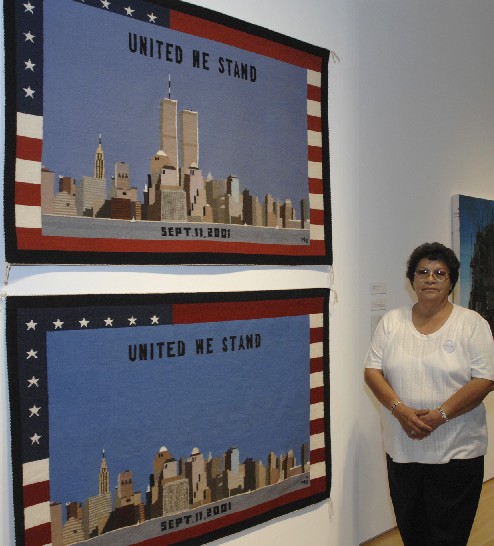
What can be more patriotic than the flag?
As an emblem of the 13 original colonies, and now 50 states, with the diversity
of its peoples becoming one in spirit, our flag is woven with American
history and hopes.
So when Navajo weaver Martha
Smith responded to 9/11 by creating an image to commemorate that day, she
chose to represent the flag as the border of her design.
And within that symbolic
border she placed the pixilated skyline of New York City with the Twin
Towers standing, with the words, “united we stand.”
You will want to see this
weaving, and its companion, at the Nerman Museum of Contemporary Art at
Johnson County Community College through August 10 when it will return
to its owner in Gallup, NM.
Is the weaving an affirmation
of what America was before 9/11, or as a statement of what America cannot
be again, or is it a powerful and defiant, through understated, protest
against the horror of that day, or as a statement of America’s endurance
through this and all other calamities, or does it ironically reflect America’s
vulnerability?
The perfect simplicity of
the design allows as many interpretations as there are feelings around
the 9/11 attacks. A lesser artist could have sensationalized or trivialized
the subject.
The museum’s director, Bruce
Hartman, first saw the weaving in New York five years ago and immediately
considered it one of the most important Native American works of the 21st
Century. But after that sighting, he was unable to locate it, much less
purchase it.
Until two years ago
when he happened to be snowed in near Gallup and saw it hanging in the
back of a trading post. He could not convince the owner to sell it, but
eventually the artist agreed to a commission to create a companion weaving
for the Nerman.
But what would the companion
look like? You can see it now below the first weaving.
The companion design seems
inevitable. It copies the first flag-framed skyline — but without the Twin
Towers. Talk about understated impact!
These weavings gain extra
significance when you remember that the Navajo have served in the Armed
Forces well beyond their numbers, and the Navajo “code talkers” provided
secrecy for military messages during WWII.
The Navajo tradition, with
its stories of Spider Woman and her loom, has produced blankets, rugs and
other textiles that are useful and beautiful, symbolic and spiritually
expressive. For us now, from this indigenous culture, a powerful contemplation
of the meaning of America today is woven.
720. 080625 THE STAR’S HEADLINE:
Sufi teacher raises a balloon
Last Thursday I went to hear a visiting
Sufi saint speak. I came home with a smile on my face and gifts from him,
including a prayer rug, photos of the Great Mosque in Mecca and of the
saint himself, Maulana Zainulabedin Kazmi, with a shirt, socks, a tie,
a piece of candy, phrases for dhikr
(recitations to remember God)
-- and a balloon.
Like everyone at the lecture
at the Tao Academy of Kansas City, I also was given a list of the 40 shaykhs
in the Naqshbandi Tariqat (“Path”), which is the only order to trace its
lineage back to Muhammad through the first Sunni caliph, Abu Bakr.
Several names in the list
grabbed my attention, including al-Bistami (804-874), who developed the
teaching of fana, “extinction,” the idea that when our ego fades we can
realize God’s true nature, and baqa, revival within God.
And Maulana brought these
ideas into his teaching that night in speaking about two kinds of knowledge,
that which can be taught and that which is “poured into the heart.” Gosh,
I need more of the latter, I realized.
I liked his call to humility.
He said a tree bows down when it is laden with fruit.
A friend in the audience
asked what the mystic Suhrawardi (1153-1191) meant by saying, “God reveals
himself by veiling himself and veils himself by revealing himself.”
I could not hear the mumbled
answer, so I contacted my friend the next day. He said that whatever the
answer was, he found himself several times pulling a balloon out of his
pocket and smiling.
My friend thought of Maulana
as a trickster or the holy fool found in many religions, who play a kind
of hide and seek, avoiding our serious questions because we need something
deeper. By defeating the ego’s seeking precisions and explanations with
their minute focus, we are poured beyond the question into the heart of
the mystery of existence.
Ibn Arabi (1165-1240) also
wrote of veils. God hides himself behind many layers of veils. But
the greatest veil, and the last one to be removed, is believing one can
see truth without a veil, to identify any idea or practice with God.
This is why Jews prohibited
idols and why Zen Buddhists sometimes say, “Enlightenment is knowing
there is no Enlightenment.” It is why Muslims say shirk, giving God any
partner, is the worst blasphemy.It’s a way of saying, If you think you
have the answer, you don’t.
God, the ultimate truth,
cannot be a possession of the ego. But God can pour himself into the heart
when we let go.
I prize the“veil” of the
prayer rug, yes, but I particularly like the “veil” of the balloon. Religion
is complete when, along with the profundities of the spirit and the disasters
of our time, it embraces a child-like sense of awe and surprise, of festivity
and playfulness.
719. 080618 THE STAR’S HEADLINE:
The beauty of Islam
Several readers of last week’s column asked
why I called Islam “incredibly beautiful.” Based on decades of study,
world travel and long friendships with Muslims, I answer with three hints.
*Our indebtedness to Muslim
culture is extraordinary. Try doing your finances using Roman instead of
Arabic numerals, and you’ll get the idea.
Have you had your cup of
coffee? The attempt 400 years ago to prohibit Christians from drinking
coffee as a Muslim drink obviously has failed.
Thomas Aquinas, for centuries
the preeminent Christian theologian, was influenced by Muslim philosophers
Ibn Sina (Avicenna) and Ibn Rushd (Averroes). The art, music and poetry
of the Renaissance, out of which today’s world developed, were stimulated
by encounter with Muslim thinkers.
Who can see the Alhambra
or the Taj Mahal or the great mosques throughout the world without awe?
One image often used to identify Kansas City is Giralda Tower on the Country
Club Plaza, a smaller version of what was once the minaret of the mosque
in Seville.
*The five “pillars” of Islam
present a spiritual path rousing admiration, if not imitation.
The first pillar is the profession
of faith, that there is but one God and Muhammad is his messenger. In context,
whether you agree or not, this simple statement serves to center and unify
every aspect of how one lives one’s life.
Second, prayer five times
daily is a renewal of one’s commitment to submit to God’s will.
Third, giving to the needy
is a religious obligation.
Fourth, in the words of Bill
Graves, then Kansas Governor, Muslims fast during the month of Ramadan
“to remind themselves that others hunger and to relieve the hunger of others,
to practice discipline through self denial, to nurture family relationships
and to strengthen commitment to God” and to recall the first revelations
of the Qur’an.
Many Christian Lenten austerities
are pale in comparison.
These first four pillars
I have repeatedly observed, and from them I have taken inspiration.
The fifth pillar is the pilgrimage
to Mecca. While this is not possible for me since I am not a Muslim, I
have witnessed how this ritual has deepened the faith of Muslim friends.
*Speaking of Kansas City
Muslim friends—they may be business people, professors, chaplains, elected
to public office, appointed to government service, doctors, scientists
or soldiers. They may fight fires, teach martial arts, report the news
or manage a library.
They are honest and generous,
working to make America and the world better. They never seek to convert
me. Their faith is beautiful.
718. 080611 THE STAR’S HEADLINE:
A plea for gay Muslims
Jihad for Love is a documentary
film about the struggles young gay and lesbians Muslims have with their
faith. Jihad means “struggle” in Arabic, and particularly the struggle
we have within ourselves to do the right thing.
The movie will be shown as
part of this month’s Gay and Lesbian Film Festival.
When I previewed it, I had
two overwhelming and paradoxical reactions.
The first reaction was how
incredibly beautiful Islam is. I would not expect most non-Muslim viewers
to have this reaction. But I have been to some of the sacred sites the
movie shows and I have participated in some of the Muslim rituals.
I cannot get out of my mind
the tenderness and devotion of a lesbian couple who trace calligraphy in
stone of a passage from the Qur’an as they seek to find their place in
their faith.
In a way, the film parallels,
say, some Roman Catholics who love the Church with its music, liturgy and
sacraments, who follow a loving Jesus, for whom the warmth of family embrace
is molded by reverential practice of the faith, but who are officially
“disordered” because they love folks of their own sex.
My second reaction was grief
at seeing devout young people suffering, with their lives threatened in
the name of their faith. I don’t like hearing an imam talk about stoning
and beheading as a punishment for loving another human being.
As the film follows individuals
and pairs in their jihad for love, we see fear, curiosity, anguish, grief,
lamentation; but because they are unwilling to abandon their faith, the
anger is restrained.
Parvez Sharma made the film
in secrecy and obscures some of the faces. The stories unfold in India,
Pakistan, Iran, Turkey, Egypt, South Africa and France, with an escape
to Canada. We learn about the harsh traditional Islamic law, but also Islamic
interpretations that permit, and even legitimize, same-sex
relationships.
It is ironic that Islam contains
a long, and at times, honored tradition of same-sex relationships. The
film includes a Pakistani holiday celebrating one such couple. But when
the West colonized many Muslim countries, anti-gay laws were adopted.
The 81-minute movie shows
at the Tivoli Cinemas June 29, Sunday at 4:45. Following the film, in cooperation
with OpenCircle, I will lead a panel and audience discussion. Panelists
are Josef Walker (Christian), Ahmed El-Sherif (Muslim), and Lynn Barnett
(Jewish).
I’ll ask, “How does the jihad
you see portrayed in this movie compare with struggles you know about that
people in your own faith have dealt with?”
[For background, I recommend Islamic
Homosexualities by Stephen O Murray and Will Roscoe, NY University
Press, 1997, ISBN 0-8147-7468-7.]
{A longer preview of this movie appears
in CAMP
and to the left.}
717. 080604 THE STAR’S
HEADLINE:
Happy Couples can start new traditions
Weddings belong to the happy couple and
their guests, not to me, the officiant. I yield to their considered wishes,
but I offer my professional advice as we plan the ceremony.
* For example, it does not
make sense for a couple who have been living together for some time to
appear at the ceremony from separate entrances, at separate times, with
separate escorts.
Still, even older couples
sometimes want the bride to be escorted down the aisle by her father, and
it is important to honor that expectation.
A wonderful variation, especially
for a young couple, is for both of them to be escorted by their parents.
* “Giving the bride away”
treats her like property. I prefer to ask, “Who presents this woman to
be married to this man and blesses their love?” to which her family responds,
“We do.”
Then I ask, “Who presents
this man to be married to this woman and blesses their love?” to which
the groom’s family responds.
This avoids the sexism of
archaic language and is easy to adapt for same-sex couples.
* The exchanging of vows
is the pivot of the ceremony. The couple can speak their vows directly
to one another, without the “repeat after me” interference from the minister.
I suggest they compose their
vows from various examples and from what is in their hearts, write them
on parchment paper and read them in front of their guests.
This gives the guests something
to see as well as hear and it dramatizes the commitment. Some couples
like to frame their vows for their home or include them in their book of
wedding memories.
* A few couples still insist
on my saying, “You may kiss the bride.” The state has given me the right
to solemnize marriages, but I am uncomfortable giving one partner permission
to kiss the other.
I’ll tell the couple an embrace
is expected after I pronounce them hitched, and they’ll probably feel like
kissing then. But they don’t need me verbalizing permission.
* Sometimes couples want
to acknowledge someone who cannot be present — an ailing aunt or a deceased
grandfather. This can be done with a note in a printed program, if any,
or by the officiant saying something like, “This day we remember . . .
.”
* In a planning session recently
a couple told me that while their wedding day would be so very happy for
them, they wanted their ceremony to recognize that not everyone is happy,
that there is much sorrow and suffering across the planet.
This couple’s marriage, I
am sure, will better the world.
716. 080528 THE STAR’S
HEADLINE:
Hope and change are possible
Preacher, author, editor of Sojourners
magazine and frequent media guest, Jim Wallis will speak here at a June
8 banquet. His latest book is The Great Awakening: Reviving Faith &
Politics in a Post Religious Right America.
In an interview, he told
me, “I believe we are seeing the beginnings of a new Great Awakening in
America that could become another spiritual revival that will change big
things in the world.
“Hope and change are really
possible, and we can make a difference. People of faith have done big things
before and will do them again.”
It is a message that will
be welcomed by the organization bringing him here, the Metro Organization
for Racial and Economic Equity (MORE2).
The Rev Eric D. Belt, one
of the MORE2 co-chairs and pastor of St. Stephan Baptist Church, said that
Wallis was especially skilled in helping people address folks “of different
cultural backgrounds and races to bring about changes for equality and
justice.”
But can religious organizations
bring about such change more effectively than other agencies?
Wallis replied, “Church-based
ministry that serves those in need is important, but organizing a movement
that can work for social justice is critical.
“And congregations have a
central role in that organizing. We can provide message and motivation
– a sense of meaning, purpose and moral value that is often missing in
the larger society.
“As a counter-cultural community,
the church can have a prophetic public voice.
“And, as often the last standing
social institution in many communities, churches have the institutional
presence and constituency for effective organizing.”
This can sound like politics,
so I asked about that.
Wallis said, “People of faith
should insist on the deep connections between spirituality and politics
while defending the proper boundaries between church and state that protect
religious and non-religious minorities and keep us all safe from state-controlled
religion.
“We should demonstrate our
commitment to pluralistic democracy and support the rightful separation
of church and state without segregating moral and spiritual values from
our political life.”
MORE2 was created in 2003
and now has 18 cooperating congregations in the metro area. It is linked
to the national Gamaliel Foundation, with whose Chicago headquarters the
young Barak Obama worked as a community organizer.
For banquet information,
visit more2.org or call 816-808-6604.
715. 080521 THE STAR’S
HEADLINE:
By their fruits you shall know them
Last week this column suggested that atheists
should welcomed into religious conversations.
A reader who disagreed wrote
that “if we know such people we should pray for them and . . . lay awake
at night praying how we can bring them to Christ.
“If this is not what you
believe, then I can understand why you are always willing to allow these
people to continue in their pagan beliefs.”
The writer also said that
the “only interfaith conference in the Bible was Elijah and the prophets
of Baal and we know what happened there.” (The Baal god was shown to be
ineffective and the God Yahweh—sometimes translated “Jehovah”—was vindicated.)
In my reply, I noted the
Gospel interfaith stories of Samaritans.
Jews of Jesus’ time are reported
as rejecting the Samaritans. (John 4:9)
At one point Jesus was even
accused of being a Samaritan and demon-possessed. Jesus denies being demon-possessed,
but he does not say he was not a Samaritan, though he was not. Perhaps
he did not wish to dissociate himself from those against whom prejudice
was directed.
Jesus also told the parable
of the good Samaritan (Luke 10:30), in which a Samaritan acted with more
compassion than the religious officials of his own tradition.
In addition, when Jesus healed
ten lepers (Luke 17:11), the only one grateful enough to express thanks
was the single Samaritan.
Finally, when Jesus visited
the Samaritan woman at the well, he said that salvation is from Jews; he
did not predict that future salvation would come from the Christians. But
he did go on to say, “Yet a time is coming and has now come, when the true
worshipers will worship the Father in spirit and truth, for they are the
kind of worshipers the Father seeks.” (John 4:23)
I am interested in those
whose faith is found in spirit and in truth more than I am interested in
what denomination or religious label, if any, they use to identify themselves.
Spirit and truth are much
larger for me than mere creeds, as Jesus indicated in Matthew 25:31, where
the righteous are described not by their beliefs but by feeding the hungry,
giving drink to those who thirst, housing the stranger, clothing the naked
and visiting those in prison.
Most of us may be less concerned
with the theology in others’ heads than with the spirit in their hearts.
Jesus said, “A good tree cannot bring forth evil fruit, neither can a corrupt
tree bring forth good fruit. . . . By their fruits ye shall know them.”
(Matthew 7:18-20)
Perhaps we should be less
concerned over the species of the tree than whether the fruit is wholesome.
714. 080514 THE STAR’S
HEADLINE:
Include atheists in making the world
a better place
Should atheists be welcomed into religious
conversations? Can agnostics, secular humanists and others sometimes grouped
together as “freethinkers” make a contribution to people of faith?
To answer these questions,
let’s consider the thought and lives of some to whom such labels might
be applied.
Some Athenians accused Socrates
of atheism. Early Christians were considered atheists by the Roman authorities
because they did not believe in the gods recognized by the Empire.
Thomas Paine, whose Crisis
papers fueled the American Revolution, was called a “dirty little atheist.”
Thomas Jefferson wrote, “It does me no injury for my neighbor to say there
are twenty gods or no God. It neither picks my pocket nor breaks my leg.”
He was accused of atheism. So was Abraham Lincoln, who never joined a church.
Paul Tillich, a towering
theologian of the 20th Century, was also called an atheist. When he said,
“God does not exist,” Tillich meant that the conception of God as a Supreme
Being was too puny. God is not a being above others but rather being itself,
the “ground of being” out of which all else arises. This understanding
of God compares with the teachings of many Christian mystics.
While Judaism developed the
potent belief in one absolute Deity, to be a Jew does not require belief
in God; the traditional requisite is to have a Jewish mother, and it is
good to affirm the community’s rituals.
Some Unitarian Universalists
use the word God, but few would think of God as a supernatural being. God
might be the power that transforms people when they are really listening
to each other.
Neither Confucianism nor
Taoism is founded on the belief of a Creator. The Tao is not God but rather
the way of the universe works.
Most Buddhists hold no belief
in a Creator God. They prefer to be called “non-theists.” If you ask, “If
there is no God, where did the universe come from?” you might be answered,
“For us, the universe is an ongoing, interrelated process that, like your
God, has no beginning and no ending.”
While most Hindus believe
in God, some branches of the faith are atheistic. Mimamsa, for example,
teaches the importance of dharma, which can be translated as morality,
duty and virtue.
Another ancient Indian faith,
Jainism, teaches respect for all creatures, advocates non-violence and
encourages charity and good works such as building hospitals and animal
shelters. It also is atheistic.
Personally, I want the conversation
to include everyone who is helping to make the world better.
713. 080507 THE STAR’S
HEADLINE:
Eighth-Century Mystic Has Teachings
for Today
In the entire history of Hindu theology,
perhaps no more influential figure can be named than Shankara, the 8th
Century mystic who in his brief life of 32 years reformed and rejuventated
Hinduism after nearly a thousand years of Buddhist ascendancy in India.
In a lineage begun by him,
Swami Nishpapananda of the St. Louis Vedanta Society will speak here Sunday
on “Shankara, the Great Teacher.”
In response to questions
I sent Nishpapananda, he wrote me that Shankara, by the time he was 12,
had a mystical experience which led him ultimately to travel “the length
and breadth of India twice on foot, debating representatives of the different
schools of thought and pointing out their deficiencies.”
Shankara’s key insight was
that reality is “non-dual,” ultimately undivided. The Sankskrit term for
this school of thought is
Advaita.
For Shankara, there is no
real difference between the individual person and the “conscious
principle underlying and sustaining the universe” called Brahman — God,
Nishpapananda said.
“This means that in the highest
mystical experience, the world disappears completely. There is no subject
or object in this experience; only the Divine Reality is. In the West mystics
like . . . (the Christian) Meister Eckhart, among others, had this
experience,” Nishpapananda explained.
The perception of divine
reality within the mystical experience can be compared to awakening from
the illusion of a dream.
I asked how one can achieve
liberation from the illusion that things are separate from the divine.
Nishpapananda replied:
“Christ put it most succinctly:
‘Blessed are the pure in heart, for they shall see God.’ A pure heart is
without desire or enmity. Purity comes from sustaining a moral course while
pursuing secular goals. The Sanskrit term is dharma.
“One learns from experience
that the best that ordinary life has to offer does not solve the knotty
problems of life and death. Then the mind turns towards God as an ideal,
and to the path that leads to liberation.
“Prayer and meditation can
then help cleanse the subconscious mind. But ultimately, liberation comes
through grace.”
In the 12th Century, Ramanuja
developed an alternative philosophy, and in the 13th Century, Madhva produced
a third view of how God and the individual are related, but Shankara’s
teachings are often identified as the central message of Hinduism.
Nishpapananda’s talk begins
at 10:30. The Vedanta Society is located at 8701 Ward Parkway. The website
is vedantakc.org.
712. 080430 THE STAR’S
HEADLINE:
Classical Music's Spiritual Charms
Almost eight years ago in this space I
called the loss of local radio station KXTR-FM a “spiritual devastation.”
An AM spot continued the call letters, and programming from Boston was
instituted.
With the return to local
programming 24/7 at 1660 AM last month, a follow-up is in order.
I asked Patrick Neas, program
director and morning show host, about the music he puts on the air.
“For me, ‘classical’ and
‘spiritual’ are interchangeable terms,” he said, “because they both mean
enduring, speaking from one generation to another, to different people,
to different eras. It opens us to all humanity.
“Music need not have been
composed for a church — it could be ‘secular’ — but if it is classical,
it nonetheless has power to transform people’s lives, to help them overcome
difficulties.”
Neas said that some works
of music may be more spiritual than others.
Beethoven’s isolation from
hearing loss, disappointments in relationships and other problems meant
“he had to deal with these issues, and he could not deal with his art as
before. His last quartets show us both the reality and the transcendence
of suffering.”
But classical music can have
a spiritual impact even at an early age. Neas cited “The System,” a Venezuelan
program that trains thousands of poor children to play instruments, increasingly
known through one of its alumni, Gustavo Dudamel, who becomes the conductor
of the Los Angeles Philharmonic next year.
Neas said The System shows
that classical music can “reduce gang violence, lift people up, nurture
them, train them to focus and give them power to overcome obstacles.”
He laughed when I told him
that I sometimes catch my son listening to classical music. “Classical
music is the rebellious thing these days. It’s not what the corporations
are telling kids to listen to. Classical music inspires passion in them.
It enriches their entire lives.”
Neas also discussed the station’s
role in encouraging local performances.
For example, Thursday at
10 am, Neas will host a one-hour interview with Ward Holmquist, artistic
director of the Lyric Opera of Kansas City, about John Brown which receives
its world premiere here Friday.
The opera includes Brown’s
activities in Lawrence, foreshadowing the Civil War. Brown invokes Moses
and raises the perplexing and fundamentally spiritual question, “When is
violence justified?”
May I say “whew!” and “amen!”
now that Neas is back doing KXTR’s programming?
711. 080423 THE STAR’S
HEADLINE:
Agnostic’s questions have biblical
answers
In the church of his youth in Lawrence,
with nearly every pew at capacity last week, Bart D. Ehrman, chairman of
the department of religious studies at the University of North Carolina
at Chapel Hill, announced that he was an agnostic.
He joked that
atheists think agnostics are wimpy atheists and that agnostics think atheists
are arrogant agnostics.
How did he lose
his faith? Ehrman said it was from asking the persistent question, “If
God is both all-powerful and all-loving, why do innocent people suffer?”
His lecture explored
three of many biblical answers.
The dominant
answer in the Hebrew Scriptures is that suffering is God’s punishment for
people’s wickedness, for their failure to keep the covenant established
between God and Israel. God had intervened to bring the children of Israel
out of Egyptian slavery, and God intervenes to reward and chastise.
Ehrman called
this the prophetic answer. The prophets, such as Amos, pronounced disasters
on their own people because they strayed from fulfilling their obligation
to be just.
By about 150
years before Christ, a new answer developed within Judaism because the
old one had failed to explain why the wicked prospered and the righteous
suffered and God was not intervening.
Ehrman called
the new answer “apocalyptic,” which means revealed. It characterizes the
Christian Scriptures.
In this view,
suffering is explained by a cosmic evil power contesting with God by hurting
people, so it is impossible for humans alone to improve things. Instead
we are called to place ourselves on God’s side.
Ultimately God
will vindicate his name and his people. God will compensate them for their
suffering and punish unbelievers with eternal damnation.
Jesus said this
redemption is at hand. Paul thought his own generation would be the last.
Ehrman gave examples of numerous predictions of imminent fulfillment from
the last 2,000 years, including The Late Great Planet Earth and the Left
Behind book series.
Ehrman’s own
approach to the problem favors the view of Ecclesiastes, a book of the
Bible that begins by saying all is vanity. The Hebrew word translated as
vanity, hevel, means mist or vapor, which compares with the Buddhist notion
that everything is transitory.
Ecclesiastes
says this life, often unjust, is all there is, with no afterlife for rewards
or punishments. We should enjoy the simple pleasures — our companions,
good food and good drink.
To this Ehrman
adds that it is impossible for him to enjoy life unless he also works to
lessen the suffering of others.
710. 080416 THE STAR’S
HEADLINE:
Islamic Society leader to speak in
Topeka
A woman and a convert to the faith is the
president of ISNA, the Islamic Society of North America, and she is drawing
Muslims and non-Muslims alike to Topeka this Sunday to hear her speak.
ISNA describes itself as
the largest Muslim organization on the continent.
A Jew on the board of Interfaith
of Topeka heard Ingrid Mattson on NPR. She spoke to fellow board member,
Ashraf Sufi, a Muslim, who invited her. She wanted to hear Mattson discuss
why the public does not hear more Muslims condemning terrorism, whether
Islam is compatible with modernity and the role of women in Islam.
Rauf Mir, the Muslim member
of the Greater Kansas City Interfaith Council, served on the nominating
committee that led to Mattson’s election as ISNA president. Mir said her
interfaith work, scholarship and leadership are “compelling reasons for
members of other faiths to attend the gathering at Washburn University.”
I contacted Mattson at Hartford
Seminary, where she is professor for Islamic Studies and Christian-Muslim
relations. I asked her about interfaith work.
She said that we often speak
about other faiths out of ignorance and from bad information. She noted
that her students from abroad were sometimes surprised to learn how important
ethics can be for Christians since the images they had of Americans had
come from TV, “which often depicts dysfunctional families devoid of much
religious faith.”
And Christians, she said,
“have many misconceptions about Islam.”
Despite our commitments to
our own faiths, “each of us is a flawed human being who can never realize
the perfection of our religions,” she said.
“We are ethically compelled
to learn about each other so at least we can fulfill our own responsibility
to speak the truth.”
“The Qur'an,” she said, “teaches
us that religious diversity is God’s will, and that we should see the presence
of the other as a challenge to do better ourselves, to ‘compete in good
works.’
“Religion in general has
gotten a bad reputation as a cause of strife and discord in the world.
We need to show that that does not have to be the case. We can remain
committed to our (own) traditions, yet still work together for a better
society.”
There is no charge to hear
Mattson speak at 2 pm at the Washburn Memorial Union. Also at the event
will be Keith Ellison of Minnesota, the first Muslim elected to Congress,
and Kansas Rep. Nancy Boyda. For more information, call Ashraf Sufi, 785-608-5879.
709. 080409 THE STAR’S
HEADLINE:
We can be alike, we can be different
The assignment offered me was to explain
“Why what we have in common is more important than our differences.” I
accepted the speaking engagement but said I would instead balance appreciating
differences with similarities.
I began my speech by acknowledging
the urge we have to spotlight our similarities. Our world is in conflict,
we are painfully aware of religious differences. We think that if we could
only agree, the fighting would stop.
But another path to peace
is celebrating our differences rather than warring over them.
Actually we value differences
all the time, I said. People in love don’t usually emphasize how similar
the beloved is to everyone else, but rather on how special he or she is.
Consider the reverse. Suppose
a husband said to his wife, “I was intimate with your best friend last
week. You are so similar, the differences shouldn’t matter.”
Or we go to a concert or
a sporting event and expect to enjoy the skill of a great performer, but
an announcer says that an amateur has been engaged instead because we are
more alike than different.
Or suppose you invite my
son and me for dinner. I thank you and say that in preparing the menu,
please keep in mind that my son has a severe cholesterol problem. When
you serve BBQ and I ask that you excuse my son from partaking, but you
insist, “BBQ is food, and all food is nutritious, so you should make him
eat it,” you will lose my respect.
I tried one more example
with my audience. Would you prefer a town with restaurants offering many
different cuisines or a town where the only entrée was a pabulum
produced by blending together whatever might be on hand?
We can see the varieties
of the world’s faiths not as threats but as gifts.
From primal faiths, for example,
we can be reawakened to the sacred in the realm of nature. From Asian traditions,
with introspective techniques like meditation and yoga, we can know ourselves
more deeply.
From the monotheism of Judaism,
Christianity, Islam and other religions, a sense of a Power moving through
history toward justice in covenanted community can correct the selfishness
and greed of our age.
Different people and different
cultures have different spiritual needs. Even in the span of our own individual
lives, our spiritual needs may vary. Respecting those differences is itself
sacred.
I asked the audience, how
many thought we are all like. Most hands went up. Then I asked how many
thought we are all different. The same hands were raised. In spiritual
matters, opposite statements can both be true.
708. 080402 THE STAR’S
HEADLINE:
There are many sides to the bible,
author says
Bart D. Ehrman may be the hottest biblical
scholar in America today. He’s been interviewed on The Daily Show, NPR,
CNN, in The Washington Post, and elsewhere. He chairs the Department of
Religious Studies at the University of North Carolina at Chapel Hill.
In his book, Misquoting
Jesus: The Story Behind Who Changed the Bible and Why, he explains
the texts that transformed him from a believer into an agnostic. His most
recent book, his 19th, is God’s Problem: How the Bible Fails to Answer
Our Most Important Question – Why We Suffer. He also wrote a book debunking
the historical claims associated with Dan Brown’s The Da Vinci Code.
At the end of my interview
with him, I asked what he’d like readers to know about himself. He said,
“I’m a Jayhawk by birth and always root for KU — unless they are playing
Carolina!”
He returns to Lawrence, where
he was raised, Apr. 14 at 7:30 pm, to speak at the Plymouth Congregational
Church, 925 Vermont.
I also asked him, Can you
explain briefly how you understand the diversity within early Christianity
for those who think there is a single authoritative “autograph” version
of the scriptures and unanimity among early Christian writers?
He responded, “Early Christianity
was not one thing, but lots of different things, with different Christian
groups teaching ideas that today would strike most Christians as absolutely
ludicrous and even blasphemous.
“But each of these groups
claimed to be representing the teachings of Jesus and his apostles (some
of them taught that there were 30 gods, or that Jesus wasn’t really a human
being, or that the Old Testament was inspired by an evil divinity, or that
this world was the result of a cosmic disaster).
“You might wonder, why didn’t
they just read the New Testament to see that they were wrong?
“The answer, of course, is
that there was no New Testament yet, in the early centuries of the church.
The New Testament emerged out of these conflicts, and represents the books
that the ‘winning side’ decided should be considered scripture.
“The other sides also had
books, though, books that claimed to be written by the apostles of Jesus.
Sometimes these alternative scriptures get re-discovered, and that’s where
scholarship on early Christianity becomes especially fascinating.”
In my interview, available
in full at cres.org/bart,
Ehrman complained that attacks on religion by “the new atheists” —
Sam Harris, Richard Dawkins, and Christopher Hitchens — are “surprisingly
ignorant about religion.”
707. 080326 THE STAR’S
HEADLINE:
Agree on terms before debating
Several weeks ago I suggested that focusing
on personal stories helps people talk with each other about faith without
arguing. Each person is an expert about one’s own experiences of the sacred;
by sharing them, we understand each other better.
But what if you want to have
a friendly argument? There’s plenty to argue about.
Is there a God? When does
human life begin? Should the scripture of this or that religion be read
literally? Why do the wicked prosper? What happens after death? Is life
worth living?
Here are four guidelines
for arguments.
*Be sure you and your partner-in-argument
know what you mean by the terms you use. For example, God can mean the
creator of the universe, the ultimate judge we all face.
But for some, God is not
a being at all, certainly not a being supreme above all other beings, but
rather the impersonal ground of being out of which everything arises, like
the blank rolls of paper without which these words could not printed.
God can also
mean the power or process that can transform us as we cannot transform
ourselves, as when folks of different races listen to each other so well
that they gain a sense of kinship unimaginable before.
For some God
is the word that summarizes all of the laws of nature. And for some God
is nothing more or less than perfect love.
All these ideas of God, and
more, are in the Western tradition. Primal and Asian faiths offer other
conceptions as well.
So if you are arguing whether
God exists, be sure you know what you mean by God.
*Discover whether you and
your friend accept the same authority and evidence for your opinions. Is
it scripture? Is it tradition? Is it ecclesiastical teaching? Is it a guru?
Is it mystical experience?
Each of these has its own
problems. The Bible, for example, has been used to support many conflicting
creeds. Reason can be clouded by background and temperament. Senses can
be deceived far beyond simple optical illusions.
For some, the human body
is evidence of divine design. For others, it is clear proof of mundane
evolution through trial and error.
*See how successful you and
your partner can be in presenting each other’s position. This is a good
check to gauge mutual understanding.
*Finally, remember that if
there were truly obvious and compelling answers to theological questions,
you probably wouldn’t be debating them. Modesty about our own positions
may remind us of the ultimate mystery too great to be contained in any
human argument.
#706. 080319 THE STAR’S
HEADLINE:
When is war a just war?
After five years, the moral, legal, political,
military, diplomatic, economic, humanitarian, security and other dimensions
of the Iraq War deserve reassessment, but this column focuses only on Christian
“just war” theory for the reader’s own evaluation.
Before the conversion of
the Roman emperor Constantine to Christianity, often dated to 313, most
Christians would not serve in the army. Early theologians Hippolytus, Tertullian
and Lactantius condemned military service, and Origin (185-254), one of
the great “church fathers,” promoted pacifism. Christians often would not
serve as judges in capital cases because they held killing to be wrong.
In 410 Christian Rome was
sacked by the Visigoths, who were also Christian.
This, and other disturbances,
led Saint Augustine of Hippo (354-430) to borrow ideas about when war is
justified from the Roman pagan Cicero (106-43 BCE).
Cicero’s theory included
these points:
* The purpose of war must
be to establish justice and peace.
* War must be waged by the
legitimate authority of the ruler.
* Violence must be restrained,
not wanton.
* Prisoners and hostages
must be treated humanely.
In 2004, Robert E. Johnson,
Professor of Christian Heritage at Central Baptist Theological Seminary
in Shawnee, identified for this space six components of Augustine’s “just
war” theory, all of which had to be satisfied:
* The purpose of war must
be to restore peace and secure justice with a reasonable chance of success.
* War must be conducted under
the direction of a legitimate ruler and be motivated by Christian love.
* War must be a last resort,
after all other options have been tried and failed.
* War must have limited objectives;
the total obliteration of an enemy is not permitted.
* Safeguards against unnecessary
violence, massacres and looting must be observed.
* Noncombatants may not be
molested.
“Just war” theory developed
further under Aquinas (1225-1274) and Christians continue to refine it.
Some consider the “Powell Doctrine” a secular expression of the theory.
A further
development in the theory concerns whether pre-emptive self-defense is
justified. In 2002, when the Iraq War was still just a possibility, I asked
Catholic scholar Garry Wills, in town to lecture at Rockhurst University,
about the “just war” doctrine. He said that Iraq posed no immediate threat
to us. Initiating war was forbidden.
“People have threatened to
kill me, and some of the threats are serious,” he said. “But I cannot take
action against them until they actually show intent to come after me.”
705. 080312 THE STAR’S
HEADLINE:
Humanism is one solution to evil
When blameless people suffer, believers
in an all-knowing, all-powerful and all-good God have some explaining to
do. Why does such a God not intervene to prevent the individual agonies
and the horrors of history that afflict upright, decent people?
Countless explanations have
been tried. The book of Job defeats the argument that the victim must be
denying one’s own wrong-doing.
John Milton’s Paradise
Lost attempts “to justify the ways of God to men” by invoking the idea
that the God’s gift of free-will involves the possibility of wrong choices
and suffering.
Currently, a widely discussed
solution is offered by John Hick who contends that unmerited suffering
gives the soul an opportunity to grow.
Others like Billy Graham
simply proclaim a faith which says we cannot understand God’s ways.
Anthony B. Pinn, professor
of religious studies at Rice University and credited with over a
dozen books, is uncomfortable with any of these solutions.
Also executive director of
the Society for the Study of Black Religion, he is keenly aware of the
suffering of slaves and their descendents in America
In his book, Why, Lord?
— Suffering and Evil in Black Theology, he reasons that expecting God
to generate good from evil can promote a sort of passivity that keeps us
from challenging oppressive social structures. The idea that suffering
can be redemptive lessens the recognition that evil is completely evil.
The book concludes, “what
are the true possibilities for transformation when God’s intervention is
not apparent, but is desperately appealed to? How strongly does one fight
for change while seeking signs of God’s presence? Humanity is far better
off fighting with the tools it has — a desire for transformation, human
creativity, physical strength, and untapped collective potential.”
Pinn values human liberation
over belief in God. He calls his position a “Humanism,” and in an interview
said he tends to capitalize the word because it “isn’t an extension of
my earlier practices and faith claims. Rather it is a different religious
practice.”
Some may think of Humanism
as an abstract, intellectual approach to issues of faith, but Pinn’s perspective
arises from a heads-on confrontation with the real experience of evil.
Islam is a religious alternative
some blacks find to “meet their spiritual needs” and provide “the disciplined
life they desire.”
Pinn speaks twice this week-end
at All Souls Unitarian Universalist Church. Saturday at 7:30 p.m. he presents
“A Religious Odyssey.” Sunday at 10 a.m. he discusses “Islam in America.”
704. 080305 THE STAR’S
HEADLINE:
'Bodies' exhibit reveals spirit
As I approached the “Bodies Revealed” exhibit
at Union Station, I offered a prayer something like this:
“Infinite source of all,
as I enter this exhibition, I honor the persons whose bodies I will see
and revere. I give thanks for the gift of learning. With this encounter,
I vow to understand and care for myself and others with greater compassion,
and to use this opportunity to benefit others, in the profound mystery
of the body as a vessel for life.”
Just as a cathedral or temple
is designed for worship but is not violated by tourists who may be inspired
by viewing it when the worshippers are gone, so the body, the temple of
the spirit, when vacated by the person, can inspire profound appreciation
for the sacred gift of life.
I recalled how humans have
shown respect for the dead for at least 200,000 years. Early graves show
bodies oriented to the east, bones placed in a fetal position, with tools
and adornments, suggesting belief in some sort of rebirth or immortality.
While some Middle Eastern
cultures separated the living from the dead body as “unclean,” megalithic
cultures in Ireland, the Aegean and elsewhere emphasized communion with
ancestors whose spirits were embodied in menhirs, upright stones, an idea
ridiculed in Jeremiah 2:27.
Common in our own culture
is viewing an embalmed body before burial, but Jews and Muslims practice
immediate burial.
Cremation is thought to be
a dignity offered the dead in Hindu and other faiths.
The traditional Parsi disposition
of corpses in “towers of silence” offers the bodies to vultures, a practice
that may shock those unfamiliar with the world view of that faith.
But eating the flesh and
drinking the blood of the Christ to honor him in the Eucharist is shocking
to those unacquainted with Christian tradition.
Of all forms of body disposition,
I wondered, except for organ donation, could there be any greater honor
offered the deceased than the sharing of our humanity in reverent intimacy
through such an exhibit?
When, at the end of the exhibit,
I was invited to touch and hold an actual human organ, I selected the brain.
I silently said a prayer, then my fingers touched the holy convolutions
of tissue which once housed ideas, sensations, desires—a personality. I
was struck anew with the mystery and fragility of awareness.
A statement by the Catholic
Diocese of Pittsburgh spoke of the “dignity and miracle of human creation”
revealed by a similar exhibition.
We spirits are made flesh.
This exhibition proves this awesome truth.
703. 080227 THE STAR’S
HEADLINE:
Right qustions open dialogue
How can you discuss religion without getting
into an argument? How can you listen to others without feeling they are
trying to convert you, and how can you present your own faith without appearing
aggressive?
Can two people with different
levels of knowledge about religious matters have a discussion on an equal
basis?
Can an Israeli and a Palestinian
discuss religion in a way that sets aside religious and political conflict?
The answer to these questions
is yes — if the conversation focuses on not who is right and who is wrong
but rather on personal stories. You cannot dispute someone’s own life experiences.
A structured exercise can
get the process going. In a conversation between you and your friend, start
with five minutes each to speak without interruption as the other listens.
It is sometimes helpful to
begin with question. Here are some examples:
*Can you tell me a story
when the universe seemed to make sense to you or when you were overcome
with a sense of awe?
*What experiences have
you had that point to the ultimate source of life’s meaning for you?
*Was there a turning point
in your life as you considered spiritual questions that helped shape who
you have become?
*Have you ever seen a painting
or heard music or walked on the beach or in a forest or played sports or
seen a sunrise or learned about science or worked a math problem or held
a child or made love when you felt lifted out beyond your ordinary sense
of self?
I like such questions because
they welcome atheists, agnostics and humanists as well as believers into
the conversation.
In listening to someone answering
such questions, it is important just to listen. It is not useful, even
in your head, to criticize your friend’s choice of words or theological
framework.
What you want is to understand
the experience as a genuine expression of what is precious or even sacred
to your friend.
Spiritual ideas cannot be
fully comprehended except as they are embedded in stories. Religious terms
can mean one thing to you, another to your friend. By listening to how
your friend uses words in the context of your friend’s experience, your
own ability to use the languages of faith will be expanded.
Religion is really about
stories. There are the stories in the sacred texts, and there are the stories
of your own and your friends’ adventures in seeking to find guideposts
within the overwhelming mystery of existence.
It can be a privilege and
a treasure when you and a friend exchange intimate details of that adventure.
702. 080220 THE STAR’S
HEADLINE:
Medicinal Marijuana is a topic for
study
Suffering is the first fact of life that
the Buddha taught, and his teaching is sometimes called a therapy. The
“medicine Buddha” is a familiar image in the faith.
Other religions also seek
to relieve spiritual and physical distress. New Testament Christians prayed
by laying hands on the afflicted. American Indian healing practices, such
as Navajo sand painting and chants, are integral to the faith.
Still, I was surprised to
learn that Jewish, Methodist, Episcopalian, Presbyterian, Baptist and other
religious bodies are supporting some form of “medical marijuana” to relieve
the suffering of those for whom no other drug is effective.
This is not the place for
political or even medical disputes, though I did talk with Dr. Eric A.
Voth of the Institute on Global Drug Policy, who testified last week before
a Kansas Senate committee against a bill that would create a defense for
those whose suffering is relieved through marijuana when a physician writes
that marijuana could help a patient, just as codeine, cocaine, morphine
and OxyContin are available by prescription.
One of the reasons Dr. Voth
opposes the bill is because he believes marijuana has no medical value,
the official position of the FDA. He was unaware of religious groups supporting
his position, which he says is based on scientific study.
Testifying in favor of the
bill was former Kansas Attorney General Robert T. Stephan who emphasized
he was not advocating legalized marijuana but urged Kansas to join with
the 12 other states encouraging removal of marijuana from the FDA’s Schedule
I to Schedule II to permit adequate research.
Stephan, a cancer survivor
himself, endured seven years of chemotherapy. For 15 years he visited cancer
patients in Wichita and Topeka, he told me.
In his testimony he said,
“Some patients said they resorted to marijuana to relieve their nausea.
It is not right that they should be subject to incarceration because marijuana
was their last resort for relief.”
Stephan sent me a note from
a woman whose sciatic nerve is exposed.
“I have been through
basically every pain medication as well as surgery for placement of a spinal
cord stimulator which quickly became ineffective and resulted in another
surgery for placement of a morphine pump.
“I also take methadone
on top of morphine, and I still suffer with extreme pain.
“Using marijuana strictly
for relief of severe debilitating pain, I am completely pain free for approximately
6 hours or slightly longer.”
She had considered
suicide. No wonder religious groups are studying the issue.
701. 080213 THE STAR’S
HEADLINE:
True listening an act of love
When I realized that last week’s column
was the 700th in this series and that tomorrow is Valentine’s Day, I thought
a little love letter to you, dear readers, would be in order.
Writing about what you hold
sacred, revealed in politics, work, sports, science, history, the arts
— and even religion — is a weekly thrill. I like presenting perspectives
that I myself might not share, and on occasion saying how things look to
me.
But the real thrill comes
from the relationship we’ve developed, you and me. Some of you write me,
some of you mention the column when you see me, some of you have invited
me speak to your groups.
Some have been less generous,
like the reader who called the column, “pitiful, pusillanimous pabulum,”
or the folks who want me to condemn Islam or Catholicism or atheism.
To them, and all, I want
to say that what we hold dear is much bigger than can fit into any words
in this space.
Religion is less about words
than about experiences of awe and duty and despair and triumph and love.
It is about the great questions.
Who am I, really? How are we alike and different, and how can we live together?
What does the great longing that I feel mean? How can I make sense out
of disappointment and suffering? Is there a purpose or destiny for us?
Am I respecting or violating the creation, the harmony of nature? What
does death mean? How do I want to live my life?
Our answers are often expressed
in stories, personal stories and the stories of traditions.
It may be the story of Moses
or Jesus or Muhammad or Durga or Buddha or the Buffalo’s Wife or even evolution.
You, dear readers, may cherish
one story as sacred and at the same time understand that other folks take
great meaning from their stories. Because we are a community, you want
to appreciate their stories, too.
An ancient story tells of
blind men who encounter an elephant. One who feels a leg says the elephant
is like a tree. Holding the tail, another says the elephant is like a rope.
A third grasping the ear says the beast is like a hand fan. The one touching
the tusk says the beast is like a solid pipe.
But unlike the blind men
in the story who argue the truth of the beast from their own limited vantages,
you, dear readers, while affirming the integrity and power of your own
experiences, are eager to hear what others say.
We may not be blind, but
faith is about the infinite, and that is too large to grasp.
Still, reaching beyond oneself
into the mystery of existence is certainly a species of love. Happy Valentine’s
Day.
700. 080206 THE STAR’S
HEADLINE:
Sufism a school of mystical love
Perhaps no American spiritual movement
is more identified with the experience of mystical love than Sufism.
Sufi orders developed in
Islam shortly after the death of the prophet Muhammad in the 7th Century.
Early in the 20th, the Indian musician and Sufi master Hazrat Inayat Khan
came to the West and developed what is called “Universal Sufism.”
His American student, Sam
Lewis, founded the “Dances of Universal Peace” which use materials from
many faiths with chanting and movement as meditation.
Wali Ali Meyer, the personal
assistant and “esoteric secretary” to Lewis will lead a workshop in Kansas
City Feb. 22-24 for the Shining Heart Sufi Community, founded here about
25 years ago.
I asked Wali Ali about love.
“Sufism has been called the
school of love, but it is not a school where it is particularly important
to conceptualize what love is. What is essential is to make it more and
more a reality in one’s life, to realize it in all one’s relationships,”
he said.
“Ultimately one may come
to feel as (the Sufi poet) Rumi has said that the Beloved (God) is all
in all, and the lover but a veil over the Beloved. It is a universal phenomenon
that pulses through every particle of the universe and connects everything.”
Wali Ali is the head of the
esoteric school for the Sufi Ruhaniat order, based in San Francisco.
Sufi orders are important
because the teachings are transmitted from master to student through a
lineage, more than by reading books. Mystical love is an experience more
than an intellectual attainment.
Mystical love involves abandoning
attachments to ways we identify ourselves that separate us and isolate
us from others.
Wali Ali is working with
several others on the Wazifa Project, an exploration of the psychological
and mystical meanings of the 99 names or characteristics of God traced
to the Qur’an, used in meditation practices to experience the dissolution
of the false self into the divine embrace.
Of his visit to Kansas City,
Wali Ali said, “The workshop will combine dances, walking attunement practices
and sitting contemplation practices on Sufi themes based on classical and
contemporary approaches. We will work a great deal with the 99 names of
God as means for uncovering the potentialities in our soul and healing
the places of disconnection.
“There will be opportunities
for questions and discussion. There is no prerequisite for attending.
All are welcome.”
Information is available
at www.shiningheartcommunity.org.
699. 080130 THE STAR’S
HEADLINE:
The Abbey is a place to feel at home
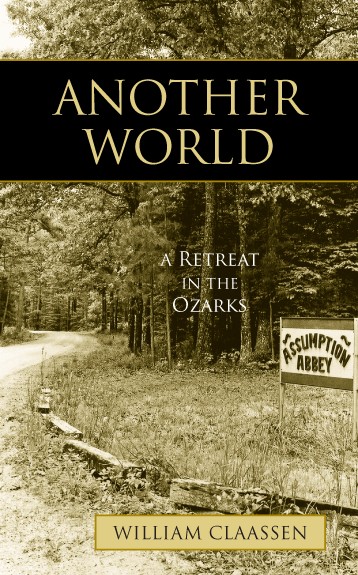 Why
do people leave ordinary society for a life set apart in a monastic setting?
Can we learn from those who appear to have separated themselves from us?
Why
do people leave ordinary society for a life set apart in a monastic setting?
Can we learn from those who appear to have separated themselves from us?
William Claassen traveled
the world exploring such questions. His first book, Alone in Community:
Journeys into Monastic Life Around the World, examined Buddhist, Christian,
Hindu, Jain, and Sufi sites and the practices of their inhabitants.
But his new book, Another
World: A Retreat in the Ozarks,
takes us just down the road to Assumption
Abbey near Ava, MO, about 90 minutes southeast of Springfield.
“Rocket,” a rock’n’roll musician
quoted in the first chapter, compares visiting Branson with the Abbey:
“Well, at one you come back with souvenirs, and the other, you come back
with a different perspective.”
One of 40 some writers Claassen
quotes about the monastic experience is Joan Chittister, OSB, who suggests
that “it may be only from a distance that we see best. It may be those
who do not have money who best know that money is not essential to the
good life. It may be those who each have only a bed and books and one closet
full of clothes in one small room to call their own who clearly realize
what clutter can do to a life. It may be those who vow obedience to another
who can sense what self-centeredness can do to corrode a heart.”
Assumption is a Trappist
monastery, like Gethsemani in Kentucky, made famous by Thomas Merton. In
Claassen’s book, illustrated with his own photos, we learn how the Trappist
monasteries originated, how they relate to each other, how they employ
the Rule of St Benedict, how they support themselves, what the daily schedule
is and how they welcome visitors.
The book is a week’s diary,
each chapter combining an account of each day’s activity with the reactions
within Claassen, himself a guest.
In addition, Claassen includes
biographical sketches of five particular monks. In an interview, he explained
why: “they represent to me the archetypal figures, . . . the abbot, the
guest master, the business manager, the hermit, and the woodsman (laborer).”
Claassen believes that the
monks “have much to teach our society.” Examples include “living simply,
practicing the art of listening, honoring ritual and ceremony, being
good stewards of the land, maintaining a daily meditative spiritual practice,
emphasizing cooperation rather than competition and honoring the value
of silence.”
More people visit monasteries
than call them home. Claassen’s book shows why such visits can offer spiritual
refreshment.
Claassen's first book was
published in 2000. The new book was published by Sheed & Ward in November,
2007. He lives in Oakland, CA but was raised in Kansas. He has a masters
in journalism from MU in Columbia.
698. 080123 THE STAR’S
HEADLINE:
Speak your mind in church
Americans venerate the First Amendment.
On one hand it prohibits the government from establishing religion while
on the other it protects “the free exercise thereof.” But how can this
balance be put into practice?
This month many of us have
attended events commemorating Martin Luther King Jr. a religious leader
whose voice renewed the American dream for all citizens. He did this by
shining the light of morality on immoral laws and practices in such a way
that governments at many levels responded. He did not seek office. He sought
to change hearts.
The Rev. Thomas Are Jr. senior
pastor at Village Presbyterian Church, examined the relationship between
faith and politics in a recent sermon.
He reminded his congregation
of this passage in the Lord’s prayer: “Your kingdom come, your will be
done on earth as it is in heaven.” The work of the church includes both
heaven and earth, Are said.
Are noted that “prophets
from Nathan to Jeremiah meddled in foreign policy. Paul tells us to pay
our taxes because the state exists to uphold the good . . . . And Jesus—in
some ways the most political of all — tells us that when we pray, we are
to pray about kingdom matters. The Bible speaks to the whole human condition.
There is nothing in our lives that God fails to care about.”
Are picked a counter-example
from Are’s own Presbyterian tradition.
The theological giant at
1861 General Assembly of the Presbyterian Church of the Confederate States
of America was James Henley Thornwell.
Are says, “Thornwell told
the Assembly that the church was to focus on spiritual matters alone, that
slavery was a political decision, and God does not speak to such issues
through the church. It is not our duty to question slavery; we must devote
ourselves to spiritual matters.
“Arguably (slavery) was the
most significant moral issue . . . and the Presbyterians said we should
not talk about it.”
Are’s point was that the
church should be a place of conversation, neither limited to concerns of
the hereafter nor should it be a branch of earthly government.
“We have become keenly aware
of how dangerous it can be when church and state are joined together, when
one’s commitment to God is collapsed with one’s commitment to the state,”
he said.
Without aspiring to hold
the reigns of government, King knew how to generate conversation. His eloquent
words and eloquent non-violent actions brought this nation closer to realizing
the nation’s promise, that all of us are created equal.
697. 080116 THE STAR’S
HEADLINE:
Let a candle light your way
Martin Luther King Jr taught the path of
"nonviolent direction action" in seeking justice but religion and violence
are horribly linked throughout history and today.
Israeli Prime Minister Yitzhak
Rabin was killed by a fellow Jew, Gandhi was murdered by a fellow Hindu,
Egyptian President Anwar Sadat was killed by a fellow Muslim and Christians
killing Christians in Ireland is still a painful memory. What makes people
of faith violent?
"History is filled
with examples of violence committed in the name of God," said the Very
Rev. Terry White, dean of Grace and Holy Trinity Cathedral, when I asked
about a program the cathedral is offering Jan. 22 and 23.
"Sacred stories in
various traditions proclaim that God wreaks violence on the ungodly, and
that God empowers God's people to do the same to those who do not believe
correctly," White said. "Serious study of Scripture and examination of
belief are essential if the cycle of violence, particularly so-called divinely
sanctioned violence, is to cease."
On Sept. 11, 2005,
"the fourth anniversary of a day of great destruction and blasphemy, when
horrible violence was claimed to have been done in God's name, and when,
in response, calls for revenge and retribution were heard throughout the
country and even in houses of worship," the cathedral inaugurated an "Altar
of Reconciliation" in its tower entrance, White said. "We must not return
evil for evil."
Whatever the cause,
the cathedral responds to community violence by burning a candle noting
each murder in Kansas City.
"The candle calls the faithful
to pray for every victim, the alleged perpetrators of the crime, the families
of victim and accused, friends, and too often due to age of victim and
accused, classmates and teachers," White said.
Next week's program,
"Religion and Violence: Untangling the Roots of Conflict," moves beyond
the community to consider the problem everywhere. It will combine a live
webcast from New York with discussion groups at the cathedral.
The Jewish speaker,
Susannah Heschel of Dartmouth College, spoke here at an interfaith Martin
Luther King Jr observance in 2005. Tariq Ramadan, author of Islam, the
West and the Challenges of Modernity, will present a Muslim perspective.
Christians include James H. Cone of Union Seminary, author of Black Theology
and Black Power, and James Carrol, who wrote Constantine's Sword.
The program will explore
whether the solution to violence can be found within or outside of faith.
To learn more contact Grace
and Holy Trinity Cathedral at ghtc-kc.org or 816-474-8260. To access the
webcast, log on to www.trinitywallstreet.org/education/?institute-2008&p=telecast
.
696. 080109 THE STAR’S
HEADLINE:
Bud Fiedler, in fond memory
Like everyone who knew Msgr. Ernest “Bud”
Fiedler, I loved him, but I did not know him as long or as well as one
of the casket-carriers, Jim Houx Jr.
The ring on Bud’s little
finger pictured in the 24-page booklet for his obsequies last Thursday
at the Cathedral of the Immaculate Conception, where he had been rector,
has a story.
Bud served as an advisor
at the first session of the Second Vatican Council and then was assigned
to a Warrensburg parish where in 1963 he and Houx, then a student, met
a high school event. They became friends.
In those days Protestants
were suspicious of Catholics who worshipped “in a strange language.” The
Protestant churches were often antagonistic to each other as well.
Bud began inviting his fellow
clergy to coffee, one by one, and ultimately spread the spirit of friendship
all around. Bud transformed the town.
In 1968, the bishop approved
Fielder presiding at the wedding for Houx and his bride, both not Catholic.
After the two exchanged rings, Houx gave Fielder the ring which like the
other two, was inscribed “one in Christ.”
Bud often joked about going
on their honeymoon as well. Bud’s Karmann Ghia was stranded in Springfield,
so the happy couple gave Bud a lift on their way to New Orleans.
Bud was later reassigned
to Kansas City and Houx’s business brought him here was well.
Houx says, “You could not
not have a good time with Bud. He was preaching, teaching and healing
without recognizing his power. He loved everyone as a child of God, and
embraced Muslims, Jews, Hindus, Buddhists—everyone.” Houx often referred
to Bud as “a ball of light and love disguised as a priest. He was
a community treasure.”
In the early 90s, Bud and
Houx talked about the culture’s placing profits above people, with spiritual
values uplifted on Sunday and greed ruling the rest of the week. This led
to the creation of what is now the Center for Spirit at Work, with speakers
from the best of Kansas City business leaders.
I cannot capture here the
wonder of the things said about Bud at the wake and funeral. But the feeling
with which Bishop Emeritus Raymond Boland presided, the glory of the music
and the extraordinary arrangements by Msgr. Robert Gregory created a fitting
and magnificent celebration of Bud’s life.
Although the Catholic faith
is not my story, the liturgy placed Bud’s life within the Christian narrative
of love, service and community, enacted and confirmed by the people receiving
the Eucharist, in the promise of eternal life, with Bud a precious
parable of the cosmic story.
695. 080102 THE STAR’S
HEADLINE:
Rumi a reed of spirituality
This column is a couple days late for the
800th anniversary of the birth of Jalaladin Rumi in 1207, but I expect
the celebration of this mystic will continue to the end of time.
Mark di Suvero’s sculpture,
“Rumi,” is outside the north end of the Bloch Building at the Nelson-Atkins
Museum of Art. He is one of the most popular poets in America today.
While the heap of books on
my night stand constantly changes, there seems always to be at least one
Rumi.
I’ve written about him several
times before, though not since I visited his shrine in Konya, in modern
Turkey, where I also saw the order of “whirling dervishes” he founded.
In what was then Anatolia,
he had become a respected scholar in the post held previously by his father
when he met and fell into a mystical love with an older man, Shams-e Tabrizi.
We do not know if they were physically intimate, but we do know their friendship
was a scandal and apparently led to Shams being murdered four years later,
perhaps by one of Rumi’s sons.
Rumi was shattered, and his
laments were mixed with praise for a divine love that persisted:
“I laugh like a flower, not
just mouth laughter./ From non-being I burst forth with gaiety and mirth./
But love taught me another way of laughter./ The neophyte laughs according
to profit and gain./ Like a shell, I laugh when broken.”
The mystical transformation
was so complete that in his longing for Shams, he found the body of his
beloved everywhere — in a stone, a field, a jug of water, even within himself.
The divine source of love penetrates the world, and when our eyes are open,
everywhere we look we will find God.
But this is possible only
when we abandon the ego, when we surrender utterly to the love that, in
the words of Kansas City Sufi musician Allaudin Ottinger, “turns grass
green, puts the fresh look in babies’ faces, and makes the sun come up.”
Rumi perhaps comes as close
as anyone in pointing to the unexplainable union of yearning and satisfaction.
“Every thirst gets satisfied except/ that of these fish, the mystics,/
who swim a vast ocean of grace/ still somehow longing for it.”
In the words of J. W. N.
Sullivan writing about Beethoven, “suffering is accepted as a necessary
condition of life, as an illuminating power.”
In the metaphor of the reed
flute, Rumi suggests how we are separated from God, yet that separation
makes song possible: “Listen to the story of the reed:/
Since I was cut from the reedbed, separated,/
I have made this crying sound./ The reed’s song is pain and comfort as
one.”


