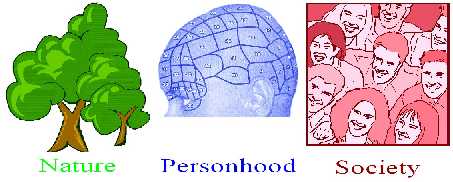
| Are
the world’s religions separate pieces of history and spirituality, or do
they, viewed together, form a pattern?
Dear Reader:
SINCE THIS ESSAY
APPEARED in 2000, “The Gifts of Pluralism” conference, Kansas City’s first
interfaith conference, was held with 250 people from 15 faith groups —
A to Z, American Indian to Zoroastrian. From that conference a number of
clarifications and new insights have emerged. In addition, many comments,
suggestions, and criticisms of this essay have been offered, for all of
which I am grateful. These are collected and awaiting incorporation in
a revised version of this essay, which I expect to make early in 2003.
You, dear reader, especially after 9/11, are also invited to contribute
your questions, responses, and criticisms for that revision. Please send
them to me: vern@cres.org or Box 45414, KCMO 64171. Thank you.
August, 2002
NOTE.— Since this
draft was issued, the crises in all three arenas — environmental, personal,
and social — have deepened. To update just the domain of our business system:
Microsoft’s practices have been found illegal, and the scandals of accounting
and executive compensation are now no longer secret. These and other matters
have not yet been incorporated into the present text which awaits revision. |
|
1.
Three Crises; Three Responses
THE CHIEF AND DEADLY DEFECT of our secularist
culture is fragmentation; that is, there is no vision of how all things
involve each other and of what things are most important, of what really
counts.
This means it is difficult to decide what
is worth living or dying for.
The secularistic
contrasts with the sacred, the holy (related to holistic, the whole), that
on which our lives depend.
This brokenness
shows itself in three domains:
— the degraded
environment, to which the ancient theological term “pollution” has now
been applied;
— the loss of
personal identity, evidenced by numbing codependent relationships and addictions;
— the deterioration
of social order, one example of which is the portrayal of violence as “entertainment.”
It is difficult for
us to see our situation clearly because we are enmeshed within it. But
the world’s religious traditions can provide us with bridges from which
we can view the currents of change.
INSTEAD of using such bridges to make sense
of,
or to envision reform of the secularism of today, two movements have themselves
become dangerous vortices.
l Fundamentalism
reacts, a whirlpool of waste. It insists it has the answers to our problems
in the exact words of the old texts of the One True Religion.
l On the other
hand, the New Age scavenges. New Age doctrine proclaims that all religions
are basically the same, but its practice sometimes focuses on crystals,
astrology, past lives, or ecstatic episodes, more than on fulfilling the
claims of faith to do good for one’s brothers and sisters.
l We propose
a third response, a response that grows out of an examination of what is
sacred in each faith. We believe that the world’s religions provide us
with the resources to address the three domains, broken in us as individuals,
as communities, and as members of a fragile biosphere. |
The urgent project
for our age is this: to discover how the answers from the world's religions
to the question “What is sacred?” mutually interpenetrate and inform each
other. Unless we do this, the sacred will remain fragmented and our culture
will teeter more precariously above a secularist hell.
|
2. The Paths
of Healing
THE SACRED, that on which our lives depend,
is generally located in different realms by the three families of faith.
1. With significant variations,
the Primal religions, including ancient practices of the Mesopotamians,
Egyptians, Greeks, and Romans, the Maya and the Inca, and the almost extinct
traditions of the American Indians and tribal Africans, and the Wiccan
tradition now being recovered, generally find the sacred in the world of
nature.
2. The Asian
religions, such as the faiths arising in China, Confucianism and Taoism,
and the faiths beginning in India called Hinduism and Buddhism, generally
locate the sacred in inner awareness.
3. The Monotheistic
religions, including Judaism, Christianity, and Islam (and one might add
Sikhism, Unitarian Universalism, Bahá’í, Marxism, and what
scholars call “American Civil Religion”), find the sacred disclosed in
the history of covenanted community.
This is not to
say that the sacred is nature, or is inner awareness, or is the history
of covenanted community. Rather, in general, these families locate the
sacred in these realms. Of course there are exceptions and variations and
subtleties. Shinto is an Asian religion that in our scheme belongs primarily
with the Primal faiths. Zoroastrianism is a special case since it greatly
influenced the Monotheistic faiths while its origins are not Abrahamic.
But the scheme we outline, despite its limitations, can be useful in three
ways:
— to provide
an overview of religious consciousness throughout history and the world,
— to guide a
“research program” for deeper understanding of the faiths, and
— most importantly,
to show us paths to the healing of the afflictions of our age.
For example,
we cannot be rescued from ecological doom only by technical solutions;
a spiritual reorientation is required by which we understand our kinship
and interdependence with trees, rocks, the air and water, not to be used
so much as to be honored.
The insights
of each of the three families are easily perverted (see
chart). The Primal faiths often degenerate into superstition; the Asian
faiths into narcissism; the Monotheistic faiths into self-righteousness
and militancy. Today dialogue amongst the faiths can lead to mutual purification.
However, even
the purest, fullest, human understanding of any separate revelation is
no longer sufficient for us as a society because we cannot understand fully
any one tradition without being acquainted with others. The additional,
urgent project for our age is this: to discover how the several answers
to the question “What is sacred?” mutually interpenetrate and inform each
other. Unless we do this, the sacred will remain fragmented and our culture
will teeter more precariously above a secularist hell. |
Religion
arises from the Holy; religion is the discovery of how
to
live in the world. The Holy leads to awe, then gratitude, then to service
—the Holy in action. |
3. The Holy
THE HOLY is that on which our lives depend,
ultimate concern, or ultimate commitment, the cornerstone of all values.
The English word is related to “health,” “wholesome,” and “holistic.” We
sometimes sense the holy in “peak experiences.” Such experiences shape
or direct or give meaning to all of life, and are rivers of the spirit.
These experiences make us vividly aware of what is valuable, connect us
to our deepest selves — and beyond ourselves, to the Infinite, and give
us perspective. The Holy, the sacred, is what is worth living for, and
dying for.
Religion
arises from the Holy; religion is the discovery of how to live in the world:
“What is so important that my life depends upon it, and what must I do
to honor and share it?”
In philosophy
the sacred is called Reality; to use information science language, it is
the Structure of All Data. The sacred is supreme worth, fundamental significance,
ultimate value, utmost concern.
The sacred is
contrasted with the profane, the fragmented, the partial, the instrumental,
the means. Our culture is secularist because it so often avoids beholding
the sacred, the whole, and instead seems preoccupied with fragments.
Unless we are
frequently recalled to the Holy, we lose the perspective, wholesome energy,
and connection that makes life meaningful. Our secularist society distracts
us from the Holy, rather than supporting our immersion in it. The trance
of our culture places the Holy at the edge of our awareness, instead of
at the radiating, nourishing center.
Immersion in
the Holy leads to reverence, awe, clarity, attention — “beholding.” When
I behold, I see without agenda, for having an agenda shapes, deforms what
I see, inhibiting clarity. The addictions, compulsions, repulsions, inhibitions,
prejudices, paranoias, hang-ups, consumptions, and co-dependencies that
characterize our age make beholding difficult. We cannot clearly see who
we are, what our situation is, or what we must do. But with the freedom
to see clearly things as they are — especially to see ambiguity instead
of falsely defined situations — we live a fit, genuine life.
In beholding
the Holy, we apprehend ultimate worth. The Anglo-Saxon term from which
our word worship derives means “shaping” or “scooping” or “considering
things of worth.”
Such beholding
often leads to gratitude, which in turn often leads to a desire to share
and be of service as a way of rendering thanks. This is why the sacred
opens, organizes, and prioritizes our living, and gives us a power and
authenticity that links us to the energy of the universe itself.
Spirituality
is a way of living out our worship experience so that our lives have transcendent
meaning, coherence, order, and relationships informed by a sense of the
Sacred. Spirituality is breathing with a sense of what counts.
To eat or love
or travel or listen or work or play or walk through a field or email a
friend or attend a concert or a game or heal or comfort a companion or
even breathe with sacred intent throws one into awareness of infinite connections
and ultimate dependencies. The world is vivid, we belong in it, and we
want to help. |
| Our
age is secularistic because it has no unifying sense of the Holy.
The profane, the partial,
separates the method from the result, the means severed from the end. The
slogan, “The end justifies the means,” is rejected by those who, like Gandhi
and King, understand that there can be no sacred distinction between the
two.
One does not build a nonviolent
society through violence. |
4.
Three Profanities of Our Secularist Age
THE WORD PROFANE means “outside the temple,”
but even the temple has often become profane, secularistic, in the sense
of being disconnected to the rest of our lives. “Profane” and “secularistic”
point to the fragmentation of our world into various disciplines (in the
universities), special interests (in politics), and social divisions (by
class, race, age, “sexual orientation” and such).
The profane is
the opposite of the Holy, that which is whole, the network on which all
depends. Our age is secularistic because it has no unifying sense of the
Holy.
The profane,
the partial, separates the method from the result, the means severed from
the end. The slogan, “The end justifies the means,” is rejected by those
who, like Gandhi and King, understand that there can be no sacred distinction
between the two. One does not build a nonviolent society through violence.
As Abraham Lincoln knew, when violence is necessary, a terrible price must
be paid. The effects of slavery brought in the New World in the 15th Century
still have not been healed. We profane • nature, • self, and • others.
The Ecology.
— The destruction of rain forests is one example of the environmental exploitation
arising from the secularism that fragments and profanes us. If we deeply
sensed how holy these forests are, and that our survival depends on their
well-being, we would not cut them down any more than we would poke out
our own eyes.
Our environmental
danger is sometimes summarized by the word “pollution,” actually an old
religious term denoting ritual desecration and moral corruption. Overpopulation,
toxic wastes from the auto, and the loss of diversity of species are signs
of this pollution. “Pollution” cannot be corrected by mere technology because
it is ultimately a spiritual problem.
The Person.
— Within the individual, the profane divides us from ourselves and leads
to three kinds of failure. The first is addiction. It may be to substances
like alcohol and tobacco, or to compulsive behaviors like gambling, sexaholism,
and workaholism, or to the kind of consumerism which distracts us from
recognizing the sacred in the ordinary. The second is dependency which
keeps us from taking responsibility for ourselves by co-dependent relationships,
handling others’ feelings, and destructive criticism of others. The third
is prejudice — acted out in oppressions like sexism, classism, heterosexism,
adultism, age-ism, limiting our spirits and distancing us from others.
Society. — We are addicted to violence. Its portrayal often ignores its
actual effect on victims and their families, further violating reality.
Games like Mortal Kombat engender competition to see who can lop off the
most heads in stylized “fun.” With advances in virtual reality computing,
it will be possible to actually feel what it is like to cut open someone’s
chest and pull out the beating heart, with your victim’s warm blood spurting
in your face. There will be no immediate consequences since it is just
a simulation. But such electronic rehearsals, profaning the spirit, will
result in actual performances. The celebrity status and huge financial
rewards that we give writers, actors, and companies that model violence
show we have not been effective in shaming them.
Our entertainment
paradigms are win/lose battles instead of creative, respectful, loyal conflict
out of which solutions which benefit all people emerge.
Is any
aspect of our society more profane than sexuality? Our culture has often
disconnected it from spirituality and turned it into a commodity. The frequency
of rape suggests that power, rather than mutuality, is society’s theme.
Most faiths agree that sex is one possible way to express or explore transcendent
love. But there is disagreement whether law and religious rules too often
treat sex as a merely physical activity. For example, should the love of
partners be expressed in marriage if they are of the same gender? Does
a negative answer arise from a physical preoccupation?
If there is an
area more profane than sexuality, it may be the exploitation which creates
the growing disparity between the very rich and the very poor. This is
happening because our disengaged citizenry too often focuses on private
matters instead of our common weal. Repenting our selfishness and greed
may be more important than tax-cuts.
|
|
5. The Holy in
the Environment
MANY PRIMAL RELIGIONS behold the sacred
in the world of nature. Unlike creationists who fear the notion that we
might be related to monkeys, the American Indian celebrates one’s bear,
fox, or frog lineage, an ancestry which gives one intimacy with nature.
This is why totem poles, family trees, portray one’s forebears in animal
form.
When we need
groceries, the sanitized supermarket is our source, not the wild. But when
a brave shoots a deer, he may say, “I am sorry I had to kill you, Little
Brother. My children were hungry. My family needs your meat. See, I hang
your antlers in the tree. I decorate them with streamers. I smoke tobacco
in your memory. Each time I cross this path, I shall honor your spirit.”
We seldom talk
to our food, and even table grace is often an embarrassment to us: our
consciousness is separated from the sacred, that on which our lives literally
depend.
When a woman
in the Southwest extracts clay from the ground to make a pot for storing
food, she offers a prayer to the earth. Even stones are considered “people.”
The streams, the air, the mountains —all are alive with sacred power, and
deserve respect as our relatives, not used as objects for selfish ends,
outside of a sacred pattern of where everything fits.
The ecological
balance we need may be different than the one the hunter or the potter
knew, but the Primal religions suggest that our environmental problems
cannot be solved merely by technology.
Ancient Egyptians,
Greeks, and Romans, the more recent Maya and Inca civilizations, and the
still-persisting tribal ways in Africa, Australia, Oceana, and elsewhere
have strikingly different ways of understanding nature. For example, the
Egyptians understood the sacred in nature as stability, the Greeks as a
dynamic order, the Romans as potencies requiring compliance. But they all
have understood nature as the fundamental expression of the Holy.
Recent thinkers,
some stimulated by encounters with Primal traditions, have begun to recover
a sense of the holy in nature, including Thomas Berry, J Baird Callicott,
J Ronald Engel and Joan Gibb Engel, Matthew Fox, Roger Gottlieb, Eugene
Hargrove, David Kinsley, Delores LaChapelle, Peter Marshall, Seyyed Hossein
Nasr, Steven Rockefeller and John Elder, Charlene Spretnak, Brian Swimme,
and, of course, Pierre Teilhard de Chardin.
In sum: Our ecological
endangerment cannot be remedied by mere technology. The intimacy Primal
peoples have with nature can guide us toward healing. |
|
|
6. The Holy in
the Self
MANY ASIAN RELIGIONS behold the sacred
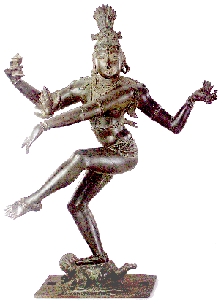
in the psyche. A Hindu story: In the forest ten thousand rishis worshipped
the god, Shiva, in only one, static manifestation. Shiva decided to appear,
to show them that his manifestations are multitudinous; that his personality
is many, not one; that he is motion, movement, dance.
But the rishis,
whose preconceptions were challenged, rejected him. They called forth a
great tiger who ferociously attacked Shiva at his throat. Shiva, with his
little fingernail, skinned the tiger and wrapped the skin around him as
a cloak. Then the rishis chanted a magic spell, and a great serpent
emerged from the ground and, around the body of Shiva, began to writhe
and twist and choke. But Shiva disabled the serpent, and cast its long
body around his neck as a streamer of garlands. The rishis’ incantations
finally caused a demon dwarf to attack Shiva with a mace. But Shiva placed
his little toe on the demon’s back and began to dance.
All the gods
came to see this dance, in which Shiva took every threat and made them
props in his performance, showing us that whatever comes our way, however
frightening, can be rendered harmless, even enriching, as we accept it
into our dance — now moving forward, now retreating, now high, now low:
the divine personality in many forms, always in process, moving in the
eternal dance of the cosmos.
This transforming
power within is sacred; from it arises the meaning of our lives. The many
dimensions of awareness are celebrated also by Buddhist mandalas. Even
the ferocious Buddhist temple guardian figures challenge us to observe
projections, and see that what we really fear may reside within us.
Through yoga,
meditation, rites, and other techniques for observing the Self (or, in
the case of Buddhism, the not-Self), Asian traditions (including Jainism,
Confucianism and Taoism) provide paths for release from the perils of the
ego.
In sum: The inner
emptiness and disorientation that leads to addiction, dependencies, and
prejudice can be healed by insights developed and nurtured by the Asian
traditions. |
|
|
7: The Holy in
Society
THE MONOTHEISTIC FAITHS behold the sacred
in the realm of history and covenanted community, not so much the tree
or the inner light, as in human relations. God is found in our meeting
one another. In memory the divine is recalled and welcomed into the present.
Moses, though brought up an Egyptian, felt a strange kinship with the Children
of Israel, who had been pressed into bondage. He discovered who he really
was by affirming his relationship with them, leading them out of the land
of slavery, into the holiness of freedom. The Law provided the way in which
Israel could be organized for holy living. In American Civil Religion,
that covenant is called the Constitution.
As we relieve
the suffering and oppression of our brothers and sisters, so, too, are
our own spirits liberated into the vitality of the community, submitting
to the commandments on which our lives and well-being as a society depend.
The succeeding
Hebrew prophets analyzed the historical forces acting on their nation and
discovered divine patterns which we have ignored — our news seems to fall
into pieces rather than patterns. Their prophesies were not so much prognostications
and predictions as they were social commentaries and warnings; today’s
prophets are the thoughtful political columnists and leaders of peace and
justice movements. The faith that God is working out his will for
justice is expressed in what may be the most prized document in American
Civil Religion, Lincoln’s Second Inaugural Address.
For Jews, the
holy community is the mystical Israel; for Christians it is the Body of
Christ, the Church; for Muslims the Umma; for Sikhs the Khalsa. Zoroastrianism,
Bahá’í, and other faiths have parallels. In the perverted
version of Monotheism called Communism (God replaced by economic determinism),
it is the Party which saves.
In our time,
we must develop a sense of community world-wide. From a shofar, or wherever
we hear a call to holiness, we awaken to a spiritual kinship and to duties
not just with those of like faith, but with all who live, have lived, and
will live.
In sum: Our social
disorientation and disintegration, the eviscerated sense of community,
the neglect of courtesy, the evaporation of service, and the growing
concerns for safety can be answered by a recovery and revitalization of
the Monotheistic sense of meaning in the process of history, as the human
relationships unfold in divine order.
But since most of us in this culture claim
a Monotheistic heritage, how did our sense of community become so damaged? |
Three
Signs
of
Secularism
Worship
of the “bottom line”
Separating
sexuality and spirituality
Acceptance
of pervasive violence
|
8.
Three Signs of American Secularism
Of the three families of faith outlined
and charted above, American culture has been largely shaped by Christianity,
a monotheistic tradition which emphasizes the covenanted community. Why,
then, has the sense of covenant been broken? Why has it been weakened even
in religious institutions?
Although many
believe they worship “the one true God,” our society is so fragmented that
we have a de facto abandonment of monotheism. We adore power, possessions,
pleasure — all of which may be good but become distractions when the vision
of how all things involve each other becomes lost.
The revelation
that God works through community now seems strange — from the jokes about
committees to our politics debased by special interests instead of decisions
for the commonweal. Rather than government as an expression of community,
its regulation and taxation seems to threaten the individual which has
been transformed from a public person (that is a citizen, a person
in relationship with others) into a bundle of desires for consumption.
The “happiness” of the Declaration of Independence involved the capacity
to affect communal good; now “happiness” too often means selfish satisfaction.
America is a
“case study” of perverted religious impulse. (See chart.) The genius of
monotheism — to see the sacred working through the history of covenanted
community — is distorted by self-righteousness and exclusivity that are
typical dangers of this family of religions.
In outline, here are three signs of this
secularism:
1. The Bottom
Line, severed from a sense of the larger good, seems to be our overarching
public value. The bottom line is expressed in pseudo-religious language
by Christian extremists who focus on heaven and hell. Instead of urging
us to do good because it is right, we are enticed with the promise of paradise
and threatened with the prospect of damnation for our beliefs. This
reward-punishment model has us so hooked that many people believe Bill
Gates has a right to fifty billion dollars of private wealth, even though
it was gained through immoral, and possibly illegal, practices.
We think of taxation
as something the governments do. We are not permitted to regard our contribution
to Bill’s bundle as taxation because it goes to him, rather than to the
government. He gets to decide how to spend it, not us. We have little choice
but to support his inferior products because of his predatory ways. His
philanthropy is no defense: Instead of each citizen controlling one’s money,
or being represented in government, Gates extorts and decides. It is taxation
without representation.
This is not to
judge Gates personally; but this is a metaphor for how difficult it is
to think about economic justice.
Business is often
judged not by whether society is helped but by whether riches result. We
have abandoned the idea of vocation as a role by which one contributes
to society with a wholesome service — making shoes, doctoring, producing
food, settling disputes, entertainment. A fair return on investment is
not wrong, but worshipping profit is.
2. Sexuality
is divorced from spirituality. One cannot be either fully spiritual or
sexual without being both. Even celibacy is an intensely spiritual wedding
to one’s sexual nature. The religious poet William Blake wrote of the genitals
as “Beauty,” but we regard their portrayal as pornography. What does it
mean that we accept the most appalling violence in the arena, on TV, and
on the screen but restrict the display of love-making?
3. The third
sign is violence. Violence arises from, and reinforces, the first two signs
of secularism. Separating profit from social good and dividing sexuality
from the spirit distorts relationships and twists energy into acts of malignity.
By the mid 60s,
community participation measured in many ways and documented by Robert
Putnum of Harvard, began a dangerous decline. Air conditioning replaced
the front porch swing and neighborly interaction diminished. With each
member of the family having one’s own TV, the viewing experience loses
its social dimension. The investment we made in the Interstate Highway
System could have been used instead for a public transportation system
that would have avoided minimized the destruction of neighborhoods by the
roads which divided or replaced them with the resulting social problems,
the advance of urban sprawl, and the degradation of our air and other environmental
damage. Recent popular perversions of Asian faiths also justified spirituality
as merely an inner concern.
Christianity
has moved from the understanding of the church as the “Body of Christ”
and the vision of community the Pilgrims shared to the “Sheila-ism” Robert
Bellah identifies as the isolated spirituality of our time. The theological
transformations have paralleled the technology in leading us into forms
of disconnection. Whether the holistic metaphor of the world wide web’s
interconnections will redeem the increasing specialization and cyberfication
of humanity remains to be seen.
With the loss
of a sense of bonding, even within families, we have become addicted to
violence. A typical American child sees 40,000 “play” murders and 200,000
dramatized acts of violence before turning 18. The link between the portrayal
of violence and acting out by the vulnerable is no longer debatable.
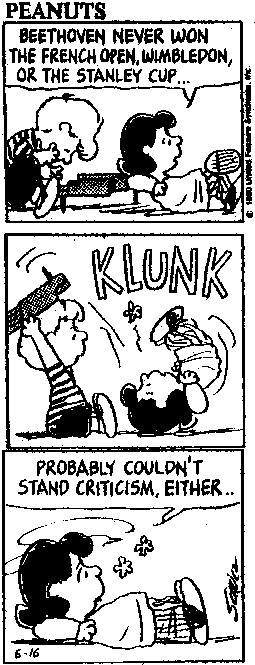
Rather than repeat
the appalling statistics, let me focus on how accepted violence has become,
so pervasive that we don’t even see it. Even gentle comic strips like Peanuts
perpetuate our culture of violence.
When I took my
son some years ago to Worlds of Fun, a place for “family entertainment,”
I discovered their video games scored by lopping off as many heads as you
could. What does it say about us that we dismiss thus as “just fun, mere
entertainment”?
The first time
friends proposed playing Cowboys and Indians, I was shocked. Why would
anyone want to play bang-bang: you’re dead just for fun? Advertisements
for games command: “kill your friends guilt free,” “get in touch with your
gun-toting, cold-blooded murdering side.” We praise the ingenuity of special
effects — violence as art — while we dismiss their impact on us, the children,
and the vulnerable. Actors, producers, and the movie companies should be
ashamed of serving their careers and the dollar by modeling violence. They
should also be embarrassed at their imaginative failure to create wonderful,
wholesome entertainment.
Our language
itself is a menace. We talk about fighting cancer more than healing. Radio
station KXTR tries to be funny by asking us to enjoy a weekend with Bach,
Beethoven, and Brahms as “the Killer B’s.” At my son’s graduation proudly
posted was the host’s school song, called — you guessed it, “The Fight
Song.” “We are the Shawnee Mission Raiders! We have the team that fights
to win. . . . Go Fight, Win!” Why not “Play Well”? Why is winning so important
that one must fight to do it? Why a school song based on such a metaphor
instead of healing or building or growing or team spirit?
We are so immersed
in violence it is hard to see its extent. Because the nature of violence
is separation, we need to discover the pattern which can heal the schisms
and bring the pieces together. |
| Religions are
alike in that they all originate from experiences of awe, encounters with
the Sacred, but the way those experiences are understood or emphasized
varies.
To blend religions together
would produce a dangerous spiritual pabulum, just as reducing the dimensions
of an amphitheater to a single point would forgo the expanses which can
contain a powerful and glorious assembly of diverse people
So how do religions fit together?
Perhaps as the length, width, and height of a room are essential dimensions
of the space, the Primal, Asian, and Monotheistic traditions we have outlined
are essential expressions of the Sacred. Each religion may have some acquaintance
with other dimensions, but as it has developed, it may become expert in
a particular expression of the Sacred.
. |
9.
Are All Faiths Really One?
We want to stop the violence we see perpetrated
in the name of religion. We think if we only recognize that all religions
are basically the same, violence will cease. It is a beguiling sentiment.
Two examples: All religions believe in God; the Golden Rule appears in
all faiths. But neither is true. While Jews, Christians and Muslims worship
one God, forms of Buddhism, Jainism, Confucianism, and Taoism are non-theistic,
and conceptions of God vary so greatly among many religions that it is
confusing to use them to support the first italicized claim. While texts
similar to the Golden Rule can be extracted out of context from many traditions,
viewing them as like ethical principles violates the integrity of the faiths
by forcing them into a Western category of thought.
Huston Smith
asks, “How fully has the proponent [of the view that all religions are
at their core the same] tried and succeeded in understanding Christianity’s
claim that Christ was the only begotten Son of God, or the Muslim’s claim
that Muhammad is the Seal of the prophets, or the Jews’ sense of their
being the Chosen People? How does he propose to reconcile Hinduism’s conviction
that this will always remain a ‘middle world’ with Judaism’s promethean
faith that it can be decidedly improved? How does the Buddha’s ‘anatta
doctrine’ of no-soul square with Christianity’s belief in . . . individual
destiny in eternity? How does Theravada Buddhism’s rejection of every form
of personal God find echo in Christ’s sense of relationship to his Heavenly
Father? How does the Indian view of Nirguna Brahman, the God who stands
completely aloof from time and history, fit with the Biblical view that
the very essence of God is contained in his historical acts? Are these
beliefs really only accretions, tangential to the main concern of spirit?
The religions . . . may fit together, but they do not do so easily.”
While the mystical
traditions within many faiths may be remarkably similar, mysticism is not
at the core of many of the world’s religions.
To say that all
religions are alike is like saying all food is alike. If I have a cholesterol
problem, have lactose intolerance, am allergic to shell fish, or observe
religious dietary laws, the fact that all food by definition is nourishing
does not enable me to eat everything. A religion may be life-giving to
one person and toxic to another. A faith that is deeply meaningful and
obviously beneficial to one person or society may be opaque or even distracting
from the path of wholeness to another.
Religions are alike in that they all originate
from experiences of awe, encounters with the Sacred, but the way those
experiences are understood or emphasized varies.
So how do religions
fit together? Perhaps as the length, width, and height of a room are essential
dimensions of the space, the Primal, Asian, and Monotheistic traditions
we have outlined are essential expressions of the Sacred. Each religion
may have some acquaintance with other dimensions, but as it has developed,
it may become expert in a particular expression of the Sacred.
To blend religions
together would produce a dangerous spiritual pabulum, just as reducing
the dimensions of an amphitheater to a single point would forgo the expanses
which can contain a powerful and glorious assembly of diverse people.
Our age is one
which, beset by environmental, personal, and social challenges, can addressed
by the special insights of Primal, Asian, and Monotheistic traditions.
We understand ourselves and our own traditions better by encountering others,
and engaging in mutual purification of the faiths through respectful exchange.
We cannot afford
to ignore their wisdom, or to live with our own so routinely that we have
lost the refreshment of the experience of awe. The peril, despite the promise
of the new millennium, is real. If we neglect any of the three dimensions
of the Sacred, civilization as we know and hope it to be will end. As the
ancient Tao Te Ching says, “Where there is no sense of wonder, there will
be disaster.”
Thus the mission
of CRES — to work with all faiths to rekindle the sense of wonder in our
overwhelmingly secularistic age. |
| Those with
faiths other than our own become our guides to a deeper understanding of
the reality beyond words on which we depend, out of which we arise, and
to which we return. |
10.
Faiths in Dialogue
The congress of the faiths can best occur
by discovery and growth within each tradition, stimulated by mutual encounter,
rather than by organizational assimilation or imitation.
Those with faiths
other than our own become our guides to a deeper understanding of the reality
beyond words on which we depend, out of which we arise, and to which we
return.
Encounter must
occur not only internationally and nationally, but regionally and locally
as well. In many communities, religious pluralism is a reality ready to
be celebrated, as it is here in Kansas City. Rather than focus on international
leaders, it may be more productive to develop exchange between and among
various faith communities within each locality. This is why CRES focuses
on our metropolitan area, though we maintain contact with international
organizations.
Because of complex and unconscious assumptions
of identity and difference within faith communities about others, it is
helpful to approach mutual study with a generalization such as the three-part
pattern here described, a generalization understood as such, with the process
of the exchange modifying, challenging, and ultimately abandoning the generalizations
as the rich texture of interfaith encounter purifies, transforms, enlarges,
and deepens the practices of the participants.
Such faith encounters,
by indirection, through conversation, visitation, common worship, shared
projects, and significant friendships, may be the best way to discover
solutions to the three crises of our secularistic age. The simple three-part
pattern we have outlined in this year-long series becomes increasingly
complex without falling into pieces. |
Appendix One:
from the Conference Declaration
Wisdom from Our Faiths Cited in 2001 Greater
Kansas City “Gifts of Pluralism” Conference Concluding Declaration:
The gifts of pluralism
have taught us that nature is to be respected, not just controlled. Nature
is a process that includes us, not a product external to us that can just
be used or disposed of. Our proper attitude toward nature is awe,
not utility. When we do use nature as we must - for food, housing,
and other legitimate purposes - we should do so with respect and care,
preserving its beauty and mindful of its connection to the Sacred and ourselves.
We have also learned
that our true personhood may not be in the images of ourselves constrained
by any particular social identities. When we realize this, out acts
can proceed spontaneously from duty and compassion, and we need not be
unduly attached to results beyond our control.
Finally, when persons
in community govern themselves less by profit and more by the covenant
of service, the flow of history towards peace and justice is honored and
advanced.
|
11.
Three Attitudes
What attitudes further such dialogue? Targeting
Jews for conversion on High Holy Days, Hindus at Divali, and Muslims at
Ramadan may appear as silly ignorance or proselytizing arrogance by those
who have tasted the fruits of genuine interfaith encounter.
Thus Pope John
Paul II, who has pursued interfaith relations vigorously, apologized for
horrors through the ages done by Christians. One evening before the negotiations
between the Israelis and Palestinians began, a panel here in Kansas City
discussed the prospects for peace. The Muslim leader began by confessing
the terrible things done in the name of his faith. The rabbi likewise enumerating
evils perpetrated by those claiming to be Jews. The audience was deeply
moved by such frank admissions. From such mutuality rather than defensiveness,
genuine encounter becomes possible. What a contrast to the schemes of conversion
some have pursued!
1. While one
can believe fervently in one’s own faith, to share it without equal openness
in encounter with another may betray unacknowledged insecurity about one’s
own religion. The idea that one religion is so superior to all others that
all should convert to it fails to acknowledge that most of us follow religious
paths shaped by the times and cultures in which we have been born. Most
Indians are Hindu. Most Saudis are Muslim. Most Americans are Christian.
Even those who adopt a different religion do so usually because of
the lens of exposure.
2. The attitude
that all religions are the same at core is also not the most helpful position
for honest dialogue. "Any attempt to speak without speaking any particular
language us not more hopeless than the attempt to have a religion that
shall be no religion in particular," said Santayana. To say all religions
at their core are the same is to say that all languages are fundamentally
identical. But since most of us are unfamiliar with many faiths, this is
not obvioius; and with a good heart and sincere intent, we look to confirm
our presumption; and in an effort to accommodate one another, it is easy
to edit differences out of our conversation and distort things to regard
them as similar.
3. If we begin,
however, as explorers, without too great an eagerness either to sell or
to buy, we can make great discoveries about our own traditions and those
of others. We may find that our faiths historically have often influenced
each other to such an extent that we may see all of us engaged in one rich
religious adventure rather than completely distinct revelations. We may
find that our common problems today — in the environment, in the personal
realm, in the human community — can draw us into deeper understanding of
the sacred, so that our attitude becomes one of mutual ownership of each
others’ traditions without losing our own paths, just as we all own the
highways of this nation even though we live on our own street. We may find
that the many paths lead us not to a single sacred spot, but to many manifestations
of the holy, from which our service to others as kin may abundantly flow.
Such awareness
may help to purify and mutually transform us into that greater witness
by which the seductive powers of secularism may be healed. |
Appendix Two
Four Levels of Engagement
1. Many people now know the dangers of
religious prejudice. They believe that everyone has the right to one’s
own religion, or none. This is the first, most superficial level of engagement
with other faiths. It is an advance from the days when people were forcibly
converted to another faith or denied opportunities because of their traditions.
Home associations can no longer prevent Jews from buying in their areas.
While Wiccans and other minorities still encounter discrimination from
time to time, we have come a long way.
But are their deeper levels
of engagement with faiths other than our own?
2. We can move from respecting not
only others’ right to their own faiths to respecting their faiths as well.
This is a subtle but crucial distinction. It is one thing for me to agree
you have the right to have whatever painting you wish in your living room,
and it is another thing for me to learn why it is beautiful to you, even
if I do not want it in my living room.
3. We take another step toward deeper understanding
when we participate in interfaith exchange. I need a mirror to see myself.
When Christians discover why Jesus is so revered by Muslims, when Tibetan
Buddhists and Jews tell their stories of suffering, when Hindus and American
Indians share dances, all can see their own heritage more clearly with
the mirror of the other.
4. But there is an even fuller engagement.
The mirrors of faith transmit and reflect the holy from many angles. Bringing
and focusing them together, a powerful, curative light can shine to heal
the three great crises of secularism: we can apply the wisdom of the world’s
faiths to the endangered environment, the violation of personhood, and
the broken community.
Is this the key religious task of the new
millennium?
|
12.
Finding the Treasures
Rather than threaten, differences can enrich.
How? By disclosing ourselves as well as giving us a clearer sense of the
diversity within the Infinite. While we can never fully escape from the
limited, the partial, the secularistic, the world’s great religions arise
from the whole, from experiences of awe and participation in the vitality
of the cosmos, from the deep questions — “What is so important that my
life depends on it or that I would die for?” and “What may I do to honor
and share it?” In other words, “What is sacred?”
The answer to
this question may come from one’s own tradition. Yet we need the help of
others to find that answer in this secularistic age. “He who knows one
religion knows none,” said Max Müller, suggesting that until we can
view our own faith from the perspective of others, we cannot know our own.
The import is similar of Kipling’s question: “What knows he of England
who only England knows?” I know what Kansas City is better by acquaintance
with San Francisco and New York and Delhi and Rome. The paradox of these
teachings is the key to understanding a favorite story of my teacher, Mircea
Eliade:
A pious rabbi named Eisik once lived in
Cracow. He was very poor. One night as he slept on the dirt floor
of his hovel, he had a dream which told him to go to Prague, and there
under the bridge that led to the royal castle he could unearth a great
treasure. The dream was repeated a second night, and a third.
He decided to
set out for Prague. After many days walking, he entered Prague, and found
the bridge that led to the royal castle. But he could not dig. The
bridge was guarded day and night. The rabbi walked back and forth awaiting
a moment when the bridge might be unwatched and he might dig for the treasure.
The captain of the guard noticed him, and went up to him. “I’ve noticed
you walking about here these several days. Have you lost something?” At
this, the rabbi innocently narrated his tale. “Really,” said the captain
of the guard, who was a secularistic, modern man, unconnected with his
dreams, “Have you worn out all your shoe leather merely on the account
of a dream? I too have had a dream, three times, which told me to go to
the town of Cracow, and look for the rabbi Eisik, and dig in his dirt floor
behind his stove in the middle of his room, and there I would find a great
treasure. But dreams are silly superstitions.”
The rabbi immediately
understood and promptly returned home, entered his hovel, and dug
underneath the heart of his hearth, where the warmth of his own being lay.
And there he unearthed a treasure, which put an end to his poverty.
From this tale Eliade draws two lessons.
The first is that the treasure which can put an end to our spiritual poverty
lies not in another country. It can be found within the heart of
our heart, the center of our own tradition. In the house of ourselves
it lies buried in our innermost being. The second lesson is the paradox:
only after a pious journey to a distant region, in a strange country where
someone speaks to us in a foreign accent, can we be directed to the location
of that buried treasure.
Through encounters
we have with the strangers of other faiths we can discover our own faith.
Through a far pilgrimage we can know ourselves and our home and be saved.
It is through the mutual purification of faiths meeting each other that
the Three Crises of Secularism can be healed. The religions of the world
fall not into pieces but compose an infinite pattern. |